When Flightradar24 announced that July 23, 2026 had been the busiest day for commercial flights ever tracked, more than 150,000 in 24 hours, the question a lot of people asked wasn’t how many planes flew. It was how much all that fuel actually cost. That’s a question that doesn’t expire with the news cycle. It can be answered with technical data and market prices that exist every single year, not just when there’s a record involved.
What kind of fuel a commercial plane actually burns
It’s not diesel and it’s not gasoline, though it’s closer to the former. Commercial aircraft run on aviation kerosene, typically Jet A-1 outside the US and Jet A inside the country. According to TotalEnergies Aviation, kerosene, like diesel, is a middle distillate of crude oil, but lighter than diesel and heavier than gasoline.
Its exact makeup isn’t locked to one fixed chemical formula. It’s governed by a technical standard: ASTM D1655, published by ASTM International, and the British DEF STAN 91-091. Both tightly regulate freezing point, volatility, thermal stability, and approved additives. That’s exactly where Jet A and Jet A-1 diverge: Jet A, used mainly in the US, has to freeze at -40°F or below (as measured, this is roughly -40°C), while Jet A-1, used everywhere else, has to hold out down to -47°C, according to ExxonMobil, one of the major suppliers certifiedunder that standard. That extra margin matters a lot at cruising altitude, where outside temperatures can hover around -50°C.
Which part of the flight actually burns the most fuel
The answer surprises most people. It’s not takeoff, even though the engines are working at their hardest there. It’s cruise, the middle stretch of the flight, simply because it lasts so much longer than everything else.
According to a Simple Flying analysis based on real route data, cruise accounts for roughly 96% of total fuel burned on a long-haul flight like London to Hong Kong, and around 68% on a short-haul flight like London to Edinburgh. Takeoff and initial climb, despite demanding 75% to 100% of available engine thrust, burn far less in absolute terms, because they only last a few minutes. Descent and approach are the most fuel efficient phase of all, burning just 5% to 7% of total fuel, with engines running at a third or less of maximum thrust, according to technical studies using Eurocontrol’s BADA performance models.
Put another way: a plane doesn’t burn more fuel because it accelerates hard on takeoff. It burns more because it spends hours at cruise, even though the engines are working relatively easy during that stretch.
The number that changes everything: which aircraft
Fuel cost on any given flight comes down to three things above all else: the aircraft model, how long the flight lasts, and the fuel price that day. An Airbus A320, the most widely used single-aisle jet in the world, burns roughly 2.5 tonnes of fuel per hour, according to technical data compiled by industry publication Aircraft Commerce. A Boeing 777, much larger and built for long-haul routes, burns between 7 and 8 tonnes per hour. An Airbus A380, the largest passenger jet in service, can burn between 11 and 12 tonnes per hour.
Multiply that by flight hours, and the gap widens fast. Which brings in the second factor: duration.
What a short flight costs versus a long one
Take the fuel price IATA published in early July 2026 as a reference point: $116.63 a barrel, according to its own Jet Fuel Price Monitor. A barrel holds 42 gallons, which works out to about $2.78 a gallon.
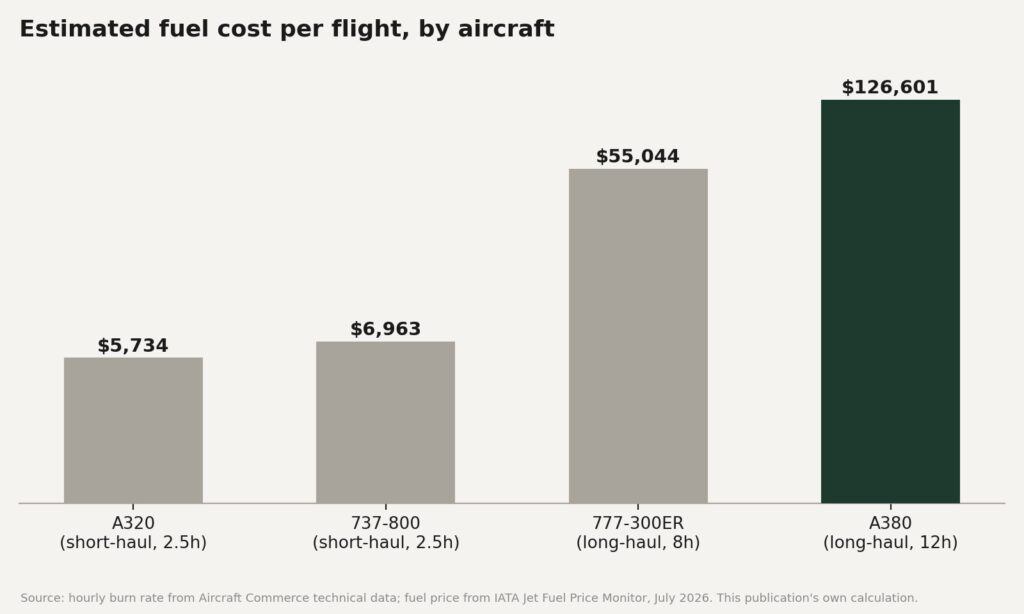
At that price, a 2.5 hour short-haul flight on an Airbus A320, something like Madrid to London, burns about 6.25 tonnes of fuel. Converted to gallons (a gallon of jet fuel weighs roughly 3 kilograms), that’s about 2,062 gallons, at an estimated cost of $5,734 in fuel alone for the entire aircraft, not counting crew, maintenance, airport fees, or any other operating cost.
An 8 hour long-haul flight on a Boeing 777, similar to Madrid to New York, burns about 60 tonnes, roughly 19,800 gallons, for an estimated cost of $55,044. And a 12 hour flight on an Airbus A380 can burn up to 138 tonnes, about 45,540 gallons, at a cost north of $126,000 in fuel alone.
These figures are this publication’s own calculation, based on technical hourly burn rate data and the fuel price IATA publishes. No airline publishes an exact fuel cost flight by flight, since route, payload, wind, and altitude all shift real world consumption.
Why it doesn’t cost the same in Europe, the Americas, or Asia
Jet fuel isn’t priced the same way everywhere, even though IATA publishes a single global average. Price varies by region based on access to crude, local refining capacity, taxes, and the cost of delivering fuel to each specific airport, according to Eurocontrol’s own technical documentation on aviation fuel costs.
In practice, that means real gaps. Based on market data reported through IATA and S&P Global Platts, European hubs traded 10% to 20% above the global average for much of 2026, due to tight middle distillate stocks across the continent. The US, meanwhile, runs on its own separate benchmark, the Gulf Coast spot price published by the EIA, which averaged $2.114 a gallon in 2025, slightly below IATA’s global average. No verified official source consulted for this piece provided a regional breakdown for Asia Pacific as detailed as what’s available for Europe and North America, so that comparison remains an open gap pending a more granular official source.
The practical takeaway: the same flight, on the same aircraft, can cost differently in fuel depending on which airport in the world it topped off at, not just when it flew.
How the price has moved since 2019, and where we project it by 2050
Jet fuel prices don’t rise in a straight line, but look at the long run and the trend is clear. According to official EIA data for the US Gulf Coast spot price, the price went from $1.879 a gallon in 2019 down to just $1.099 in 2020 amid the pandemic, then spiked to $3.374 in 2022, before easing to $2.699 in 2023, $2.338 in 2024, and $2.114 in 2025. By July 2026, IATA’s global average price works out to about $2.78 a gallon.
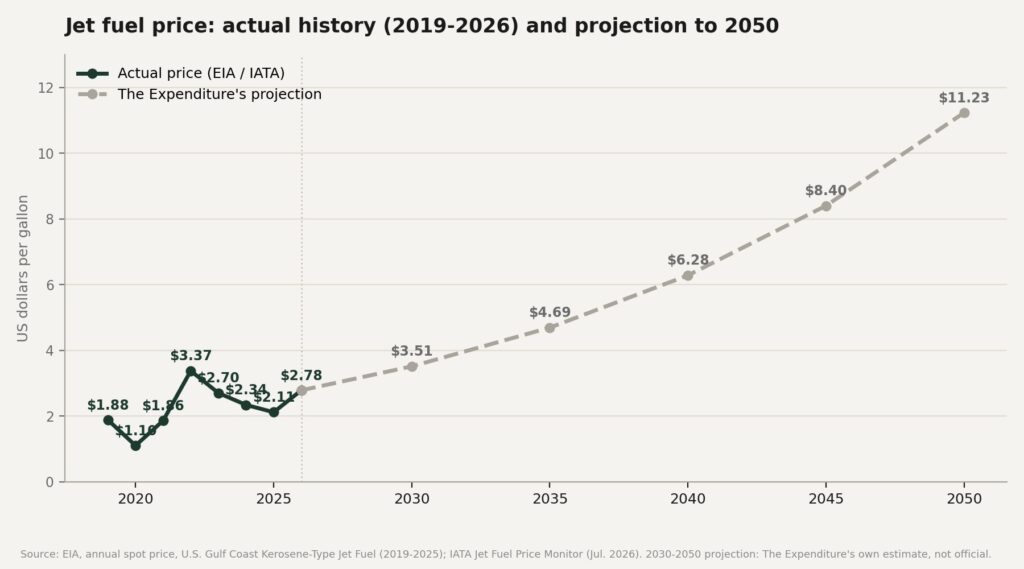
Comparing the starting point (2019) to the most recent figure (July 2026), the average annual increase comes out to roughly 6%, calculated by this publication from both official figures. That average hides a real roller coaster underneath, not a straight climb.
Here’s where The Expenditure puts its own projection on the table, and we’re being fully upfront about it: this isn’t a forecast from IATA, the EIA, or any official body. It’s our own calculation, extending that same 6% annual average forward. If that rate held steady for the next 24 years, jet fuel could land around $11.23 a gallon by 2050, four times today’s price.
That’s a deliberately naive projection, and it will probably be wrong, because it ignores everything that could change the picture: mass adoption of sustainable aviation fuel (SAF), new decarbonization policy, far more efficient aircraft, or the opposite, another geopolitical shock like 2026’s that pushes prices up even faster. Treat it as a reference exercise, not a serious forecast.
What fuel costs per kilogram the aircraft weighs
Another way to compare the four aircraft is to divide each flight’s fuel cost by the plane’s own certified maximum weight, its MTOW, or maximum takeoff weight, a figure Airbus and Boeing do publish for every model.
An Airbus A320 has an MTOW of about 78,000 kilograms. Against its short-haul fuel cost ($5,734), that works out to roughly $0.07 per kilogram the aircraft weighs at takeoff. A Boeing 737-800, with an MTOW of about 79,015 kilograms and a similar cost, comes out to about $0.09 per kilogram. A Boeing 777-300ER, with an MTOW of 351,500 kilograms and its long-haul fuel cost ($55,044), works out to about $0.16 per kilogram. An Airbus A380, with an MTOW of 575,000 kilograms and the cost of its longest flight ($126,601), comes out to about $0.22 per kilogram.
The pattern is worth noting: the bigger the aircraft and the longer the flight, the more expensive the fuel gets relative to the plane’s own weight. That tracks, since on long-haul flights a big share of that maximum weight is, quite literally, the fuel the aircraft has to carry to reach its destination.
Why 2026 has been such a volatile year
The price behind these calculations isn’t fixed, and 2026 has been an especially unstable year to illustrate that. In late February, the conflict between Israel, the US, and Iran effectively shut down commercial traffic through the Strait of Hormuz, a route that carries around 25% of the world’s crude, according to IATA itself. Jet fuel prices topped $200 a barrel by mid April, more than double where they started the year. By July, with a ceasefire in place, the price had already come back down to that $116.63 a barrel figure.
That swing, from $200 to $116 a barrel in just three months, explains why the exact same light can cost twice as much in fuel depending on which month you calculate it. For the airline industry as a whole, IATA estimates the 2026 fuel bill will reach $351 billion, up 40% from $252 billion in 2025.
Why this matters beyond curiosity
Fuel is, by a wide margin, the largest single operating cost for any airline. It will account for 31.4% of the industry’s operating expenses in 2026, according to IATA, more than salaries, maintenance, and airport fees combined. That’s why airlines don’t just absorb a spike in oil prices, they pass it on to ticket prices. IATA expects ticket revenue to rise 9.2% in 2026, to $839 billion, an increase driven mostly by price, not by more passengers.
It also explains why airlines chase fuel efficiency so aggressively in their newest aircraft. An Airbus A320neo, the latest version of the A320, burns roughly 15% less fuel per seat than the previous generation, according to industry data. In a business where fuel is the single biggest expense, every percentage point of efficiency turns directly into profit.
Frequently asked questions
- What kind of fuel do commercial planes use? Aviation kerosene, typically Jet A-1 outside the US and Jet A inside the country, under the ASTM D1655 specification. It’s neither diesel nor gasoline, though it is a middle distillate of crude oil similar to diesel, lighter than diesel and heavier than gasoline, according to TotalEnergies Aviation.
- Which phase of the flight burns the most fuel? Cruise, not takeoff. Cruise accounts for up to 96% of fuel burned on a long-haul flight and around 68% on a short one, according to data compiled by Simple Flying, simply because it lasts far longer than takeoff or descent.
- How much fuel does a commercial plane burn per hour? It depends on the model. An Airbus A320 or Boeing 737-800 burns between 2.5 and 3 tonnes per hour. A Boeing 777 burns between 7 and 8 tonnes per hour. An Airbus A380 can reach 11 to 12 tonnes per hour, according to technical data compiled by Aircraft Commerce.
- How much does it cost to fully fuel a commercial plane? It depends on the tank size and the aircraft. An Airbus A320 holds between 24,000 and 27,000 liters. An Airbus A380 can hold up to 320,000 liters. At the July 2026 fuel price (about $2.78 a gallon), fully fueling an A380 would in theory cost more than $235,000, though in practice aircraft rarely take off with a completely full tank.
- Does jet fuel cost the same everywhere in the world? No. European hubs traded 10% to 20% above the global average through 2026, according to market data from IATA and S&P Global Platts, while the US benchmark (Gulf Coast, EIA) tends to run slightly below the global average.
- What’s the current price of jet fuel? $116.63 a barrel as of July 1, 2026, according to IATA’s Jet Fuel Price Monitor. The price shifts weekly and can vary widely by region.
- Why did jet fuel prices spike so much in 2026? Because of the effective shutdown of the Strait of Hormuz following the conflict between Israel, the US, and Iran in late February 2026, a route that carries close to 25% of the world’s crude oil, according to IATA.
- What share of an airline’s costs is fuel? 31.4% of the industry’s total operating expenses in 2026, according to IATA, the single largest cost category, ahead of salaries and maintenance.
- How much does jet fuel price rise on average each year? Around 6% a year between 2019 and 2026, based on this publication’s own calculation using EIA and IATA data. That’s not an official annual growth figure, it’s the average rate that comes from comparing those two specific years, and it hides much sharper swings year to year.
- How much will jet fuel cost in 2050? Nobody knows for sure, no official body publishes a forecast that far out. As its own exercise, The Expenditure calculates that if the price kept rising 6% a year, as it has on average since 2019, it would land around $11.23 a gallon by 2050, four times today’s price. It’s a deliberately naive projection, not a serious industry forecast.
- How much does fuel cost per kilogram of the aircraft’s weight? It varies by model and flight length, from about $0.07 per kilogram on a short-haul Airbus A320 flight to about $0.22 per kilogram on a long-haul Airbus A380 flight, based on this publication’s calculation using each aircraft’s official MTOW and the estimated fuel cost of the flight.