
Record Data Sheet
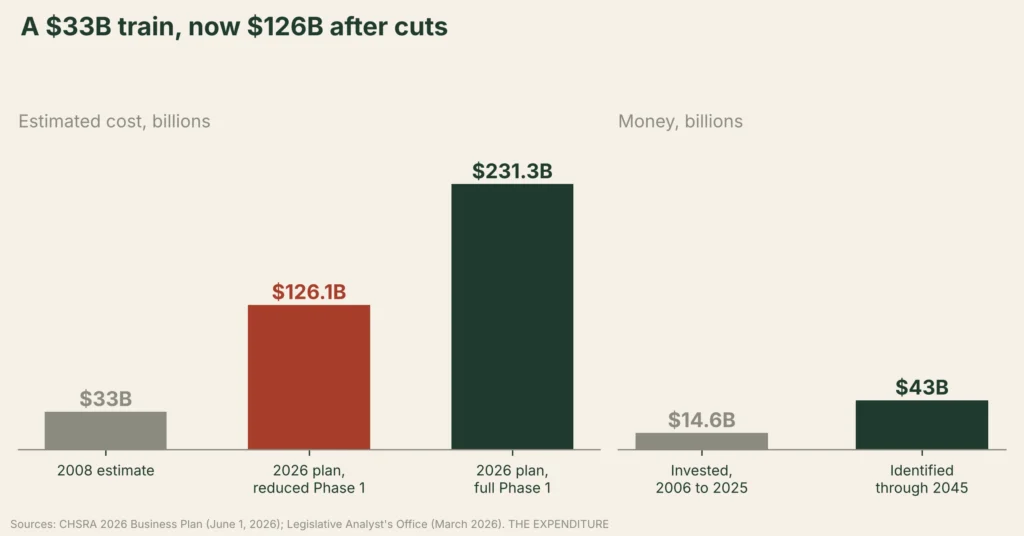
On June 1, 2026, the board of the California High-Speed Rail Authority approved its 2026 Business Plan. The document puts the cost of the first phase of the system, from San Francisco to Los Angeles and Anaheim, at $126.1 billion. That is the reduced version. Built as originally specified, the same phase would cost $231.3 billion.
In 2008, California voters approved Proposition 1A, a $9.95 billion bond for a train linking San Francisco and Los Angeles in under three hours. The total cost was estimated at $33 billion at the time. Eighteen years later, the reduced estimate is almost four times that figure, and not a single high-speed train is running.
What $126.1 billion means
The difference between $231.3 billion and $126.1 billion comes from about $105 billion of changes the Authority calls optimization: building less at first, sharing existing commuter tracks in parts of the Bay Area, and deferring parts of the system. The plan presents $126.1 billion as the figure to fund.
Even the reduced figure is large against public budgets. It is about five times NASA’s annual budget of $24.8 billion. It is more than the annual economic output of 12 US states, including New Hampshire ($119 billion in 2024) and Hawaii ($118 billion), according to the Bureau of Economic Analysis.
The only segment being built
The money being spent now goes to 171 miles of track between Merced and Bakersfield, in the Central Valley, the only segment under construction. The plan puts its cost at $35.7 billion. Construction is due to finish in 2032 and passenger service to start in 2033, a year later than the previous plan.
The Legislative Analyst’s Office, which advises the state legislature, reviewed the draft plan in March 2026. It counted about $39 billion available for the segment after the federal government withdrew roughly $4 billion of grants in July 2025, and about $43 billion of funding identified through 2045, including $1 billion a year from the state’s cap-and-invest program. It warned that once borrowing costs are included, the segment still faces a gap of about $2 billion, and that “staying on budget may be difficult.” The Authority reports that it invested $14.6 billion statewide from 2006 through 2025.
The segment loses money. The full line would not
When the Central Valley segment opens, it will not cover its running costs. The plan forecasts $39.8 million to $49.4 million a year in fares, plus $19.5 million to $41.3 million of other revenue, against operating and maintenance costs of $155.7 million to $176.4 million. That is a cost recovery ratio of 38% to 51%.
The picture changes if the line reaches the Bay Area. For a San Francisco to Bakersfield service in 2040, the plan forecasts $1,237 million to $1,389 million a year in fares against $733.5 million to $830.8 million in operating costs, a recovery ratio of 186% to 201%. That segment would cost $61.2 billion to build, and most of that money is not yet identified.
The gap matters for a legal reason. Proposition 1A requires that the high-speed rail service, once running, not need a public operating subsidy. A Central Valley line that covers half its costs would not meet that test on its own. The Authority’s argument is that the segment is a first step, and that the full system would more than pay its operating costs.
Where the money is still missing
To complete the $126.1 billion first phase, about $87 billion is still missing, according to coverage of the plan’s approval. The Authority is counting on new state funding, private investment and changes to the law that do not yet exist. After the federal grant termination, the plan describes the current federal administration as “not a reliable partner.”
The comparison with other megaprojects is instructive. Large public works routinely miss their first estimates, as Hinkley Point C did in Britain. How three countries measure what they spend on infrastructure is the subject of China, the US and India, and the cost of building rail in the desert is compared in the Gulf’s railways.
What the plan promises in return
Once the first phase is complete, the plan forecasts 23.8 million to 30.3 million riders a year in 2040, a recovery ratio of 261% to 301% for the full line, about 18 million metric tons of CO2 avoided over 30 years, and more than $114.2 billion in social, environmental and economic benefits over the same period. All of it depends on funding that has not been identified.
What we could not confirm
We could not find in the 2026 Business Plan the figures of $173 billion in economic output and 797,500 job-years cited in an earlier version of this article, or a single figure for total funding secured through 2045. We used the Legislative Analyst’s Office figures for funding instead.
What to watch
The next test is the Central Valley schedule: track laying and the first train orders, both planned to begin in 2026. The next business plan, due in 2028, will show whether the 2032 completion date and the $35.7 billion segment cost hold.
Frequently asked questions
The 2026 Business Plan puts the reduced first phase, San Francisco to Los Angeles and Anaheim, at $126.1 billion. Built as originally specified, it would cost $231.3 billion.
About $33 billion, when voters approved the $9.95 billion Proposition 1A bond in 2008.
Service between Merced and Bakersfield is planned for 2033. Service to San Francisco is planned for 2040.
No. The plan forecasts that Merced to Bakersfield will cover 38% to 51% of its operating costs. A line to San Francisco would cover 186% to 201%.
About $87 billion to complete the first phase. The federal government withdrew about $4 billion of grants in 2025.
Notes. All figures are in US dollars as published by the California High-Speed Rail Authority in its 2026 Business Plan, approved on June 1, 2026, unless attributed to the Legislative Analyst’s Office. State GDP figures are 2024 current dollars from the Bureau of Economic Analysis. NASA’s budget is the fiscal 2025 enacted total.
Sources
- California High-Speed Rail Authority, 2026 Business Plan, June 1, 2026: https://hsr.ca.gov/wp-content/uploads/2026/06/2026-Final-Business-Plan-060126-A11Y.pdf
- California High-Speed Rail Authority, 2026 Business Plan page: https://hsr.ca.gov/communications-outreach/reports/business-plans/2026-business-plan
- Legislative Analyst’s Office, “Oversight of the California High-Speed Rail Project,” March 2, 2026: https://lao.ca.gov/handouts/transportation/2026/Oversight-of-the-CA-High-Speed-Rail-Project-030226.pdf
- KALW, “High-speed rail business plan approved, envisions passenger service by 2033,” June 3, 2026: https://www.kalw.org/bay-area-news/2026-06-03/high-speed-rail-business-plan-approved-envisions-passenger-service-by-2033
- KTVU, “California high-speed rail costs soar to $231 billion”: https://www.ktvu.com/news/california-high-speed-rail-cost-soars-231-billion
- California Policy Center, the 2026 draft business plan and Proposition 1A: https://californiapolicycenter.org/californias-high-speed-rail-the-2026-draft-business-plan-is-ambitious-expensive-and-still-legally-problematic/
- Wikipedia, list of US states by GDP (Bureau of Economic Analysis data, 2024): https://en.wikipedia.org/wiki/List_of_U.S._states_and_territories_by_GDP
- The Planetary Society, NASA’s FY2025 budget: https://www.planetary.org/space-policy/nasas-fy-2025-budget