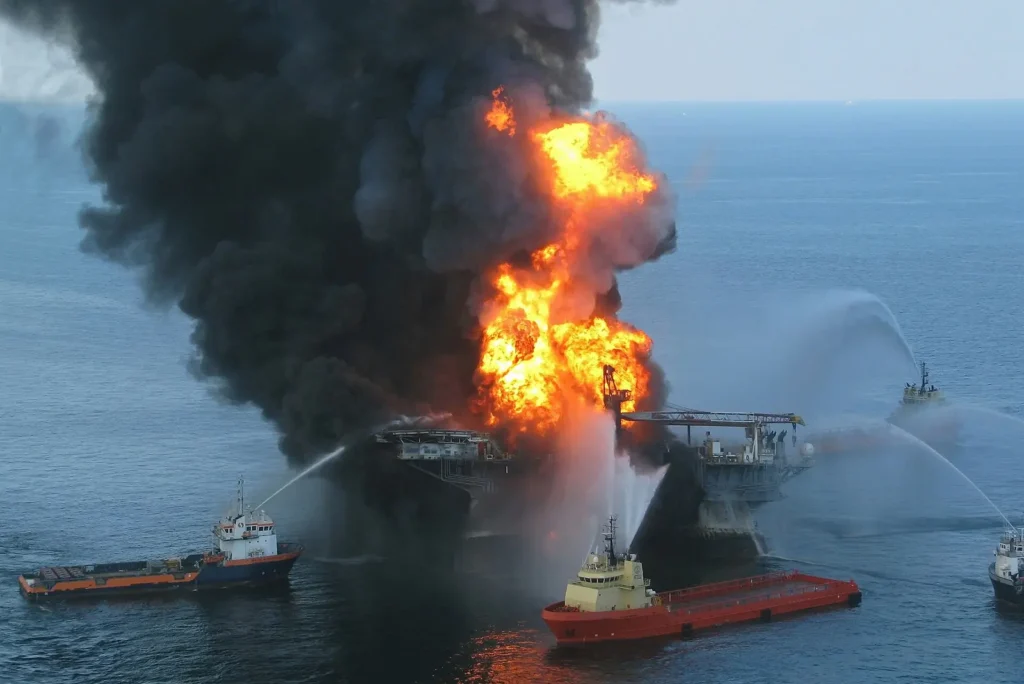
Record Data Sheet
The figure most people reach for is the settlement, usually the $20.8 billion agreed with the United States in 2015. It is the wrong number, because a settlement is what a company pays a government, and governments were only part of the queue. The number that measures the accident is the one BP put in its own accounts, covering penalties, claims, cleanup, response and everything else, and it is more than three times larger. That total is the subject here, and it is the largest corporate record of its kind anywhere.
How much did Deepwater Horizon cost BP?
$65.765 billion. The sentence is BP’s own, in its fourth quarter and full year 2017 results filed with the Securities and Exchange Commission: “The cumulative pre-tax income statement charge since the incident, in April 2010, amounts to $65,765 million.”
That was the point at which the number effectively stopped growing, seven and a half years after the blowout. The payments did not. BP guided to roughly $3 billion of cash outflows in 2018 and in fact paid $3.2 billion, telling investors afterwards: “2018 payments totalled $3.2 billion, in line with our guidance of just over $3 billion.” It then set out the rest of the schedule: “We expect payments of around $2 billion in 2019, stepping down to around $1 billion per year for the next 14 years.”
A company that stopped drilling the well in 2010 will still be writing checks for it in 2033.
What was the money spent on?
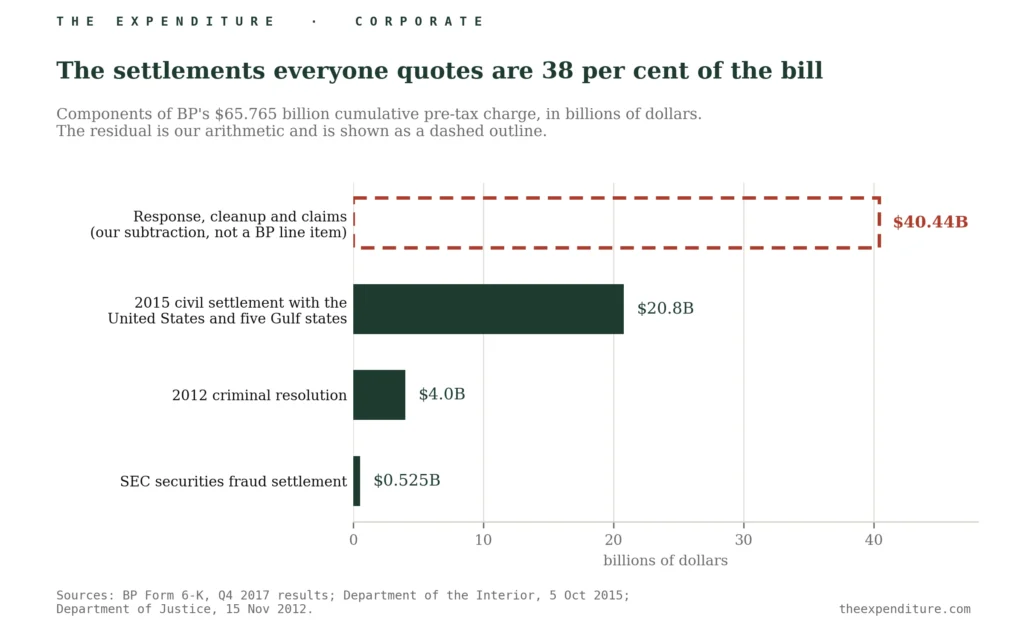
Roughly 38 percent of it went to governments and the rest went on everything else. The identifiable government settlements are three. The civil resolution with the United States and five Gulf states, announced on October 5, 2015, was “worth $20.8 billion” in the Interior Department’s words, comprising a “$5.5 billion federal Clean Water Act penalty, plus interest”, “$8.1 billion in natural resource damages” and “$4.9 billion to the five Gulf states”. The criminal resolution of November 15, 2012, was “a record $4 billion in criminal fines and penalties”. Alongside it, “the SEC simultaneously resolved civil securities fraud charges with BP in a $525 million settlement”.
Those three total $25.325 billion on our arithmetic, which is 38.5 percent of the $65.765 billion. The remaining $40.4 billion is the part nobody quotes: the response itself, the capping and relief wells, the shoreline cleanup, and the economic and property damage claims settled with businesses and individuals rather than with governments.
How much oil was spilled?
3.19 million barrels, as determined by the court rather than by either side. On January 15, 2015, Judge Carl Barbier of the United States District Court for the Eastern District of Louisiana found that 3.19 million barrels of oil were discharged into the Gulf of Mexico from the Macondo well.
That finding had a price attached. Clean Water Act penalties run from $1,000 to $4,300 a barrel, which put BP’s theoretical maximum exposure at $13.7 billion. The $5.5 billion it eventually agreed is 40 percent of that ceiling.
Set the court’s volume against BP’s total and the result is $20,616 of cost for every barrel that left the well. The oil itself, had it reached a refinery, would have been worth a tiny fraction of that.
Is this the most expensive industrial accident in history?
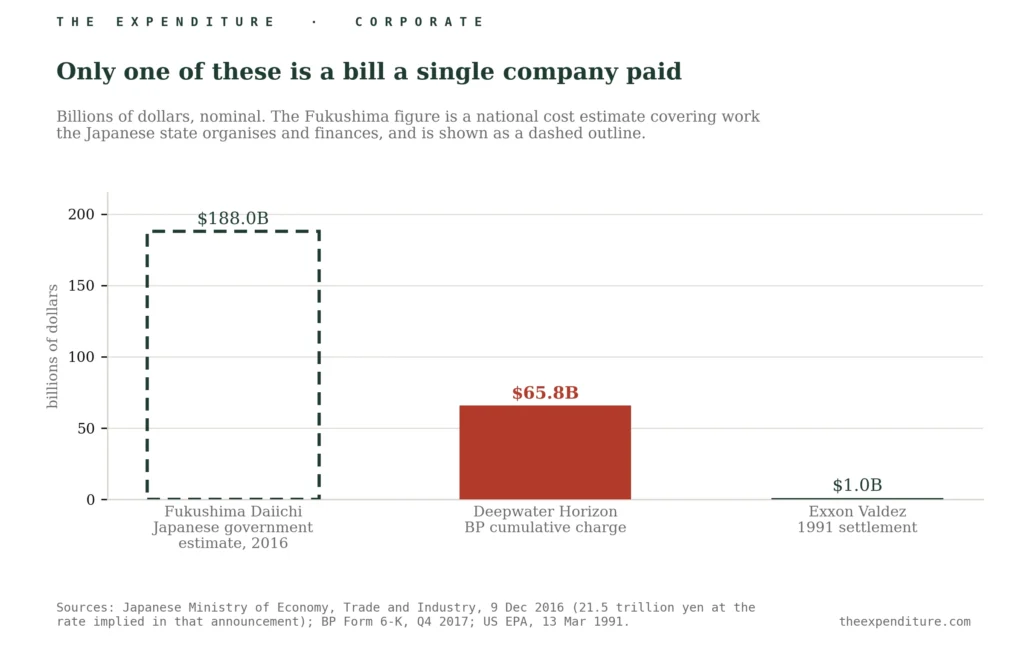
No, and the distinction matters. Japan’s Ministry of Economy, Trade and Industry revised its estimate of the costs related to the Fukushima nuclear disaster to 21.5 trillion yen, about $188 billion, on December 9, 2016, nearly double the 11 trillion yen it had calculated in 2013. The revision broke down as 8 trillion yen for decommissioning, 7.9 trillion for compensation and 5.6 trillion for the treatment and storage of contaminated soil.
Fukushima is therefore the more expensive accident. It is not the more expensive corporate bill. The Japanese figure is a national estimate covering work the state is organizing and financing, with the operator’s share advanced through government support. BP’s $65.765 billion is a charge taken by one company, against its own earnings, and paid from its own balance sheet.
That is why the record here is stated as the largest cost borne by a single company rather than the most expensive accident. Written wider, it would be wrong.
What was the previous record for a company?
The Exxon Valdez, and it was smaller by a factor that is hard to credit. On March 13, 1991, Exxon agreed to “pay a criminal fine of $100 million, of which $50 million will be remitted” and to settle all federal and state civil claims “by the payment of $900 million in damages”. The Environmental Protection Agency called the result “by far the largest single amount ever paid as a result of environmental violations.”
One billion dollars. BP’s 2015 civil settlement alone is 20.8 times that figure, and its total charge is 65.8 times it.
The volumes are not as far apart as the money. Approximately 11 million gallons escaped the Valdez, which is about 262,000 barrels. The Macondo well released 12.2 times as much.
Did anyone go to prison?
No. BP was charged in a 14-count information that included “11 counts of felony manslaughter”, one for each of the workers killed when the rig caught fire on April 20, 2010, and the Justice Department described the outcome as “the largest criminal resolution in United States history”. The felony counts were against the corporation. Individual prosecutions of BP employees did not produce manslaughter convictions.
Of the $4 billion criminal recovery, approximately $2.4 billion was “dedicated to acquiring, restoring, preserving and conserving” habitat in the Gulf region, and a further $350 million was directed to oil spill prevention and response research.
The case that $65.8 billion overstates it
The strongest argument against the figure is that a pre-tax charge is not a cost to shareholders. Large parts of what BP paid were deductible against US and UK corporation tax, which means the public purse absorbed a share of the bill through foregone revenue, and the after-tax number carried by BP’s owners is materially smaller than $65.765 billion. The Clean Water Act penalty was explicitly non-deductible, but the natural resource damages and most of the claims payments were not, and BP itself reported post-tax charges well below the pre-tax ones in the years it took them. On this reading the headline figure flatters the accounting and the real corporate loss is lower.
The objection is correct and does not change the record. Every comparable figure in this article, including Exxon’s and the Fukushima estimate, is stated on a pre-tax basis, and switching BP alone to a post-tax basis would make the comparison meaningless. More to the point, deductibility reduces what BP’s shareholders ultimately bore, not what BP paid out. The checks cleared at face value.
What was counted and what was not
The headline is BP’s own cumulative pre-tax income statement charge as stated in its fourth quarter 2017 results. It is pre-tax, and the tax treatment is discussed above rather than netted off. It is nominal, in dollars of the years the charges were taken between 2010 and 2017, and it has not been inflated to 2026 prices.
The split between government settlements and everything else is our arithmetic on three published settlement figures, not a line item BP publishes. The $40.4 billion residual is therefore a subtraction, and we have labeled it as one.
The per-barrel figure divides BP’s total by the court’s volume finding. It is a ratio we have constructed, not a penalty rate, and it should not be confused with the statutory $1,000 to $4,300 a barrel.
Excluded: the settlements paid separately by Transocean, Halliburton and Anadarko, which are not BP’s costs and would double-count the accident if added. Excluded too is any estimate of the spill’s wider economic damage to the Gulf region, which has no single authoritative figure. And a note on kind: this is money BP paid out, which is a different thing from the $54.2 billion AOL Time Warner wrote off its own balance sheet in 2002. The larger number never left a bank account. This one did, over twenty-three years.
Key figures
- $65.765 billion: BP’s cumulative pre-tax charge for the spill, as stated in its own accounts
- $20.8 billion: the 2015 civil settlement with the United States and five Gulf states
- $4 billion: the 2012 criminal resolution, the largest in United States history
- $525 million: the simultaneous SEC settlement
- $25.325 billion: the three government settlements combined, 38.5 percent of the total
- 3.19 million barrels: the volume the court found was discharged
- $20,616: cost per barrel spilled
- $1 billion: the Exxon Valdez settlement of 1991, the previous record for a company
- 11: workers killed on the rig on April 20, 2010
The open question
BP will be paying for Macondo until 2033, which is twenty-three years of installments for a well that blew out in April and was shut in by the middle of July. No regulator designed that schedule and no statute requires it. It is simply how long it takes one company to settle the bill for a single hole in the seabed.
Frequently asked questions
From the explosion on April 20, 2010, until July 15, when BP’s own filings record that the well "has been shut-in since July 15". It was not permanently sealed until September, after a relief well intercepted the annulus on September 15 and the casing and annulus were filled with cement.
Between $1,000 and $4,300 per barrel discharged, with the higher rate applying where gross negligence is found. Applied to the 3.19 million barrels the court identified, that put BP’s theoretical maximum at $13.7 billion.
Approximately 11 million gallons, which is about 262,000 barrels. The Macondo well released roughly twelve times as much.
Yes. BP faced a 14-count information including 11 counts of felony manslaughter, one for each worker killed, and the resulting $4 billion resolution was described by the Justice Department as the largest criminal resolution in United States history.
About $2.4 billion of the $4 billion was dedicated to acquiring, restoring, preserving and conserving habitat in the Gulf region, and a further $350 million went to oil spill prevention and response research.
21.5 trillion yen, or about $188 billion, as revised by its Ministry of Economy, Trade and Industry in December 2016. That is nearly double the 11 trillion yen the ministry had estimated in 2013, and it is a national figure rather than one company’s bill.
Notes. Currency note: Japanese yen are converted at the rate implied by the Ministry of Economy, Trade and Industry’s own announcement of December 9, 2016, which gave 21.5 trillion yen as about $188 billion, an implied rate of approximately 114.4 yen per dollar. All dollar figures are nominal, in dollars of the year each was recorded, and are not adjusted for inflation. Figures from different years are compared but never added.
Sources
- BP p.l.c., Form 6-K, fourth quarter and full year 2017 results, filed with the SEC
- BP p.l.c., Form 20-F for the year ended December 31, 2018
- US Department of the Interior and US Department of Justice, “U.S. and Five Gulf States Reach Historic Settlement with BP to Resolve Civil Lawsuit Over Deepwater Horizon Oil Spill”, October 5, 2015
- US Department of Justice, Office of the Attorney General, announcement of the BP criminal resolution, November 15, 2012
- United States District Court for the Eastern District of Louisiana, findings of Judge Carl Barbier on discharge volume, January 15, 2015, as reported by the Gulf of Mexico University Research Collaborative and the Associated Press (press)
- US Environmental Protection Agency, “Exxon to Pay Record One Billion Dollars in Criminal Fines and Civil Damages in Connection with Alaskan Oil Spill”, March 13, 1991
- Japanese Ministry of Economy, Trade and Industry estimate of December 9, 2016, as reported by Reuters and Toyo Keizai (press)