Record Data Sheet
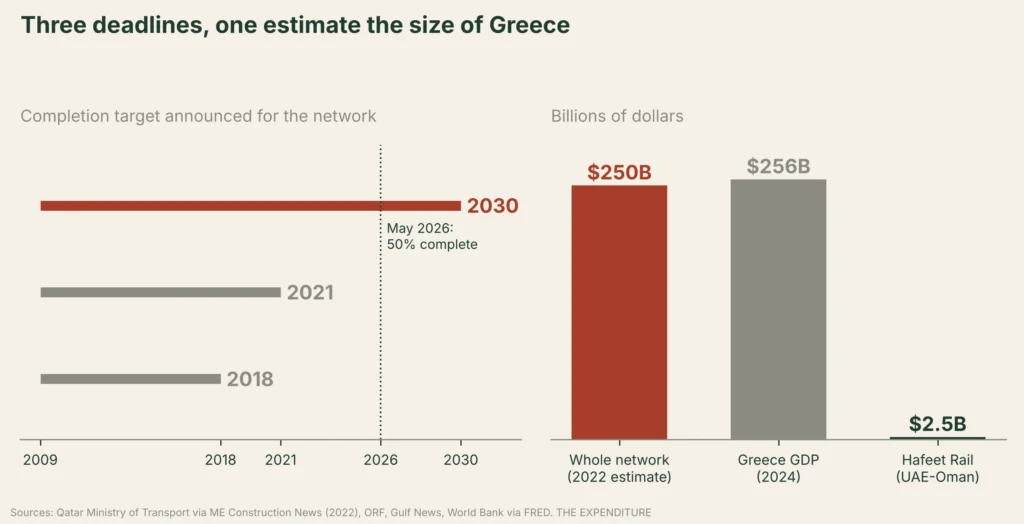
On May 11, 2026, Mohammed Al Shebrami, director of the GCC Railways Authority, said the Gulf Railway had reached 50% completion and was scheduled to be fully operational by December 2030. The network is meant to link all six Gulf Cooperation Council states, Saudi Arabia, the United Arab Emirates, Qatar, Kuwait, Bahrain and Oman, from Kuwait City to Muscat.
The cost figure attached to the project is $250 billion. That is roughly the size of Greece’s entire economy, which the World Bank put at $256 billion in 2024. It is also a figure that no Gulf government has broken down.
Where the $250 billion comes from
The number traces back to official statements, not to a published budget. In March 2022, Qatar’s transport minister, Jassim Saif Ahmed Al Sulaiti, described a $250 billion railway of 2,177 kilometers linking all six states. A 2019 legal briefing by the law firm Al Tamimi put the estimated expenditure at more than $240 billion. The Observer Research Foundation, a think tank, describes $250 billion as the initial estimate.
The network’s length also varies by source. The Qatari minister and the foundation give 2,177 kilometers. Gulf News, reporting the May 2026 progress update, described a 1,700-kilometer network. The difference depends on which national lines are counted as part of the shared system.
Six countries, six bills
There is no single budget because there is no single payer. Each country funds the section on its own territory, so Saudi Arabia and the UAE, with the longest stretches, carry the largest costs. The Observer Research Foundation notes that a unified GCC fund to finance the network was never created.
The parts that have been costed publicly are small next to the headline. Hafeet Rail, the 238-kilometer line linking Sohar in Oman with the UAE network through Al Ain, is budgeted at $2.5 billion, with $1.5 billion of project financing secured. Its partners are Etihad Rail, Oman Rail and the Abu Dhabi fund Mubadala, and it was 40% complete as of April 2026, according to Gulf News. Kuwait signed a design contract for its 111-kilometer section, from Al Shadadiya near Kuwait City airport to Nuwaiseeb on the Saudi border, with the Turkish firm Proyapı in April 2025, worth 2.5 million Kuwaiti dinars, about $8.1 million.
In December 2025, Saudi Arabia and Qatar signed an agreement for a 785-kilometer high-speed line from Riyadh to Doha through Hofuf and Dammam, to be completed within six years. The figure of SAR 115 billion attached to it describes the expected economic impact, not the construction cost.
Fifteen years of delays
The project was conceived in 2009. According to Al Tamimi, it was originally due for completion in 2018, and by 2019 the target had moved to 2021. The current target is December 2030.
The Observer Research Foundation points to three reasons. First, money: without a joint fund, wealthier states moved ahead on their own while others faced fiscal pressure, especially after the 2014 oil price collapse. Second, politics: the 2017 rift between Qatar and its neighbors suspended Qatar’s section for years. Third, coordination: customs rules, technical standards and border procedures have lagged behind construction.
The result is uneven progress. The UAE and Saudi Arabia have the most advanced national networks. Qatar has a modern rail system that is not yet connected to the rest. Bahrain has no national railway, and Kuwait and Oman have faced the longest delays.
The figure that matters
Of the $250 billion, the share that can be traced to a published contract or budget is a few billion dollars. That does not mean the rest is not being spent. Saudi Arabia and the UAE fund national rail programs that serve the network, and their costs sit inside national budgets rather than in a regional account. It means that the headline cost cannot be checked, and progress figures such as 50% cannot be tied to money spent.
The comparison with California is instructive. Its high-speed rail line, priced at $33 billion in 2008, is now estimated at $126.1 billion, and every revision is published in a business plan, as we report in the train that was supposed to cost $33B. How countries measure infrastructure spending is the subject of China, the US and India.
What we could not confirm
We could not find an official, itemized budget for the Gulf Railway from the GCC Railways Authority or any member state, or a breakdown of the $250 billion estimate. We also could not confirm how the 50% completion figure is measured, by length, by spending or by contracts awarded.
Two descriptions in an earlier version of this article could not be confirmed from primary sources and are listed as unconfirmed: Saudi Arabia’s Landbridge, a 950-kilometer Riyadh to Jeddah line described as already underway, and Etihad Rail preparing passenger service of roughly 900 kilometers connecting 11 cities.
What to watch
The next milestones are Hafeet Rail, with trial operations planned for late 2027, and the tender for Kuwait’s section once its design is complete. Either could be the first test of whether the 2030 date holds.
Frequently asked questions
About $250 billion, according to the most widely quoted estimate, given by Qatar's transport minister in 2022. No government has published a consolidated budget.
2,177 kilometers, according to the Qatari minister and the Observer Research Foundation. Other reports give different lengths depending on which national lines are counted.
The current target is December 2030. The original target was 2018, later moved to 2021.
The GCC Railways Authority said in May 2026 that the project was 50% complete.
Each country pays for the section on its own territory. There is no joint GCC fund.
Notes. All figures are in US dollars unless stated otherwise. Kuwait’s contract value is converted as reported by the International Railway Journal. Greece’s GDP is the World Bank figure for 2024 in current dollars, published by the Federal Reserve Bank of St. Louis (FRED).
Sources
- Gulf News, “50% of Gulf Railway project complete,” May 11, 2026: https://gulfnews.com/amp/story/uae%2Ftransport%2F50-of-gulf-railway-project-completed-1.500536920
- Middle East Construction News, “Construction of $250bn Qatar to KSA GCC railway link to begin soon,” March 1, 2022: https://meconstructionnews.com/51440/construction-of-250bn-qatar-to-ksa-gcc-railway-link-to-begin-soon-minister-of-transport-says/amp
- Observer Research Foundation, “The Gulf Railway Project: Bridging the gaps between vision and reality,” April 25, 2025: https://www.orfonline.org/index.php/research/the-gulf-railway-project-bridging-the-gaps-between-vision-and-reality
- Al Tamimi & Company, “The Development of Rail Infrastructure Projects in the GCC,” September 2019: https://www.tamimi.com/law-update/september-2019/articles/the-development-of-rail-infrastructure-projects-in-the-gcc-2/
- Gulf News, “Oman ratifies UAE railway agreement as $2.5bn Hafeet Rail project advances”: https://gulfnews.com/world/gulf/oman/oman-ratifies-uae-railway-agreement-as-25bn-hafeet-rail-project-advances-1.500663419
- International Railway Journal, “Kuwait signs consultancy contract for GCC network,” April 2025: https://www.railjournal.com/regions/middle-east/kuwait-signs-consultancy-contract-for-gcc-network/
- Gulf Business, Riyadh to Doha high-speed rail agreement, December 2025: https://gulfbusiness.com/en/2025/transport/riyadh-doha-two-hours-gulf-sar115bn-rail-project/
- FRED, Gross Domestic Product for Greece (World Bank): https://fred.stlouisfed.org/series/mktgdpgra646nwdb