Record Data Sheet
South Africa has a new infrastructure number worth watching.
More than 170 infrastructure projects with an estimated value of R264 billion are expected to enter procurement over the next 12 to 18 months, according to President Cyril Ramaphosa’s 25 August 2026 address at the Sustainable Infrastructure Development Symposium South Africa. The projects span water and sanitation, transport and logistics, energy and electricity, and municipal infrastructure.
For investors, however, the headline figure is almost beside the point.
The real question is whether South Africa can turn R264 billion of prepared infrastructure into R264 billion of productive assets.
The pipeline has become much larger
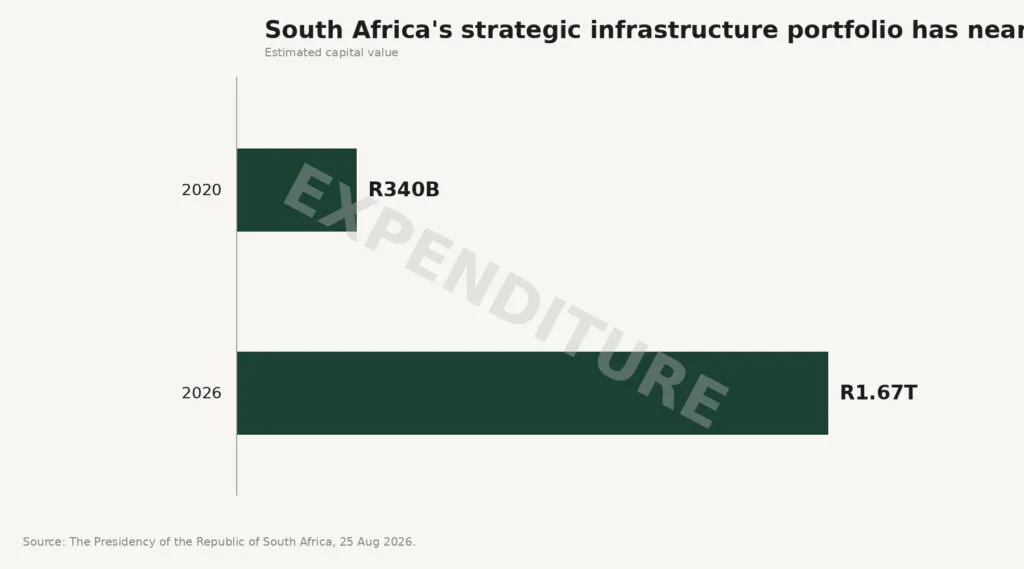
South Africa’s Strategic Integrated Projects portfolio has grown dramatically. The estimated capital value of the country’s strategic infrastructure portfolio has increased from approximately R340 billion in 2020 to more than R1.67 trillion today, according to Ramaphosa. The current portfolio contains 195 public- and privately-led infrastructure projects across priority sectors.
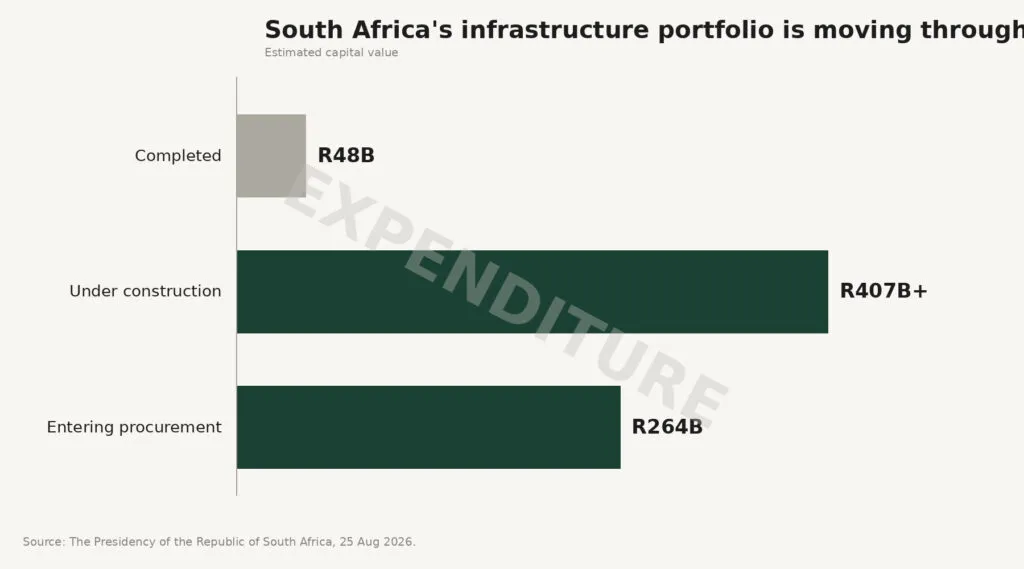
Of those 195 projects, 32 projects worth approximately R48 billion have been completed; 55 projects worth more than R407 billion are currently under construction; and more than 170 projects worth R264 billion are expected to enter procurement over the next 12-18 months.
South Africa’s real infrastructure problem is conversion
Ramaphosa’s assessment is unusually revealing. South Africa does not primarily suffer from a shortage of infrastructure proposals. It suffers from the gap between a project that is needed and a project that is ready.
The government has therefore shifted its emphasis toward project preparation, financing, procurement and execution. A proposed railway does not move freight. A planned power project does not generate electricity. A water project does not improve industrial output until the asset is actually installed and operating.
The scale is large. The investment gap is larger
Gross fixed capital formation, investment in productive assets such as infrastructure, machinery, equipment and productive capacity was approximately 14% of GDP in 2025, according to Ramaphosa. The National Development Plan envisages an investment level of 30% of GDP by 2030.
This is the paradox: South Africa can announce a R264 billion infrastructure pipeline while still having an economy that is underinvesting relative to its own development target. The problem is not simply finding projects. It is creating a system in which capital can move from identification to preparation, financing, procurement, construction and operation.
R1.8 million unlocked R800 million
One of the most interesting numbers in Ramaphosa’s speech is not R264 billion. It is R1.8 million. Infrastructure South Africa spent R1.8 million preparing and packaging a Matjhabeng Local Municipality project involving the replacement of more than 1,700 kilometers of water pipes. That preparation helped unlock an R800 million debt-financing facility from the Development Bank of Southern Africa.
The implied ratio is striking: R1.8 million of preparation → R800 million of financing. It is not a claim that every rand spent on preparation will produce the same result. It does illustrate that project preparation can itself be a form of capital allocation.
The R600 million facility behind the pipeline
The government has established a R600 million project preparation facility through Infrastructure South Africa. According to Ramaphosa, 26 projects have received or are receiving project-development support through the facility.
The logic is straightforward. Instead of asking investors to finance an unfinished idea, the state can spend relatively small amounts preparing projects to a level where private and development finance can participate. The state’s role is not necessarily to fund every project itself. It is to make projects financeable.
The private sector has to become part of the equation
The scale of South Africa’s infrastructure requirements makes a purely government-funded strategy unrealistic. Ramaphosa described infrastructure development as requiring partnerships between the state, private sector, development finance institutions and commercial lenders.
The third edition of the Construction Book is designed to give the market greater visibility over projects that are funded and investment-ready and expected to enter procurement in the next 12-18 months. Quarterly performance reporting should make it easier for investors to judge whether the pipeline is actually moving.
South Africa is trying to solve an execution problem
South Africa has already accumulated a R1.67 trillion strategic infrastructure portfolio. The challenge is no longer demonstrating that the country has infrastructure needs. It is demonstrating that projects can consistently move through the system.
If the R264 billion pipeline moves efficiently into procurement and construction, it could become an important source of economic activity and productive capacity. If projects remain stuck in preparation, procurement or institutional bottlenecks, the headline number will have little economic meaning.
The municipal problem may be the decisive one
The government is increasingly focusing on municipal infrastructure. That matters because reliable local infrastructure directly affects the private economy. Businesses cannot operate efficiently without dependable water, electricity, sanitation, roads and other municipal services.
Ramaphosa also stressed that funding an asset without ensuring the institution can operate and maintain it is not sustainable. Infrastructure is therefore not just a construction business. It is an asset-management business.
The number that matters now is not R264 billion
South Africa’s R264 billion pipeline is substantial. But the more interesting number is R1.67 trillion, the estimated value of the country’s current Strategic Integrated Projects portfolio.
The investment thesis is still being built. South Africa has moved from a period in which the problem was
identifying infrastructure needs toward a period in which the critical test is conversion: plans into prepared projects, prepared projects into investment, investment into construction, and construction into infrastructure that supports economic activity.
Sources
The Presidency of the Republic of South Africa: Address by President Cyril Ramaphosa at the 2026 Sustainable Infrastructure Development Symposium South Africa, 25 August 2026. Supporting context: The Presidency’s official infrastructure and investment statements. No media or secondary sources used.