Record Data Sheet
On March 14, 2023, at its annual press conference, Volkswagen Group presented its investment plan for the next five years. The figure was €180 billion, about $193 billion at the exchange rate of the day, to be spent between 2023 and 2027. The plan before it had come to €159 billion.
The number has since been quoted as a ten-year commitment to electric cars. The company’s documents do not support that reading. The plan covered five years, not ten, and it covered all of the group’s investment, not only electric vehicles.
What the €180 billion covered
Volkswagen splits each planning round into two parts. One is what it calls electrification and digitalization: battery-electric models, the PowerCo battery business, software and charging. The other is everything else, including the combustion engines and hybrids that still produce most of its revenue.
In the 2023 to 2027 plan, the first part received €122.4 billion, about $131 billion. That was 68% of the total, up from 56% in the previous plan. The remaining €57.6 billion went to the rest of the business. Within the electric share, the company also set aside an additional €15 billion for battery plants and raw materials, according to reporting by Kallanish at the time.
So the largest single figure that can fairly be called Volkswagen’s electric commitment for that period is $131 billion over five years, not $193 billion over ten.
Where the electric money was meant to go
The biggest single destination was batteries. Volkswagen had set up PowerCo, a separate company, to build its own cell factories instead of buying cells from Asian suppliers. At the time of the 2023 plan, it had confirmed plants in Germany, Spain and Canada, and said PowerCo should reach annual sales of more than €20 billion by 2030. The rest of the electric share went to new battery-electric models, to expansion in North America and to software through its CARIAD unit.
The previous plan gives a sense of the pace. In December 2021, the 2022 to 2026 round set aside €89 billion for the same purposes and expected a quarter of the group’s production to be battery-electric by 2026. The 2023 plan raised the electric budget by about €33 billion in fifteen months.
The plans that followed
Volkswagen updates its five-year plan every year, and each update replaces the last. The next round, for 2024 to 2028, kept the total at €180 billion. In June 2024, the company said €120 billion of it, two thirds, would go to electrification and digitalization. Chief financial officer Arno Antlitz described the rest plainly: “The future is electric, but the past is not over. It is a third and it will stay a third.”
After that, the total started to fall. The plan for 2025 to 2029 came to €165 billion. The plan for 2026 to 2030, confirmed by chief executive Oliver Blume in an interview with the Frankfurter Allgemeine in late 2025, came to about €160 billion. Blume said the focus would be on Germany and Europe, with less expansion in the United States and China. For these two rounds, the reports we found did not give the electric share.
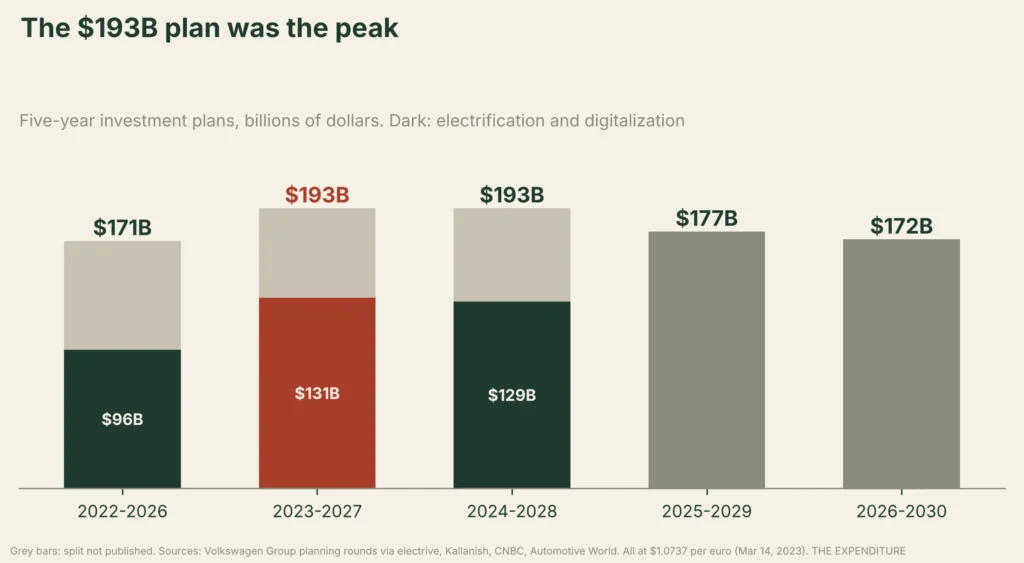
In dollar terms, at the same exchange rate, the planned budget went from $193 billion to $172 billion in three rounds, a cut of about 11%.
Why the budget shrank
The company’s 2025 results, published on March 10, 2026, explain much of the change. Revenue was €322 billion, about the same as the year before. Operating profit more than halved, to €8.9 billion, and the operating margin fell from 5.9% to 2.8%. Blume said the direct and indirect effects of US tariffs alone came to about €5 billion. At Porsche, in which Volkswagen holds the majority, operating profit fell by 98%, partly because of the cost of slowing its own electric plans, a story we follow in Porsche’s first half of 2026.
The electric business itself grew. Volkswagen reported that its battery-electric deliveries rose 32% worldwide in 2025 and 66% in Europe, where it held 27% of the electric market. Volume was not the problem. Profit was.
What we could not confirm
We could not find a source for the claim that the €180 billion covered 2023 to 2033, or that it was the largest bet in automotive history, as this article originally stated. We also could not find how much of the €165 billion and €160 billion plans is set aside for electrification and digitalization. And because each plan replaces the last, there is no published figure for how much of the original €180 billion was actually spent before the budget was revised.
What to watch
The next planning round, normally concluded at the end of the year, will show whether the total keeps falling and whether Volkswagen publishes the electric share again. The 2026 annual report will show the first full year of the reduced plan. As with Microsoft’s $80B AI year, the useful comparison is between what was announced and what the reports later show.
Frequently asked questions
Not exactly. €180 billion was its total investment plan for 2023 to 2027. Of that, €122.4 billion, or 68%, was for electrification and digitalization.
No. It covered five years, from 2023 to 2027. Volkswagen sets a new five-year plan every year.
About €160 billion for 2026 to 2030, according to chief executive Oliver Blume, down from €165 billion in the previous plan and €180 billion in the two before that.
Profits fell. Operating profit more than halved in 2025, to €8.9 billion, with US tariffs costing about €5 billion and Porsche's profit almost disappearing.
Yes. Battery-electric deliveries rose 32% worldwide in 2025 and 66% in Europe, where Volkswagen held 27% of the electric car market.
Notes. Plan figures are converted at $1.0737 per euro, the ECB reference rate on March 14, 2023, the day the €180 billion plan was announced; the same rate is used for every plan so the series can be compared. At that rate, €159 billion is $171 billion, €165 billion is $177 billion and €160 billion is $172 billion. The €159 billion total for 2022 to 2026 is derived from the reported €89 billion for electrification and digitalization, stated as 56% of the plan. The €57.6 billion for the rest of the business is our subtraction. 2025 results are in euros as reported; at the 2025 average rate of $1.13 per euro (Bank of Finland, from ECB reference rates), operating profit was about $10.1 billion and the tariff effect about $5.7 billion.
Sources
- CNBC, “Volkswagen announces five-year $193 billion investment plan as electrification gathers pace,” March 14, 2023: https://www.cnbc.com/2023/03/14/volkswagen-announces-five-year-193-billion-investment-plan-as-electrification-gathers-pace.html
- Kallanish, “VW Group earmarks €122.4 billion for electrification, digitalisation,” March 2023: https://kallanish.com/en/news/power-materials/market-reports/article-details/vw-group-earmarks-euro1224-billion-for-electrification-digitalisation-0323
- electrive, “VW concludes planning round,” December 9, 2021: https://www.electrive.com/2021/12/09/vw-concludes-planning-round-diess-stays
- electrive, “VW invests €120 billion in electrification and digitalisation,” June 11, 2024: https://electrive.com/2024/06/11/vw-invests-e120-billion-in-electrification-and-digitalisation
- Automotive World, “Volkswagen to refocus on Europe, invest €160bn through 2030”: https://www.automotiveworld.com/news/volkswagen-to-refocus-on-europe-invest-e160bn-through-2030/
- auto motor und sport, “VW investiert 160 Milliarden bis 2030”: https://www.auto-motor-und-sport.de/verkehr/vw-investiert-160-milliarden-bis-2030-deutliche-abstriche-bei-den-konzern-ausgaben-in-europa/
- Volkswagen Group, Annual Report 2025, letter to shareholders: https://annualreport2025.volkswagen-group.com/to-our-shareholders/letter-to-our-shareholders.html
- BusinessDay, “Embattled Volkswagen reports major profit slump,” March 10, 2026: https://www.businessday.co.za/motoring/2026-03-10-embattled-volkswagen-reports-major-profit-slump
- China Daily, “US tariffs cost VW $5.8 billion in 2025, says CEO,” March 2026: https://www.chinaservicesinfo.com/s/202603/13/WS69bbc81c498e36855033b60d/us-tariffs-cost-vw-5-8-billion-in-2025-says-ceo.html
- Pound Sterling Live, ECB euro to dollar reference rates for 2023: https://www.poundsterlinglive.com/bank-of-england-spot/historical-spot-exchange-rates/eur/EUR-to-USD-2023
- Bank of Finland, average annual exchange rates for 2025: https://www.suomenpankki.fi/en/statistics/interest-rates-and-exchange-rates/exchange-rates/average-annual-exchange-rates-for-the-year-2025/