Record Data Sheet
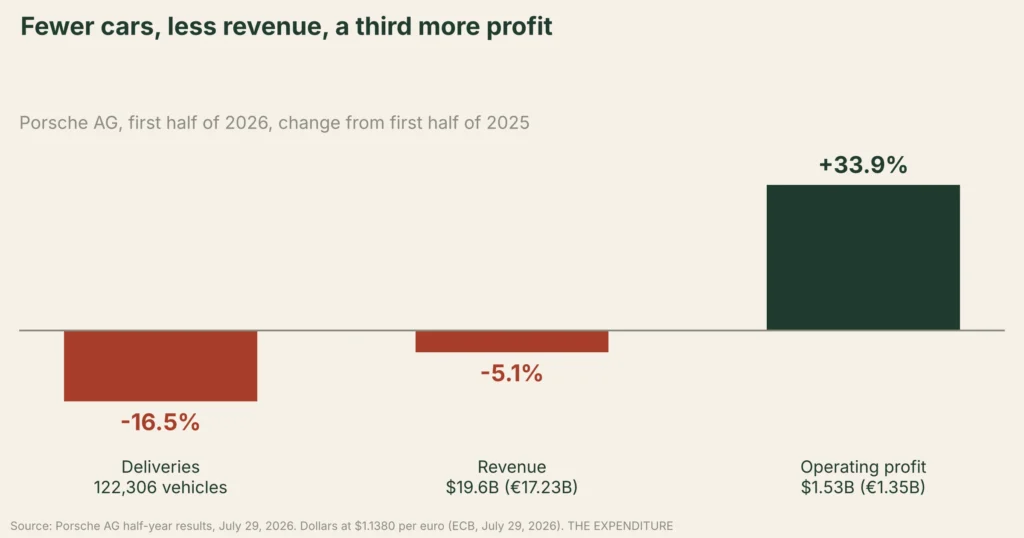
On July 29, 2026, Porsche AG published its results for the first half of the year, and at first glance they do not add up. The company delivered 122,306 cars, 16.5% fewer than a year earlier, and still made 34% more operating profit. The explanation is a phrase Porsche has repeated for two years: value over volume.
The numbers, from Porsche’s own report
Between January and June 2026, Porsche AG’s revenue was $19.6 billion (€17.23 billion), down 5.1% from $20.7 billion (€18.16 billion) a year earlier. Operating profit rose 33.9%, to $1.53 billion (€1.35 billion), from $1.15 billion (€1.01 billion). That beat the $1.43 billion (€1.26 billion) analysts expected, according to the Visible Alpha consensus cited by Reuters.
Return on sales rose from 5.5% to 7.8%. Net cash flow from the car business reached $1.16 billion (€1.02 billion), against $448 million (€394 million) a year earlier.
The comparison with last year as a whole is even starker. In all of 2025, Porsche’s operating profit was $470 million (€413 million), after about €3.9 billion of one-off costs. In six months of 2026, it earned more than three times that.
Why it makes more while selling less
The first reason is price. Porsche’s average selling price in the half was about $143,400 (€126,000) per vehicle, according to figures from the earnings call. Fewer cars left the factory, but the mix moved toward more expensive ones.
The second is the 911, the brand’s most profitable model. Deliveries rose 19%, to 30,534, helped by the phased launch of new versions, including the GTS, Turbo and GT models. In a half when almost every other model fell, the 911 carried the business.
The third is a sharp drop in restructuring costs. Porsche booked about $114 million (€100 million) of charges for its strategic realignment in the first half of 2026, against about $910 million (€800 million) in the same period of 2025. That gap alone explains much of the profit increase.
What is behind the drop in deliveries
Porsche’s delivery report shows where the cars went missing:
| Model | Deliveries, first half of 2026 | Change |
|---|---|---|
| Cayenne | 38,141 | -9% |
| Macan | 35,315 | -22% |
| 911 | 30,534 | +19% |
| Panamera | 9,308 | -38% |
| Taycan | 6,219 | -25% |
| 718 | 2,789 | -73% |
The company blames the end of production of the combustion-engine 718 in October 2025, the expiry of US tax incentives for electric and hybrid vehicles, which hit the Macan, and a temporary gap in the Panamera range in China. By region, China fell the most, by 32%, to 14,501 cars. North America remained the largest market, with 37,712, down 13%.
The job cuts behind the strategy
On Monday, July 27, two days before the results, Porsche agreed with worker representatives to cut 5,000 more jobs by 2035. That comes on top of 3,900 cuts agreed in February 2025 and 500 more announced this year, for a total of about 9,000, roughly one job in five. Porsche had 42,600 employees at the end of 2024.
The cuts are to be made without forced layoffs, through attrition and voluntary schemes. In exchange, Porsche guaranteed its German sites until the end of 2035 and committed about $2.4 billion (€2.1 billion) to its Zuffenhausen plant and its Weissach research center.
What is still to be paid
The profit jump does not mean restructuring is over. Porsche said the new package will bring realignment costs of “a three-digit-million amount” in the second half of 2026, with more expected in 2027. Its full-year guidance already absorbs €800 million to €900 million of such costs and about €700 million of US tariffs, according to the earnings call.
Porsche is not the only part of the group restructuring. Its parent, Volkswagen, has been reshaping its own spending, as covered in Volkswagen’s $193 billion plan.
What Porsche expects for 2026
Porsche kept its full-year guidance unchanged:
- Revenue of $39.8 billion to $41.0 billion (€35 billion to €36 billion), against $41.3 billion (€36.27 billion) in 2025
- Operating return on sales of 5.5% to 7.5%
- Automotive net cash flow margin of 3% to 5%
- Automotive EBITDA margin of 15% to 17%
- Battery electric share of deliveries of 24% to 26%, against 19.4% in the first half
The company will present more detail on its strategy at its Capital Markets Day on October 7, 2026. Holding the guidance stands out in a year when several German carmakers have cut theirs, citing a weaker Chinese market, cost pressure and softer demand.
What to watch
The second half will show whether the margin holds once the new restructuring costs are booked. The battery electric target is the hardest test: Porsche needs to raise its share from 19.4% to at least 24% in six months.
Frequently asked questions
$1.53 billion (€1.35 billion) of operating profit, up 33.9% from $1.15 billion (€1.01 billion) a year earlier.
122,306, down 16.5% from 146,391 a year earlier.
A higher average price, about $143,400 (€126,000) per vehicle, 19% more 911 deliveries, and restructuring charges that fell from about €800 million to €100 million.
Yes. On July 27, 2026, it agreed to cut 5,000 more jobs by 2035, for a total of about 9,000 with earlier plans.
No. It kept revenue of €35 billion to €36 billion, about $40 billion, and an operating margin of 5.5% to 7.5%.
The 911, with deliveries up 19% to 30,534.
Notes. Euro figures are converted at $1.1380 per euro, the ECB reference rate on July 29, 2026, the day of the results (Banca d’Italia). Figures from Porsche’s release are rounded as published; the first-half 2025 figures are €18.157 billion of revenue and €1.007 billion of operating profit.
Sources
- Porsche AG, “At a glance: financial figures half year 2026,” July 29, 2026: https://newsroom.porsche.com/en/2026/company/porsche-financial-figures-half-year-2026-42785.html
- Porsche AG, “Porsche delivers 122,306 sports cars in the first half of the year”: https://newsroom.porsche.com/en/2026/company/porsche-deliveries-first-half-2026-42820.html
- Porsche AG, annual press conference, financial year 2025: https://newsroom.porsche.com/en/2026/company/porsche-annual-press-conference-financial-year-2025-annual-and-sustainability-report-41708.html
- Euronews, “Porsche profit jumps 34% despite China slump and falling sales,” July 29, 2026: https://www.euronews.com/2026/07/29/porsche-profit-jumps-34-despite-china-slump-and-falling-sales
- SMM, Porsche first-half figures: https://news.metal.com/en/newscontent/104034130-porsches-deliveries-fell-165-year-on-year-in-the-first-half-while-operating-profit-rose-to-€1348-billion
- Quartr, Porsche Q2 2026 earnings call summary: https://quartr.com/events/porsche-ag-p911-q2-2026_oSgUsXJx
- TimesLIVE, citing Reuters, “Porsche ramps up job cuts to 9,000 by 2035,” July 27, 2026: https://www.timeslive.co.za/motoring/2026-07-27-porsche-ramps-up-job-cuts-to-9000-by-2035/
- Banca d’Italia, euro reference rates, July 29, 2026: https://www.bancaditalia.it/compiti/operazioni-cambi/cambio/cambi_rif_20260729