Record Data Sheet
On August 6, 2026, SpaceX and Tesla confirmed Terafab, a semiconductor mega factory planned for Grimes County, Texas, with Governor Greg Abbott’s office putting the first phase capital investment at more than $16.8 billion and 3,000 jobs, according to the state’s official press release. Almost every headline about the project led instead with a different number: $119 billion. That figure comes from a SpaceX state incentive filing describing a four-phase ceiling, not a confirmed commitment, and neither company has explained the 86% gap between what’s been filed and what’s been announced.
What’s actually confirmed
The confirmed figure comes from Texas Governor Greg Abbott’s official announcement: a first-phase capital investment of more than $16.8 billion, creating at least 3,000 jobs in Grimes and neighboring Brazos County, at a former coal plant site near the Gibbons Creek Reservoir. Intel has joined the project as a partner but has not disclosed its own financial contribution. The state’s public support is comparatively modest against that private figure, a $30 million Texas Enterprise Fund grant, plus a Jobs, Energy, Technology and Innovation Act property tax abatement.
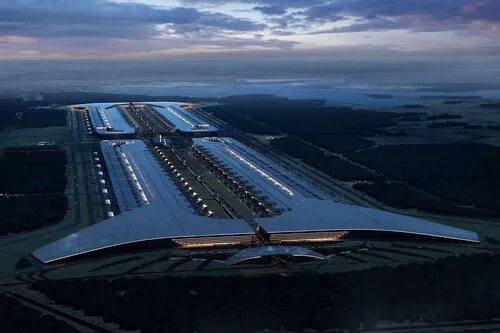
The plant itself is designed to combine logic chip manufacturing, memory production, packaging, and testing under a single roof exceeding 100 million square feet, aimed at supplying chips for Tesla’s Optimus robots and Cybercabs and SpaceX’s planned space-based data centers, according to both companies.
Where the $119 billion figure actually comes from
The $119 billion ceiling traces back to a SpaceX filing tied to a Texas property tax incentive application, first surfaced in a Grimes County public hearing notice in May 2026 and later confirmed in reporting on the state JETI filing. That notice described the full four-phase build-out potentially reaching $119 billion. It is, by its own framing, a planning ceiling for a multi-phase project, not a board-approved capital commitment.
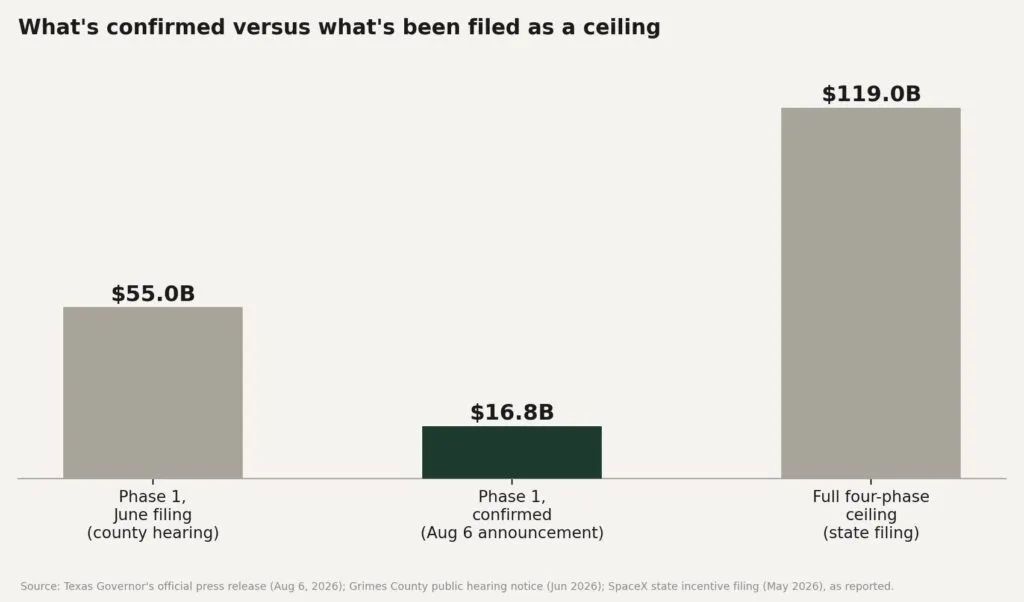
The gap shows up again inside Phase 1 alone. The same June county hearing notice put the initial phase at roughly $55 billion. Two months later, the confirmed announcement priced Phase 1 at $16.8 billion, a reduction of more than two thirds, with neither company publicly reconciling the difference between the two figures.
The evidence that this isn’t being treated as a firm commitment
Two details, both easy to miss inside the coverage, matter more than the headline number. First, SpaceX did not mention Terafab once during its first earnings call as a newly public company, held the same week as the Texas announcement, despite the call being the natural venue to discuss a capital commitment of this scale to investors now holding its stock. Second, reporting on SpaceX’s own IPO filing describes the company characterizing Terafab internally as a “general framework” carrying no binding commitments.
Neither detail means the project won’t happen. Musk has a documented history of eventually building what he announces, at some scale, on some timeline. But it does mean that treating $119 billion as committed capital, the way most headlines about the project have, overstates what either company has actually obligated itself to spend today. The confirmed number is $16.8 billion. Everything beyond that is a ceiling, contingent on production milestones, financing, and demand that has not yet materialized.
Sizing the ceiling against something real
If the full $119 billion figure were ever spent, it would be roughly comparable to the entire 2024 gross domestic product of Kenya, Africa’s sixth largest economy, which the World Bank put at $124.5 billion. The confirmed $16.8 billion figure is a different kind of comparison entirely, closer to the annual GDP of a small country like Chad or Niger. The distance between those two comparisons is itself the story: describing this project by its ceiling rather than its confirmed spend inflates its economic scale by roughly the entire output of a mid-sized African economy.
Why we consider this relevant
This is a pattern worth recognizing beyond Terafab specifically. Large capital projects seeking state or local tax incentives frequently file a maximalist, multi-phase ceiling figure as part of the incentive application process, since the size of the filed commitment can influence the scale of tax abatement negotiated. That filing figure then gets repeated in press coverage as though it were the actual investment, when the only number either party has firmly committed to is typically the first phase alone.
For anyone evaluating capital expenditure announcements, whether from a public company, a government incentive filing, or a press release, the discipline is the same: find the confirmed, board-approved or contractually obligated figure, and treat any multi-phase ceiling or filing maximum as exactly that, a ceiling, not a spend.
Frequently asked questions
$16.8 billion for Phase 1, according to Texas Governor Greg Abbott’s official announcement on August 6, 2026. That figure is confirmed; the broader $119 billion figure is not.
A SpaceX filing tied to a Texas property tax incentive application, describing a four-phase ceiling for the full build-out, first reported from a Grimes County public hearing notice in May 2026.
Neither company has publicly explained the reduction. The $55 billion figure appeared in a June 2026 county hearing notice; the confirmed $16.8 billion figure came in the official August 6, 2026 announcement.
No. Reporting on the call notes the facility was not mentioned, despite the call taking place the
same week as the Texas confirmation.
A $30 million grant through the Texas Enterprise Fund, along with a property tax abatement under the state’s Jobs, Energy, Technology and Innovation Act.
At least 3,000, according to the confirmed announcement, with hiring focused on residents of Grimes and Brazos counties.
Intel has joined as a partner in the project but has not disclosed the size of its financial contribution, according to available reporting.