Record Data Sheet
Two rivals, one question: how much does each spend on its military, and how fast is the difference shrinking?
THE NUMBERS
| United States | China | |
|---|---|---|
| Military spending, 2025 (SIPRI) | $954B | $336B (estimate) |
| Change from 2024 | Down 7.5% | Up 7.4% |
| Change, 2016 to 2025, after inflation | Up 11% | Up 62% |
| Share of world spending | 33% | 12% |
| Share of GDP | 3.1% | 1.7% |
| Official budget for 2026 | $1.05T (fiscal 2026, national defense) | ¥1.91T, about $277B |
| Population | 341.8M | 1,404.9M |
| Military spending per resident, 2025 (our metric) | About $2,791 | About $239 |
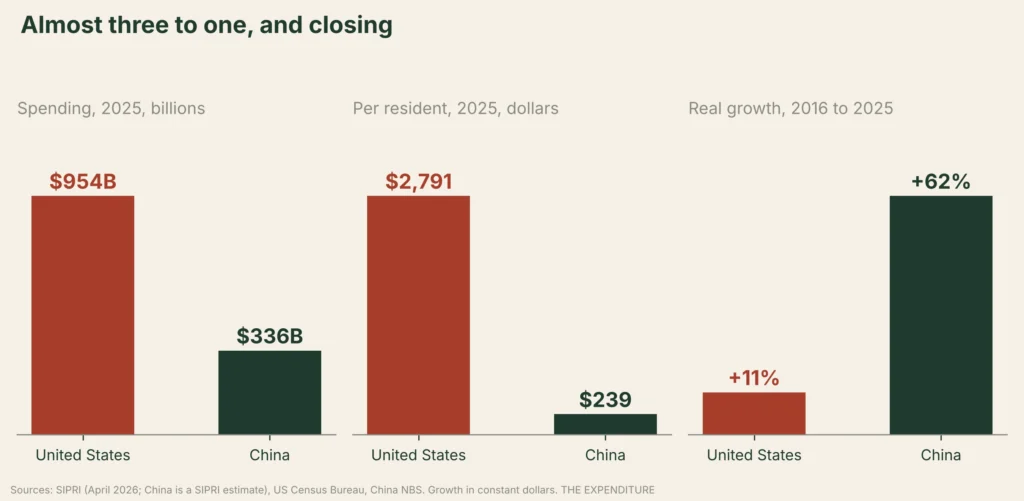
Spending in 2025: the US by almost three to one
The most widely used comparison of military budgets comes from the Stockholm International Peace Research Institute (SIPRI), which applies the same definition to every country. Its figures for 2025, published in April 2026, put US military spending at $954 billion and China’s at an estimated $336 billion. The United States spent 2.8 times as much as China. A year earlier, the ratio was 3.2 to 1.
The two countries together accounted for 45% of the world’s military spending, which SIPRI put at $2,887 billion in 2025, the eleventh consecutive year of growth.
Why the gap is closing
The gap narrowed in 2025 from both sides. US spending fell by 7.5%, which SIPRI attributes mainly to a sharp reduction in military aid sent abroad. China’s rose by 7.4%, its largest increase in a decade and its 31st consecutive annual rise.
The longer trend points the same way. Between 2016 and 2025, after inflation, US military spending grew by 11%. China’s grew by 62%. If those rates held, the ratio would keep falling. They may not hold. The US figure for 2025 was pulled down by a one-off drop in aid, and the 2026 budget moves sharply in the other direction.
The 2026 budgets
Both governments have already set their 2026 budgets. In the United States, Congress approved about $1.05 trillion for national defense in fiscal 2026, including $893 billion in regular appropriations and about $156 billion from the budget reconciliation law. That is about 17% more than the year before, and it is where the figure of $1.1 trillion sometimes quoted for American defense comes from.
In March 2026, China announced a defense budget of 1.91 trillion yuan, about $277 billion, an increase of 7%. China has raised its official budget by single digits every year for more than a decade.
The two 2026 figures cannot be compared directly. The US number is a full national defense total. The Chinese number is the official budget, which leaves out several categories that other countries count as military spending.
How much China really spends
This is the central difficulty of the comparison. China’s official budget excludes defense-related research and development, some capital spending, and internal security and mobilization activities. The US Department of Defense estimates that China’s real spending in 2024 was between 32% and 63% higher than the announced figure.
SIPRI’s estimate already adjusts for part of this. Its $336 billion for 2025 is about 30% above China’s official budget for that year, 1.78 trillion yuan, or about $259 billion. If the Pentagon’s highest estimate were applied to that official figure, China’s spending would come to about $422 billion, and the US would lead by about 2.3 to 1 instead of 2.8. On any of these estimates, the US still spends more than twice as much.
The case for China
Dollar comparisons understate what China gets for its money. Soldiers’ pay, construction and many weapons cost less in China than in the United States, so each dollar buys more. China also concentrates its spending on one region, while the United States maintains forces, bases and alliances across the world. Measured against the area where the two would most likely meet, the Western Pacific, the difference in available forces is much smaller than the difference in budgets.
China also carries a lighter burden. Its military spending is 1.7% of GDP, against 3.1% for the United States, so it has more room to increase spending without straining its economy. Europe faces the opposite question, how fast it can raise its own share, covered in Europe’s defense investments in summer 2026.
Verdict
- Total spending: United States, by about 2.8 to 1.
- Spending per resident: United States, by more than 11 to 1.
- Growth over the decade: China, 62% against 11% after inflation.
- Room to grow: China, at 1.7% of GDP against 3.1%.
- Transparency: United States. Its budget is published in full; China’s official figure leaves out categories that outside estimates have to fill in.
The open question
The verdict on total spending would flip only if China kept growing at its decade pace while US spending stood still for many years, which the fiscal 2026 budget already contradicts. The question that matters more is how much each dollar buys. The next SIPRI release, due in April 2027, will show whether the 2025 narrowing was a trend or a single year shaped by the fall in US military aid. For a different kind of public-private race in a strategic sector, see SpaceX vs NASA.
Frequently asked questions
$954 billion in 2025, according to SIPRI, 33% of the world total. For fiscal 2026, Congress approved about $1.05 trillion for national defense.
SIPRI estimates $336 billion in 2025. China's official defense budget for 2026 is 1.91 trillion yuan, about $277 billion.
Almost. The ratio was 2.8 to 1 in 2025, down from 3.2 to 1 in 2024, using SIPRI figures.
Yes. Between 2016 and 2025, after inflation, China's military spending grew by 62% and US spending by 11%. In 2025, US spending fell while China's rose.
China's official budget leaves out items such as defense research and some capital spending. SIPRI adds an estimate of these, and the Pentagon estimated China's real 2024 spending at 32% to 63% above the official figure.
Notes. All figures are in US dollars. SIPRI figures are in current US dollars for 2025; growth rates from 2016 to 2025 are SIPRI’s, after inflation. China’s 2026 budget of 1.91 trillion yuan is converted at the rate used in the cited coverage (about $277 billion). China’s official 2025 budget of 1.78 trillion yuan is derived from the reported 7% increase to 1.91 trillion yuan in 2026 and converted at the same rate. The figure of about $422 billion is our calculation, applying the Pentagon’s upper estimate for 2024 (63%) to the 2025 official budget. Population: 341.8 million (United States, July 1, 2025, US Census Bureau) and 1,404.89 million (China, end of 2025, National Bureau of Statistics).
Sources
- SIPRI, “Trends in World Military Expenditure, 2025,” April 2026: https://www.sipri.org/sites/default/files/2026-04/2604_milex_2025.pdf
- Arms Control Association, “U.S. Defense Spending Rises by More Than 17 Percent,” March 2026: https://www.armscontrol.org/act/2026-03/news/us-defense-spending-rises-more-17-percent
- Defense News, “China amps up its 2026 defense budget by 7% amid purge of generals,” March 10, 2026: https://www.defensenews.com/global/asia-pacific/2026/03/10/china-amps-up-its-2026-defense-budget-by-7-amid-purge-of-generals/
- China Daily, “Defense budget pegged at 1.91t yuan, up 7%,” March 11, 2026: https://govt.chinadaily.com.cn/s/202603/11/WS69b0f3c5498e36855033b310/defense-budget-pegged-at-1-91t-yuan-up-7.html
- National Bureau of Statistics of China, Statistical Communiqué on the 2025 National Economic and Social Development: https://www.stats.gov.cn/english/PressRelease/202602/t20260228_1962661.html
- US Census Bureau population estimates, July 1, 2025 (via Iowa State Data Center): https://www.iowadatacenter.org/index.php/blog/2025-population-estimates-us-and-states