Record Data Sheet
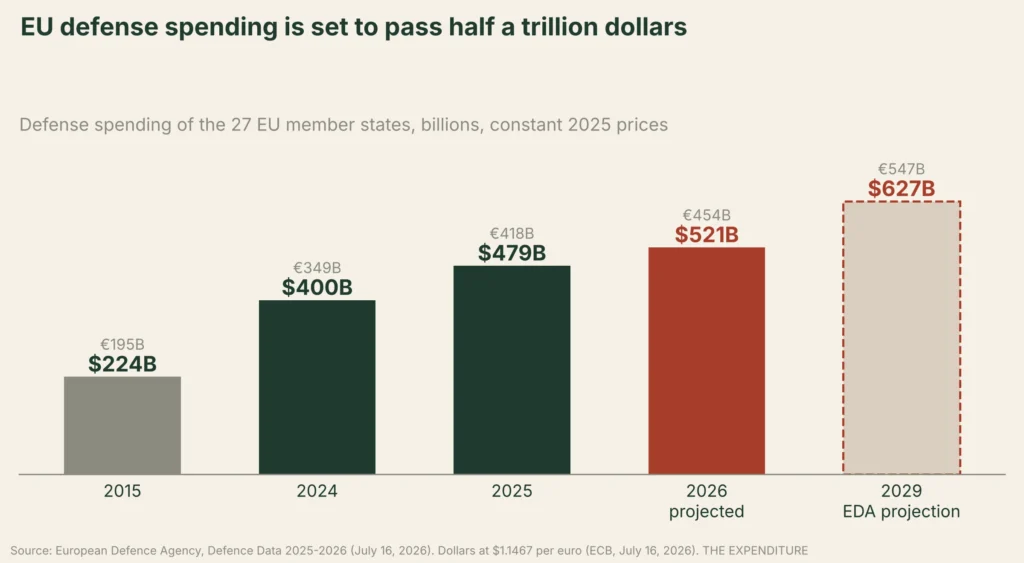
On July 16, 2026, the European Defence Agency published its Defence Data 2025-2026 report. The 27 EU member states spent $479 billion (€418 billion) on defense in 2025, 20% more than in 2024, and they plan to spend $521 billion (€454 billion) in 2026. Europe has been rearming for several years, but never this fast.
What the European Defence Agency found
Spending in 2025 equaled 2.2% of the EU’s combined GDP, and is projected to reach 2.4% in 2026. In constant 2025 prices, it has risen 47% since 2022 and more than doubled since 2015, when it stood at €195 billion.
The breadth of the increase is as striking as its size. In 2025, 23 of the 27 member states spent at least 2% of GDP on defense, against 13 a year earlier, and 15 raised their budgets by more than 10%.
More of the money is going to equipment rather than running costs. Procurement of new equipment reached $132 billion (€115 billion) in 2025, up 26%, and defense investment is expected to make up 36% of total spending in 2026. Research and development is set to rise from $19.5 billion (€17 billion) to $22.9 billion (€20 billion). Only 24% of equipment spending, however, was bought jointly with other countries.
“EU Member States are making unprecedented investments in defence,” said André Denk, the agency’s chief executive. If current trends hold, the EDA projects spending could reach $627 billion (€547 billion) by 2029.
Who is spending what
The answer depends on the measure. In absolute terms, Germany is Europe’s largest spender: $109 billion (€95 billion) in 2025, or 2.14% of GDP, rising to a planned $134 billion (€117.2 billion) in 2026, according to the European Parliamentary Research Service. Germany plans to reach $186 billion (€162 billion) by 2029.
As a share of the economy, Poland leads. Its 2026 budget allocates 200 billion zlotys, about $53 billion, to defense, equal to 4.8% of GDP, the highest ratio in NATO. In 2025, it was already spending 4.48%, ahead of Lithuania (4.00%), Latvia (3.73%) and Estonia (3.38%).
France has set its 2026 defense budget at $78.5 billion (€68.5 billion), or 2.25% of GDP. Italy and Spain have both reached 2%, in part by reclassifying security spending that was previously counted elsewhere, according to the EPRS.
How this compares with the two largest spenders in the world is the subject of US vs China defense spending. Together, the 27 EU states now spend more than half as much as the United States.
The $172 billion loan program
Beyond national budgets, the European Commission has created a joint borrowing tool, SAFE (Security Action for Europe), which lends up to $172 billion (€150 billion) to member states that buy defense equipment together. It is part of the Commission’s wider Readiness 2030 plan, which aims to mobilize up to $917 billion (€800 billion) for defense.
On January 15, 2026, the Commission approved the first wave of SAFE plans, for eight countries: Belgium, Bulgaria, Denmark, Spain, Croatia, Cyprus, Portugal and Romania. Together they are entitled to about $43.6 billion (€38 billion) in long-term, low-cost loans. Romania has the largest allocation in the group, $19.1 billion (€16.68 billion), and Cyprus the smallest, $1.4 billion (€1.18 billion). The Commission said first payments were expected in March 2026, with the remaining countries to follow.
What the industry has signed in 2026
Governments are not the only ones scaling up. The year’s agreements show where the money is going.
- January 22: BAE Systems won a £453.5 million contract from the UK Ministry of Defence for full-scale production of the ECRS Mk2 radar for the Royal Air Force’s Typhoon fighters.
- January: Rheinmetall and MBDA agreed to form a joint venture for naval laser weapons.
- April 13: Rheinmetall and Destinus formed a joint venture for missile systems.
- July 7: At the NATO summit’s defense industry forum in Ankara, Lockheed Martin and Rheinmetall signed a memorandum of understanding to produce ATACMS missiles in Europe, at Rheinmetall’s site in Unterlüß, Germany. It would be the first production line for the missile outside the United States. Production of rocket motors and missile components could begin as early as 2027, and Rheinmetall estimates European and Ukrainian demand at 600 to 800 missiles a year. The plan still needs US government approval for the technology transfer.
What to watch
The EDA’s 2029 projection assumes the current pace holds. The first test is whether the 2026 budgets are spent as planned, and whether the share of equipment bought jointly, now under a quarter, rises as SAFE loans are paid out.
Frequently asked questions
About $521 billion (€454 billion), or 2.4% of GDP, according to the European Defence Agency.
$479 billion (€418 billion), 20% more than in 2024.
Germany in absolute terms, $109 billion (€95 billion) in 2025. Poland as a share of its economy, with 4.8% of GDP planned for 2026.
23 of 27 in 2025, against 13 in 2024.
An EU loan program of up to $172 billion (€150 billion) for countries that buy defense equipment together. The first eight countries were approved on January 15, 2026.
At Rheinmetall's site in Unterlüß, Germany, under a memorandum signed with Lockheed Martin on July 7, 2026.
Notes. Euro figures are converted at $1.1467 per euro, the ECB reference rate on July 16, 2026, the day the EDA report was published (Banca d’Italia). Poland’s 200 billion zlotys are converted at 4.3285 zlotys per euro on the same date. EDA totals are in constant 2025 prices. The comparison with the United States uses the figures in our US vs China article.
Sources
- European Defence Agency, “EU defence spending: €418 billion in 2025, projected to €454 billion in 2026,” July 16, 2026: https://eda.europa.eu/news-and-events/news/2026/07/16/eu-defence-spending—418-billion-in-2025–projected-to–454-billion-in-2026
- European Defence Agency, Defence Data 2025-2026: https://eda.europa.eu/docs/default-source/eda-publications/2026-eda_defencedata_webpublic.pdf
- EDR Magazine, “EU defence spending hits €418 BN in 2025, set for €454 BN in 2026”: https://www.edrmagazine.eu/eu-defence-spending-hits-e418-bn-in-2025-set-for-e454-bn-in-2026
- European Parliamentary Research Service, “EU Member States’ defence budgets,” March 9, 2026: https://epthinktank.eu/2026/03/09/eu-member-states-defence-budgets-2/
- Militär Aktuell, “Poland plans record defense spending of 4.8 percent of GDP”: https://militaeraktuell.at/en/poland-plans-record-defense-spending-of-4-8-percent-of-gdp/
- European Commission, “Commission approves first wave of defence funding for eight Member States under SAFE,” January 15, 2026: https://defence-industry-space.ec.europa.eu/commission-approves-first-wave-defence-funding-eight-member-states-under-safe-2026-01-15_en
- Lockheed Martin, “Lockheed Martin and Rheinmetall move forward with ATACMS co-production in Europe,” July 7, 2026: https://investors.lockheedmartin.com/news-releases/news-release-details/lockheed-martin-and-rheinmetall-move-forward-atacms-co
- Defense News, “Germany set to become first international site for ATACMS missile production,” July 7, 2026: https://www.defensenews.com/global/europe/2026/07/07/germany-set-to-become-first-international-site-for-atacms-missile-production/
- Naval News, “Rheinmetall and MBDA to establish a joint venture for naval laser weapon,” January 2026: https://www.navalnews.com/naval-news/2026/01/rheinmetall-and-mbda-to-establish-a-joint-venture-for-naval-laser-weapon/
- Rheinmetall, “Rheinmetall and Destinus form joint venture for missile systems,” April 13, 2026: https://www.rheinmetall.com/en/media/news-watch/news/2026/04/2026-04-13-rheinmetall-and-destinus-form-joint-venture-for-missile-systems
- UK Defence Equipment and Support, “State-of-the-art radar production contract secures 1,300 UK defence jobs,” January 22, 2026: https://des.mod.uk/state-of-the-art-radar-production-contract-secures-1300-uk-defence-jobs/
- Banca d’Italia, euro reference rates, July 16, 2026: https://www.bancaditalia.it/compiti/operazioni-cambi/cambio/cambi_rif_20260716