Record Data Sheet
China’s state policy banks have begun deploying the first funds of the 2026 policy financing instrument. On September 1, the Zhejiang branch of the Agricultural Development Bank of China put 300 million yuan into a pumped-storage power station, and China Development Bank released 460 million yuan for projects in battery manufacturing, nickel-chromium materials and transport infrastructure. The total for the year is 800 billion yuan, about $119.2 billion. What that money does is less a spending story than a financial engineering story, and the engineering is the interesting part.
What this money is not
It is not a loan to a project, and it is not a grant. China’s “new-type policy-based financial instrument” provides capital through equity investments, shareholder loans and similar means, strengthening a project’s own capital base, the slice a project needs before banks will lend against it. Chinese rules generally require projects to hold a minimum share of their own capital before commercial loans can follow, and many viable projects in slower-growing regions cannot find investors for that first slice. The instrument supplies it.
The money is raised by China’s three policy banks, China Development Bank, the Agricultural Development Bank of China and the Export-Import Bank of China, through their own bonds, rather than by the central government issuing sovereign debt. In 2025, the three split 500 billion yuan: 250 billion from China Development Bank, 150 billion from the Agricultural Development Bank and 100 billion from the Export-Import Bank. Because the debt sits on the banks’ books, not the treasury’s or local governments’, the spending does not appear in official government debt figures, even though it is directed by the state.
The multiplier is the point
When the 2025 round of 500 billion yuan was rolled out in October 2025, the government said it was expected to stimulate more than 7 trillion yuan of investment, about fourteen times the capital injected. For 2026, some market analysts have projected that total investment could reach 10 trillion to 11 trillion yuan, about $1.5 trillion to $1.6 trillion, a multiple of roughly thirteen. That projection comes from analyst commentary rather than an official figure. Both are expectations, not results.
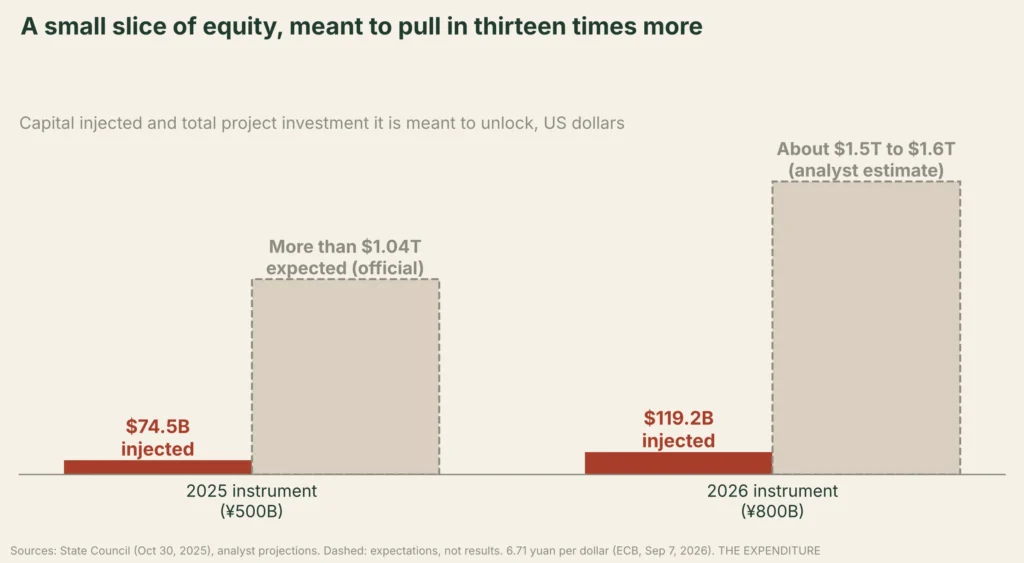
The injected capital is not the loan. It is the credibility that unlocks the loan. If the multiple holds anywhere near those levels, China is using about $119 billion of policy bank capital to try to set off investment on the order of a trillion dollars or more.
Where the money goes in 2026
This year’s round is weighted toward new energy, the digital economy, artificial intelligence and the low-altitude economy of drones and electric aircraft, a shift from the infrastructure focus of earlier rounds. The first disbursements went to a pumped-storage plant, batteries, advanced materials and transport. The banks expect to disburse the full amount within one to two months of the start in early September.
Why it exists now
China’s own investment data provides the backdrop. Fixed-asset investment fell 6.7% year on year in the first seven months of 2026, to 26.03 trillion yuan, worse than the 5.7% decline in the first half. Property investment fell 19.2% and infrastructure investment 3.6%. GDP grew 4.3% in the second quarter, the weakest pace in more than three years. A tool designed to make capital-short projects bankable is a direct response to that slowdown, not a routine annual allocation. Analysts have noted that the late start, with applications opening only in August, could limit its effect this year.
Sizing it against an economy
About $119 billion is almost the entire 2024 gross domestic product of Ecuador, about $124 billion according to World Bank data. China’s capital injection alone is close to a South American economy’s annual output, before any of the bank lending or private capital it is designed to attract is added on top.
Why it matters
The mechanism travels beyond China. A government facing weak private investment can spend directly, cut interest rates, or do what China is doing: inject a relatively small amount of capital at the exact point in a project’s financing that unlocks much larger bank and private money behind it. The multiple, not the headline injection, is the number that matters.
It is also a reminder that official government debt can understate the state’s footprint. Capital routed through policy banks issuing their own bonds can fund large state-directed investment while leaving the headline debt figures largely unchanged. For the scale of what China already spends on transport, see China, the US and India compared.
Figures we could not confirm
Several details in an earlier version of this article could not be confirmed and are listed as unconfirmed: first-batch funds sent to Yunnan, Sichuan and Xinjiang; a 2026 interest subsidy of 1.5 percentage points a year for up to two years on small business loans, capped at 50 million yuan per company; private investment falling by a steeper margin than total fixed-asset investment; and the analyst projection of 10 trillion to 11 trillion yuan of total investment for 2026, which we could not tie to a named source.
Frequently asked questions
800 billion yuan, about $119.2 billion, up from 500 billion yuan in 2025.
Neither. It provides capital through equity investments, shareholder loans and similar means, which strengthens a project's own capital base so banks will lend to it.
The 2025 round was expected to stimulate more than 7 trillion yuan. For 2026, some market analysts project 10 trillion to 11 trillion yuan, about $1.5 trillion to $1.6 trillion, an estimate we could not tie to an official source.
Not in official statistics. The money is raised by policy banks through their own bonds, not by the central government.
New energy, the digital economy, artificial intelligence and the low-altitude economy, alongside some infrastructure.
Fixed-asset investment fell 6.7% in the first seven months of 2026, and growth slowed to 4.3% in the second quarter.
Notes. Yuan figures are converted at about 6.71 yuan per dollar, derived from the ECB reference rates on September 7, 2026 (7.7995 yuan and $1.1622 per euro, Banca d’Italia). The multiples are our calculations from the official 2025 expectation and the analyst projection for 2026.
Sources
- World Bank via FRED, Gross Domestic Product for Ecuador: https://fred.stlouisfed.org/data/MKTGDPECA646NWDB
- The Standard, “China deploys first 2026 policy financing funds to spur investment,” September 2026: https://www.thestandard.com.hk/finance/article/341800/China-deploys-first-2026-policy-financing-funds-to-spur-investment
- State Council of China, 500 billion yuan policy-based financial instrument, October 30, 2025: https://english.www.gov.cn/news/202510/30/content_WS69031190c6d00ca5f9a072fc.html
- Mysteel, “NBS: China’s Jan-Jul FAI falls 6.7%, property investment slumps 19.2%,” August 17, 2026: https://www.mysteel.net/news/5136943-nbs-chinas-jan-jul-fai-falls-67-property-investment-slumps-192-yoy
- Business Today, “China’s fixed asset investment down 6.7% in first seven months,” August 17, 2026: https://www.businesstoday.com.my/2026/08/17/chinas-fixed-asset-investment-down-6-7-in-first-seven-months/
- Banca d’Italia, euro reference rates, September 7, 2026: https://www.bancaditalia.it/compiti/operazioni-cambi/cambio/cambi_rif_20260907