Record Data Sheet
On September 8, 2026, the UK government published its new Space Strategy, led by a headline figure of £7.8 billion in funding through 2030, according to the official announcement from the Department for Business and Trade and the Ministry of Defence. Tracing every individual funding line the government has published against that headline gets you to roughly £4.86 billion, about 62% of the total. Getting to that number required including a correction the government itself had to make days after the original announcement, after being asked to explain a figure that didn’t add up.
What the government actually itemized
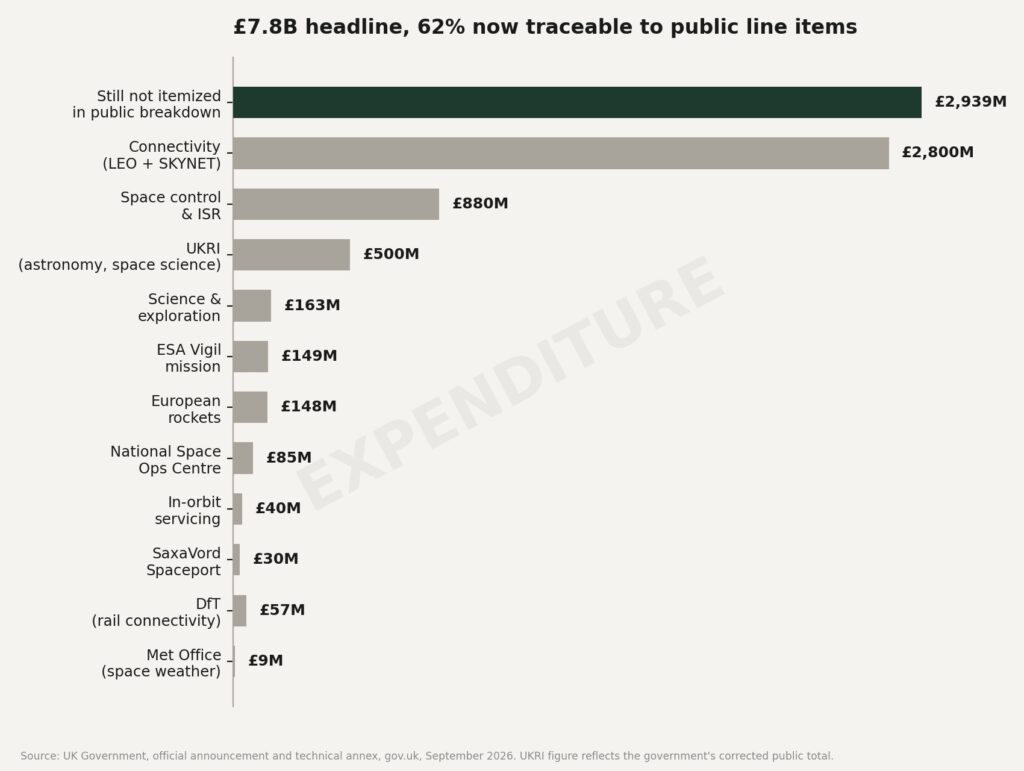
The largest single confirmed piece is £2.8 billion for connectivity, spanning both the Connectivity in Low Earth Orbit programme and the military’s SKYNET satellite communications system, according to the official release. Space control and intelligence, surveillance, and reconnaissance capabilities account for £880 million. UK Research and Innovation’s contribution to astronomy and space science accounts for more than £500 million. Beyond those three, the published figures get considerably smaller: £163 million for science and exploration missions, including the UK’s contribution to the Rosalind Franklin Mars rover, £149 million for the European Space Agency’s Vigil space weather mission, £148 million for European rocket programmes, £85 million for a National Space Operations Centre, £57 million from the Department for Transport for rail connectivity applications, £40 million for in-orbit servicing and manufacturing capability, £30 million for the SaxaVord Spaceport in Shetland, and £9 million from the Met Office for space weather forecasting.
Sum every one of those figures and the total comes to roughly £4.861 billion, against a headline of £7.8 billion, leaving about £2.94 billion, 38% of the total, without a specific public line item this publication could locate. Separately, government officials have described more than £3 billion of the total package as allocated to defence-related space capabilities specifically, a figure that likely overlaps substantially with the £880 million ISR line and a portion of the £2.8 billion connectivity figure, given SKYNET is itself a military system, rather than representing additional money on top of what’s itemized above.
The correction that improves this story
The UKRI figure above is not the number the government gave when the strategy was first published. Initial coverage of the announcement cited UKRI’s contribution at £190 million. Research Professional News, a specialist publication covering research funding, asked the government to clarify that figure against UKRI’s own portfolio of space-related programmes, and the government subsequently confirmed the real total was more than £500 million, over 2.6 times the originally cited figure.
That correction matters beyond the £310 million difference. It means the government’s own initial public accounting of its own £7.8 billion strategy undercounted one of its own funding partners by a wide margin, only fixed after outside scrutiny. For anyone trying to verify a headline government spending figure against its component parts, that is direct evidence the underlying paperwork was incomplete even by the government’s own later admission, not merely difficult for outsiders to parse.
What this buys against the size of the sector it’s meant to grow
The UK’s space sector currently generates roughly £18.6 billion in income and supports more than 55,000 jobs, according to the government’s own figures cited alongside the strategy. Measured against that existing base, £7.8 billion in public investment through 2030, taken at face value, equals roughly 42% of the sector’s current annual income, spread across several years rather than committed in one go. It is a meaningful public bet on growing an existing, already sizeable industry rather than an attempt to build a space sector from nothing.
Sizing £7.8 billion against something concrete
At current exchange rates, £7.8 billion converts to approximately 10.5 billion dollars. That is close to the entire 2024 gross domestic product of Malta, which the World Bank put at approximately 21.7 billion dollars, putting the UK’s full space strategy commitment at just under half of an entire EU member state’s annual economic output, spread over roughly four years rather than spent in a single year.
Why we consider this relevant
Government spending headlines are built to be quoted as a single number, and single numbers are precisely where the most useful questions get lost. Here, tracing the published components of a £7.8 billion figure surfaces a real, government-acknowledged correction along the way, evidence that even careful public reporting on this strategy required going back to the source twice, not once. Readers evaluating any government spending announcement, in any country, owe themselves the same exercise performed here: total the published line items, compare that sum to the headline, and treat that remaining gap as a specific, nameable question rather than rounding error, understanding that the itemized total itself may need revisiting as more of the underlying detail becomes public.
Frequently asked questions
How much is the UK spending on its new Space Strategy?
£7.8 billion through 2030, according to the official government announcement published September 8, 2026.
How much of that figure is traceable to specific published line items?
Approximately £4.86 billion, based on individual funding figures the government has published, including £2.8 billion for connectivity, £880 million for space control and intelligence capabilities,
more than £500 million from UK Research and Innovation, and smaller amounts for science missions, rocket programmes, spaceport infrastructure, and space weather forecasting.
Did the government get any of its own numbers wrong?
Yes. UK Research and Innovation’s contribution was initially cited at £190 million. After a specialist publication questioned the figure, the government confirmed the real total was more than £500 million.
How big is the UK space sector today?
It generates approximately £18.6 billion in annual income and supports more than 55,000 jobs, according to the government’s own figures cited alongside the strategy.
How much of the £7.8 billion is specifically for defence?
UK officials have described more than £3 billion of the package as allocated to defence-related space capabilities, though how that figure relates to the individually itemized line items, several of which arethemselves defence-linked, is not fully clarified in the public documentation.
What replaced this strategy?
The 2026 Space Strategy replaces the UK’s 2021 National Space Strategy, according to the official government announcement.
Sources
- UK Government, Department for Business and Trade and Ministry of Defence, official announcement, “New Space Strategy will bolster UK defences against threats from space,” gov.uk, September 8, 2026
- UK Government, technical annex to the Space Strategy, gov.uk, September 2026
- UK Research and Innovation, corrected public figure on its space science and astronomy funding contribution, as confirmed to Research Professional News following the strategy’s publication
- UK Space Agency, figures on UK space sector income and employment, cited in the official Space Strategy announcement
- The World Bank, GDP data for Malta (current US dollars, 2024), World Bank national accounts data