Record Data Sheet
On July 9, Micron announced a $50 billion increase to its US investment plan. That brings its total commitment through 2035 to more than $250 billion. The company made the announcement in Clay, New York, the same day it poured the first concrete for its new fab, more than a quarter ahead of schedule.
What Micron actually announced
Micron Technology is the largest memory chipmaker (DRAM and NAND) in the United States. Back in June 2025, the company had already announced a roughly $200 billion investment plan for the country. On July 9, 2026, it raised that number to more than $250 billion, an increase of about $50 billion, according to the company itself.
The announcement landed alongside a construction milestone. Micron marked the first concrete pour at its new plant in Clay, near Syracuse, New York. That facility is on track to become the largest semiconductor manufacturing site in US history, according to the company. The project calls for up to four fabs in New York.
Micron CEO Sanjay Mehrotra tied the decision to the moment the country is in. He said that as America celebrates its 250th anniversary, data and memory have become the backbone of the modern economy. Commerce Secretary Howard Lutnick and New York Governor Kathy Hochul both attended the event.
Why Micron is spending this much right now
The short answer is AI memory demand. High bandwidth memory chips have become essential for training and running large AI models, and that demand has sent Micron’s revenue soaring. The company’s stock is up more than 250% so far in 2026, according to Barchart Times, and Micron crossed a $1 trillion market cap for the first time this year.
Micron also set a concrete target: producing 40% of its DRAM on US soil. That number reflects both market demand and pressure from Washington to cut the country’s reliance on chip manufacturing done overseas.
Alongside the main expansion, Micron announced another $3 billion to strengthen its domestic supply chain. Of that, $500 million is strategic financing for GlobalWafers, a Taiwan based silicon wafer maker, to expand its Texas facilities. The deal also includes a ten year supply agreement for raw silicon wafers.
How it stacks up against other big semiconductor investments
Micron’s number lands just weeks after TSMC raised its own US investment to $265 billion. Taken together, the two announcements show just how big this race to manufacture chips on American soil has gotten.
Here is how the two compare against the other major players.
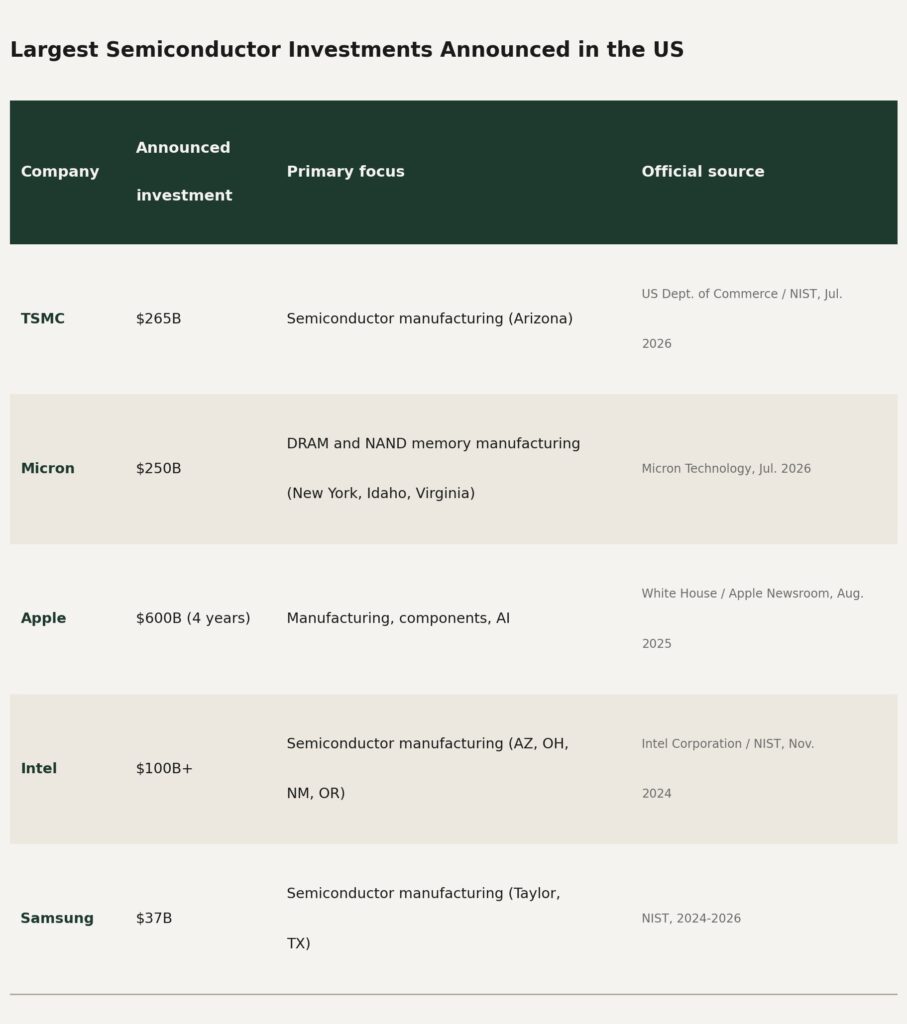
One distinction is worth making clear. TSMC makes logic chips, the kind of processor that runs calculations. Micron makes memory, the component that stores and moves the data those processors need. They are different pieces of the same supply chain, and both have become equally critical since AI demand took off for each of them.
The expected economic impact
According to Micron’s own figures, the full scope of its US expansion is expected to support more than 90,000 jobs. In New York alone, the project is projected to create about 50,000 jobs, 9,000 of which would be direct Micron positions.
The company already has early results to point to. In less than six months since breaking ground in January 2026, Micron has directed roughly $675 million to New York based contractors and suppliers. More than 80% of on site workers are New York residents. Micron has also committed more than $50 million to community programs across Central New York, covering workforce training, STEM education, housing, and support for veterans.
Outside New York, Micron is moving forward in parallel in Idaho, where it expects first wafer output by mid 2027, and in Virginia, where it has already launched initial production of its 1αDDR4 technology for the automotive, industrial, medical, aerospace, and defense sectors.
Why this matters for the AI race
No AI model runs without enough memory to move its data fast enough. High bandwidth memory chips are, alongside processors, one of the two physical bottlenecks of this entire industry. With TSMC building more processors on US soil and Micron building more memory, the country now has something it didn’t have just a few years ago: direct control over both core pieces of AI hardware, not just the chip designs themselves.
Frequently asked questions
How much is Micron planning to invest in the United States? More than $250 billion through 2035, according to Micron Technology’s own announcement on July 9, 2026.
How much bigger is this than its previous plan? About $50 billion more than the roughly $200 billion plan Micron had announced back in June 2025.
How many jobs will Micron’s investment create? More than 90,000 jobs nationwide, according to Micron, with about 50,000 of those tied to the New York project alone, including 9,000 direct Micron positions.
Where is Micron building its new plants? Mainly in Clay, New York, near Syracuse, with up to four fabs planned there. It also has active projects in Idaho and Virginia.
How does this compare to TSMC’s US investment? It’s slightly smaller. TSMC has committed $265 billion, compared to Micron’s $250 billion, though the two make very different products: TSMC builds processors, Micron builds memory.
Why is memory investment growing so fast right now? Because of demand for high bandwidth memory chips, which are essential for training and running AI models. Micron’s stock is up more than 250% so far in 2026, according to Barchart Times.
What else did Micron announce alongside this expansion? Up to $3 billion to strengthen its domestic supply chain, including $500 million in strategic financing for GlobalWafers, a Taiwan based silicon wafer manufacturer.