Record Data Sheet
On July 16, the Korean government said SK, GS and Naver could be part of a private investment program worth roughly ₩550 trillion to build gigawatt scale AI data centers. The same government plan called for domestic capabilities across AI chips, infrastructure, networks, software and services, alongside next generation semiconductor work at the 1 nanometer level and advanced stacked memory.
That is already an extraordinary capital commitment. But it is only one layer of the strategy.
The deeper program is to make sure that Korea does not build an AI economy that depends on foreign suppliers for every critical input. Seoul is simultaneously increasing public funding for AI, quantum technology, advanced biotechnology, materials and next generation energy, while setting physical targets for lunar missions, satellite communications, small modular reactors and brain computer interfaces.
The first number to understand is ₩10.1 trillion
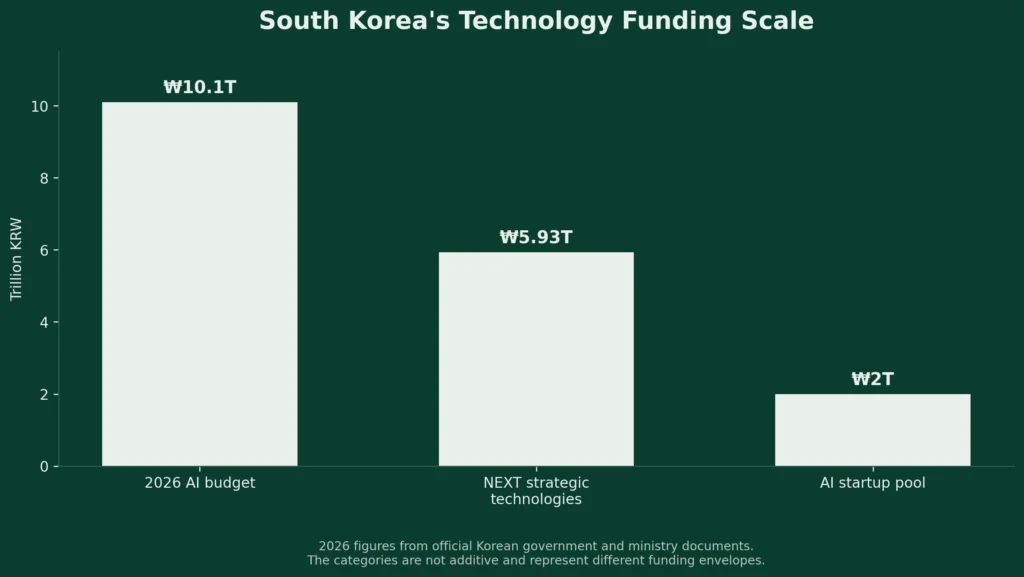
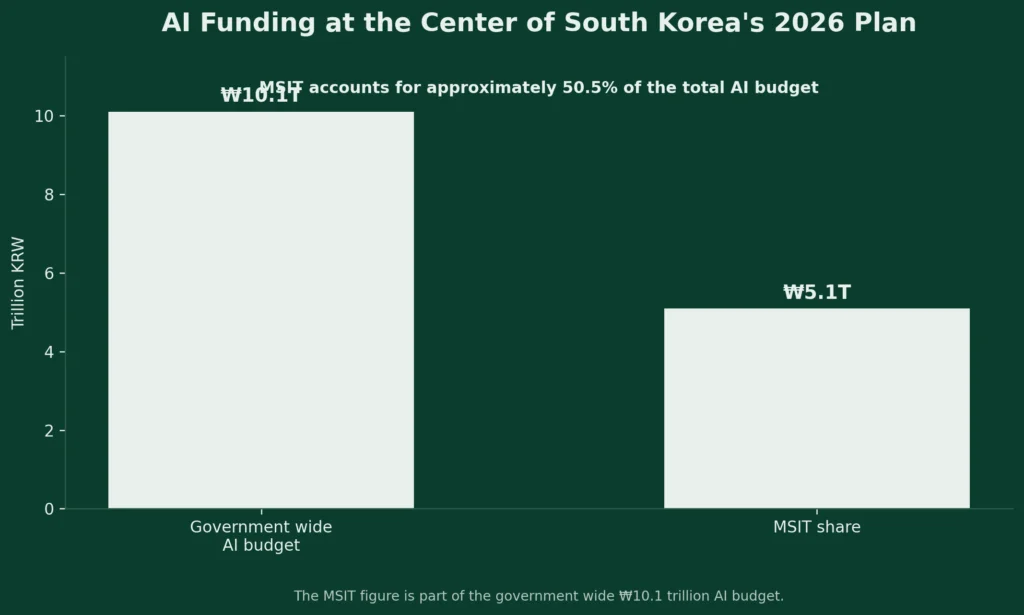
The Korean government has set a total 2026 AI budget of ₩10.1 trillion across ministries. Within that envelope, the Ministry of Science and ICT is responsible for about ₩5.1 trillion. Its own 2026 budget proposal totals ₩23.7 trillion, including ₩11.8 trillion for research and development.
Those figures matter because they show that AI is no longer being treated as a narrow technology program. The allocation covers computing infrastructure, advanced GPUs, AI semiconductors, physical AI, regional AI hubs, public sector adoption, cybersecurity and talent.
MSIT says it plans to secure an additional 15,000 advanced GPUs in 2026, bringing the cumulative figure to 37,000 units when previous procurement is included. It also plans a National AI Computing Center and new network infrastructure designed for AI workloads.
For a CFO, this is more important than a simple budget headline. Korea is attempting to reduce the fixed cost of access to computing. The economic question is whether more domestic compute lowers the capital barrier for Korean companies, researchers and startups, or whether the public sector ends up subsidizing capacity that is difficult to commercialize
Then comes the second layer: the technologies Korea wants to own
MSIT’s 2026 proposal allocates ₩5.93 trillion to NEXT strategic technologies, up 27.8 percent from the previous year. The portfolio includes semiconductors, displays, secondary batteries, advanced biotechnology, quantum technology, materials and next generation energy.
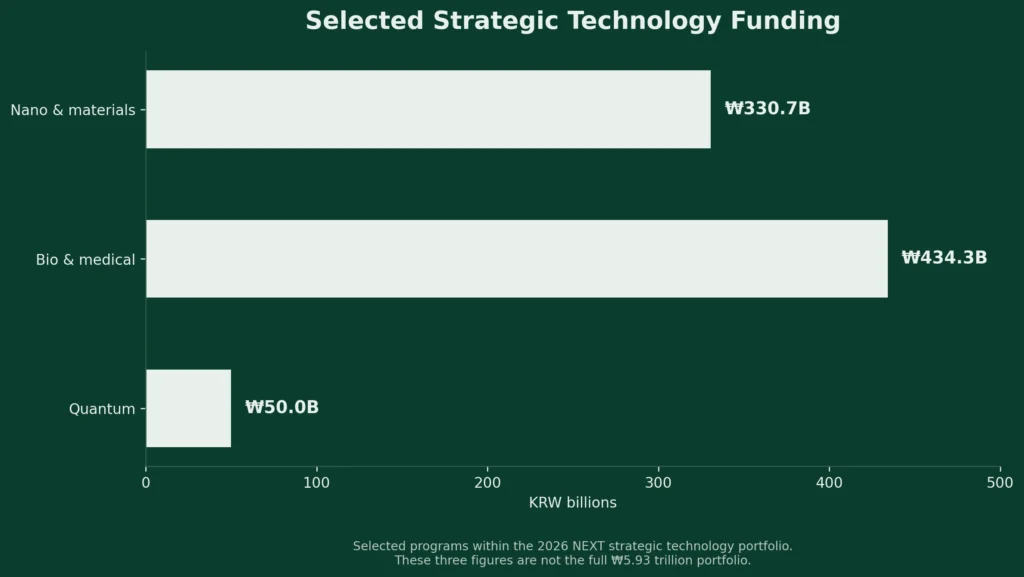
The important detail is composition. Quantum flagship funding rises to ₩50.0 billion. Bio and medical technology development rises to ₩434.3 billion. Nano and materials technology development rises to ₩330.7 billion. New programs also target AI bio innovation and next generation semiconductor technologies.
This is a portfolio approach. Seoul is not trying to predict one winner. It is buying exposure to several technologies that could become strategic industries while deliberately strengthening the enabling layer beneath them.
Quantum is being treated as an industrial capability
Korea wants a domestic 50 qubit quantum computer during 2026 and an error corrected 100 qubit system by 2029.
The interesting part is not whether 100 qubits makes Korea a global commercial leader. It does not, by itself, answer that question. The interesting part is the attempt to build the manufacturing and research capability needed to move from laboratory demonstrations toward a domestic industrial base.
For finance leaders, this changes the way the investment should be interpreted. The state is funding an option on a future industry. The near term return is not necessarily revenue. It is the creation of know how, intellectual property, talent and supplier relationships that make later private investment less risky.
Energy is becoming a technology input
Korea’s technology strategy also recognizes a constraint that is easy to overlook in AI discussions: electricity.
The government is pushing small modular reactors, fusion and next generation renewable technologies while AI data centers and advanced semiconductor manufacturing increase power demand. Korea says it is pursuing a commercial SMR project, preparing a larger public and private project around an SMR powered vessel, and designing a fusion demonstration facility with a target of completing the demonstrator in 2035.
The economic logic is straightforward. If compute becomes strategic infrastructure, reliable low carbon electricity becomes strategic infrastructure too. The result is that Korea’s AI strategy, energy strategy and industrial policy increasingly overlap.
The space program is not just about the Moon
Korea wants to launch a small lunar lander in 2030 and a lunar orbit communications satellite in 2029. It also wants a Korean low Earth orbit satellite communications network by 2035. The government’s broader aerospace strategy targets 1,200 aerospace companies and a 3.0 percent global market share by 2035.
Again, the headline mission is less interesting than the industrial architecture. A lunar program forces investment in launch systems, propulsion, communications, materials, testing, software, sensing and advanced manufacturing. Those capabilities can spill into commercial aerospace and defense.
The people behind the strategy
At the political level, the program sits under President Lee Jae Myung’s administration.
The most relevant technocratic figure is Bae Kyunghoon, Deputy Prime Minister and Minister of Science and ICT. His background is unusually aligned with the government’s approach. Before becoming minister, he was President of LG AI Research in 2021, after holding AI and technology roles at LG, SK Telecom and Samsung Thales.
That history helps explain why the strategy repeatedly links research, computing infrastructure, industrial application and commercialisation instead of treating basic research as a separate silo.
On the industrial policy side, Minister Kim Jeonggwan leads the Ministry of Trade, Industry and Energy, the institution responsible for much of Korea’s industrial, trade, energy and supply chain agenda.
The corporate side is equally important. The government’s AI data center plan specifically identifies SK, GS and Naver as participants in a private investment program that could reach ₩550 trillion. The stated objective is not only to build data centers, but also to localize core equipment and build supporting clusters around talent, testing, finance and exports.
What the money is really trying to buy
At the bottom sits public research funding. Above it sits infrastructure such as compute, data centers, power systems and test facilities. Around that sits supplier development, strategic stockpiles and industrial policy. At the top sits private capital, which can scale technologies once the risk profile becomes acceptable.
This architecture matters because South Korea has a structural advantage and a structural weakness at the same time. Its large industrial companies can build at extraordinary scale, but a high tech economy remains exposed when key materials, equipment or upstream technologies are controlled abroad.
The policy therefore tries to move Korea further along the value chain. The objective is not simply to become better at assembling a finished product. It is to own more of the inputs that determine whether the finished product can be built at all.
The startup angle is also deliberate
Korea is not relying only on conglomerates. The government says the joint public and private investment pool supporting AI startups is targeted to reach ₩2 trillion during 2026, alongside a new ₩20 billion venture fund focused on early stage AI startups.
This is small beside the ₩550 trillion data center figure, and that comparison is revealing. The huge number represents infrastructure and corporate investment. The smaller number is intended to create a pipeline of new companies that could eventually supply or complement that infrastructure.
For investors, the question is whether those two pools of capital connect. A healthy ecosystem needs both large buyers and new suppliers. Without the first, startups cannot scale. Without the second, incumbents eventually import the most valuable technology.
The strategic trade off
There is a clear risk in this approach: governments can identify promising technologies long before markets reveal which ones are economically viable.
A program spread across quantum computing, fusion, SMRs, space, biotechnology, AI and advanced materials can generate technological options, but it can also dilute capital. The performance test therefore cannot simply be whether Korea achieves each technical milestone.
A more useful scorecard would track four things: private capital attracted per won of public support, export revenue created, domestic share of critical inputs, and the number of globally competitive suppliers that emerge from the program.
Those are the metrics that would tell us whether Korea is building an industrial advantage or simply building an impressive collection of publicly funded projects.
The number to watch
The most important figure may not be ₩10.1 trillion, ₩23.7 trillion or even ₩550 trillion.
It is the amount of private capital that eventually becomes commercially productive because the government was willing to absorb part of the early technology and infrastructure risk.
That is the core economic bet behind South Korea’s current technology policy. The country is using public capital to reduce uncertainty, corporate capital to build scale, and industrial policy to close supply chain gaps.
If the system works, the visible result will not simply be more AI data centers, another semiconductor process or a lunar landing. It will be a broader industrial base capable of supplying the next generation of technologies from within Korea.
Frequently Asked Questions
South Korea’s 2026 government R&D budget was set at ₩35.3 trillion, up 19.3% from ₩29.6 trillion in 2025. Of that amount, ₩30.1 trillion is classified as major R&D overseen through the Presidential Advisory Council on Science and Technology.
The government’s 2026 major R&D allocation includes ₩2.3 trillion for artificial intelligence, an increase of 106.1% from the previous year. This is a separate R&D classification from the broader ₩10.1 trillion government wide AI budget, so the two figures should not be added together.
The government plans to secure a cumulative 37,000 GPUs by 2026. This includes 15,000 GPUs through government procurement and 9,000 through Supercomputer No. 6, with the broader total incorporating previously secured capacity. The resources are intended for national projects, public AI services, startups and regional AI transformation initiatives.
The government has previously outlined a National AI Computing Center with a budget of up to ₩2 trillion, developed through public private investment. A subsequent implementation plan says the center is intended to add more than 15,000 GPUs by 2028, alongside continued expansion of Korea’s AI computing infrastructure.
South Korea’s Ministry of Science and ICT says the ₩550 trillion private investment is associated with companies including SK, GS and Naver. The government describes the investment as supporting gigawatt scale, ultra large AI data centers and says it will provide administrative support for electricity, land, permits and licensing. The government source does not provide an individual allocation of the ₩550 trillion among those companies, so the figure should not be attributed to any one company.
South Korea’s national AI strategy targets 70% AI adoption across industry and 95% adoption in the public sector by 2030. The government has also estimated that nationwide AI deployment could generate approximately ₩310 trillion in economic impact by 2026. These are government targets and projections rather than realized economic output.
The two figures represent fundamentally different capital pools. The ₩10.1 trillion figure is a government AI budget for 2026, while the ₩550 trillion figure refers to private investment in large AI data center infrastructure. They also differ in timing, scope and capital provider. Treating the two figures as equivalent annual expenditures would therefore be misleading.