Record Data Sheet
On August 23, 2026, Alibaba said it would raise HK$80 billion, about $10.2 billion, by selling new shares in Hong Kong, with every dollar earmarked for artificial intelligence. Read the announcement next to Alibaba’s own quarterly results from the same week and a second figure appears: the company already spent roughly $10 billion on capital expenditure in a single quarter, April through June, up 75% from a year earlier. One number is money Alibaba is about to raise. The other is money it already spent. They happen to be almost the same size, and that coincidence is worth untangling rather than glossing over.
What Alibaba actually announced
Alibaba will issue 710 million new shares at HK$112.70 each, a 3.6% discount to Friday’s closing price, according to the company’s own statement. All net proceeds go toward what Alibaba calls its “full stack” AI capabilities, a category spanning chips, computing infrastructure, and the models and applications built on top of them. The company did not break the $10.2 billion down by category.
The deal is structured as an offshore placement, not registered under US securities law, according to Alibaba’s own disclosure, meaning American investors cannot participate.
The spending that was already happening
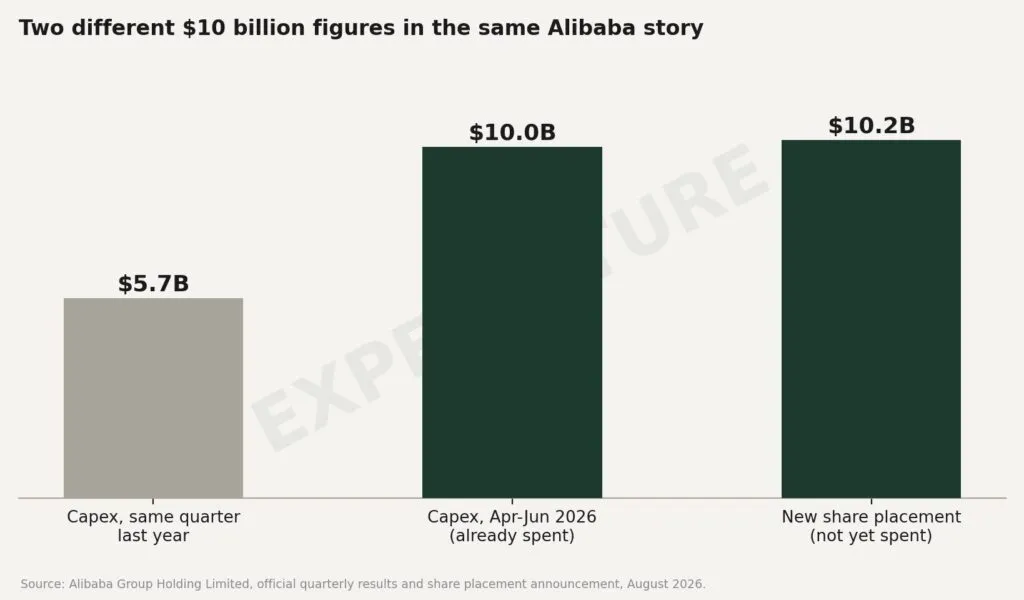
A few days before the placement, Alibaba reported quarterly revenue of nearly $40 billion, up 9% year over year, with its cloud and AI business growing revenue 45% over the same quarter last year. Capital expenditure for the quarter came in at 67.7 billion yuan, roughly $10 billion, up 75% from the equivalent quarter a year earlier.
That $10 billion was not raised through this share placement. It came out of Alibaba’s existing cash flow and balance sheet, spent before the new shares were even announced. The share sale is capital for what comes next, not a reimbursement for what already happened. Treating the $10.2 billion raise as the full measure of Alibaba’s AI commitment undercounts the company’s actual spending by roughly half once this quarter’s capex is added back in.
Why raise equity instead of just spending from cash flow
Alibaba could, in principle, keep funding this expansion the way it funded the most recent quarter, from operating cash flow and existing reserves. Choosing to raise external equity instead signals something about the scale Alibaba expects ahead: either the spending pace itself is set to accelerate further, or the company wants a larger cash buffer before committing to that pace, rather than funding it quarter by quarter out of operations alone.
It is worth noting what Alibaba did not choose. It raised equity, not debt. Equity dilutes existing shareholders immediately, since the new shares represent a real claim on the same company divided among more shares outstanding. Debt would have preserved ownership percentages but added fixed repayment obligations regardless of how the AI spending eventually performs. Alibaba’s own statement does not explain why it chose this structure over debt financing.
What the market did with that information
According to Hong Kong Stock Exchange trading data, Alibaba shares fell 8.5% the trading day after the placement was announced, a decline noticeably larger than the 3.6% discount at which the new shares were priced. A discount alone would explain a small mechanical drop. An 8.5% fall suggests the market was pricing in something beyond simple dilution math.
Sizing $10.2 billion against something concrete
Ten point two billion dollars is close to the entire annual gross domestic product of Iceland, which the World Bank put at approximately $30 billion in 2024, making Alibaba’s single-share placement worth roughly a third of an entire developed national economy’s yearly output. It is also worth comparing to the scale of capital spending disclosed by major US technology companies in their own 2026 guidance: Amazon’s own guidance points to about $220 billion in 2026 capital expenditure, Alphabet’s own guidance points to between $195 billion and $205 billion, Microsoft’s own guidance points to roughly $175 billion, and Meta’s own guidance points to between $130 billion and $145 billion. Summed together, those four companies’ own individually disclosed figures total somewhere around $720 billion to $745 billion for 2026, a figure this publication calculated by adding each company’s own guidance rather than one drawn from a single consolidated source. Alibaba’s new raise alone equals roughly 1.4% of that combined total.
Why we consider this relevant
The habit worth building from this story is checking whether a headline capital raise is genuinely new money or a figure that overlaps with spending already disclosed elsewhere in the same company’s own reporting. Here, two honestly reported $10 billion figures, one already spent, one not yet raised, sit one week apart in the same company’s disclosures and describe different things entirely. Collapsing them into a single “$10 billion for AI” headline, which most coverage of this event did, understates what Alibaba is actually committing to by close to half.
Frequently asked questions
Alibaba is raising $10.2 billion through a new Hong Kong share placement, announced August 23,
2026. Separately, its own quarterly results show it already spent roughly $10 billion on capital expenditure in the April to June 2026 quarter alone, before this placement was announced.
Alibaba’s official statement says all net proceeds will go toward its full stack AI capabilities, including chips, computing infrastructure, and AI model and application development, without a more specific category breakdown.
Shares fell 8.5% the following trading day, according to Hong Kong Stock Exchange trading data, more than the 3.6% pricing discount alone would explain.
Alibaba’s own statement did not explain the choice. Raising equity dilutes existing shareholders but avoids adding fixed debt repayment obligations, a structural tradeoff companies typically weigh based on how confident they are in near term cash flow relative to the scale of spending planned.
No. The deal is structured as an offshore transaction not registered under US securities law, according to Alibaba’s own disclosure, which excludes American investors from participating directly in this placement.
Sources
Alibaba Group Holding Limited, official statement on the HK$80 billion share placement, August 23, 2026
Alibaba Group Holding Limited, quarterly results announcement for the quarter ended June 30, 2026
Hong Kong Stock Exchange, official trading data on Alibaba share price movement, August 24, 2026
The World Bank, GDP data for Iceland (current US dollars, 2024), World Bank national accounts data
Amazon.com, Inc., Microsoft Corporation, Alphabet Inc., and Meta Platforms, Inc., own official 2026 capital expenditure guidance, as disclosed in each company’s own earnings releases and calls