Record Data Sheet
On September 15, 2026, The Coca-Cola Company said its U.S. system plans to invest $10 billion in new and expanded production, distribution and office facilities between 2026 and 2030. The word that matters is “system.” Coca-Cola’s chief financial officer, John Murphy, told Fortune that “the lion’s share” of the $10 billion represents the plans of its bottling partners, not Coca-Cola’s own spending.
What Coca-Cola announced
The company named projects in Rancho Cucamonga, California; Colorado Springs, Colorado; Indianapolis; Birmingham, Alabama; Coopersville, Michigan; St. Cloud, Minnesota; Orlando, Florida; and Webster, New York. It did not publish an allocation by project or a schedule by year.
The announcement came with an economic study commissioned by Coca-Cola, which found that the U.S. system contributed $85 billion to the country’s GDP in 2025, supported nearly 1 million jobs and spent about $37 billion with American suppliers. The system includes 61 independent bottlers, more than 70 production plants and hundreds of distribution centers.
Who actually spends the money
Coca-Cola runs an asset-light model. It owns the brands and sells concentrate; independent bottlers own most of the plants, trucks and warehouses that turn concentrate into drinks and get them to stores. That is why most of the $10 billion will not appear in The Coca-Cola Company’s own accounts. According to Murphy, only its capital-intensive businesses, notably the dairy brand Fairlife, count toward Coca-Cola’s own capital spending within the figure.
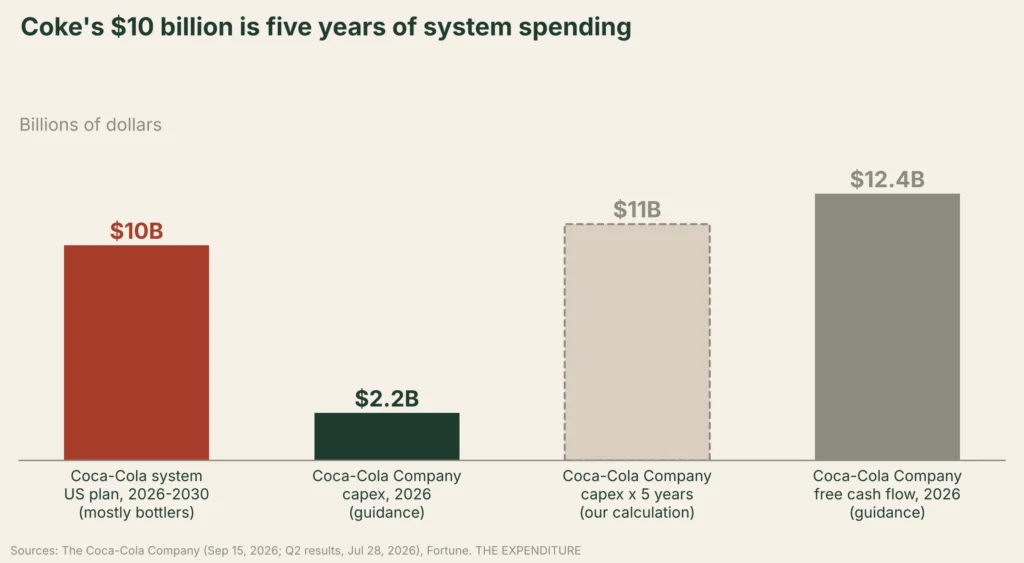
The company’s own numbers make the point. Coca-Cola expects about $2.2 billion of capital expenditure in 2026, worldwide, after spending $2.112 billion on property, plant and equipment in 2025. Spread evenly, the $10 billion U.S. plan would be $2 billion a year, about the size of Coca-Cola’s entire global capital budget. Coca-Cola has not said the money will be spent evenly, and the two figures cover different companies, periods and geographies.
Against Coca-Cola’s own cash
In its second-quarter results on July 28, Coca-Cola raised its 2026 outlook to about $14.6 billion of cash from operations and about $12.4 billion of free cash flow, after the $2.2 billion of capital spending. In other words, the company generates in a single year more free cash than the entire five-year system plan, most of which others will pay for.
That is not a criticism of the plan. It is a description of the business: the brand owner keeps the cash, and the bottlers carry the factories. The headline invites readers to see $10 billion of Coca-Cola investment. The accurate reading is $10 billion of investment by a network of companies, of which Coca-Cola is one.
How it compares with its rival
PepsiCo, by contrast, owns much of its own bottling and manufacturing in North America, so its capital spending sits largely on its own balance sheet. That difference in structure is behind the gap between the two companies’ margins, the subject of PepsiCo vs Coca-Cola: PepsiCo sells about twice as much, and Coca-Cola earns more.
Why it matters
When a company announces an investment on behalf of a “system,” a “network” or its “partners,” the first question is whose balance sheet carries it. Here the answer came from the company’s own finance chief. The $10 billion and the $2.2 billion should not be added together, and they should not be confused: one is five years of U.S. spending across dozens of companies, the other one year of global spending by one.
Frequently asked questions
The Coca-Cola system plans to invest $10 billion in U.S. facilities between 2026 and 2030.
Mostly not. Its finance chief said the lion's share comes from its bottling partners.
About $2.2 billion expected in 2026, worldwide, after $2.112 billion in 2025.
New and expanded production, distribution and office facilities in eight named locations and elsewhere.
About $14.6 billion from operations and $12.4 billion of free cash flow expected in 2026.
Coca-Cola has not given a schedule. $2 billion is the $10 billion divided by five.
Notes. All figures are in US dollars. The annual average and the five-year capex comparison are our calculations. Coca-Cola’s capital expenditure guidance is global; the $10 billion plan covers the United States only.
Sources
- The Coca-Cola Company, “The Coca-Cola System: A 140-Year Legacy That Continues to Deliver for America,” September 15, 2026: https://investors.coca-colacompany.com/news-events/press-releases/detail/1171/the-coca-cola-system-a-140-year-legacy-that-continues-to-deliver-for-america
- Fortune, “Coca-Cola to invest $10 billion in U.S. growth through 2030, CFO says,” September 15, 2026: https://fortune.com/2026/09/15/coca-cola-invest-10-billion-us-growth-through-2030-cfo/
- The Coca-Cola Company, second quarter 2026 results, July 28, 2026: https://www.sec.gov/Archives/edgar/data/0000021344/000162828026049922/a2026q2earningsreleaseex-9.htm
- The Coca-Cola Company, Form 10-K for 2025: https://www.sec.gov/Archives/edgar/data/21344/000162828026010047/ko-20251231.htm