Record Data Sheet
On July 16, TSMC confirmed a $100 billion expansion of its investment plan in the United States. Its total commitment in the country now stands at $265 billion. No foreign company has ever announced a larger direct investment on American soil. It sits ahead of every other industrial project in the country’s history.
This is not an abstract number. Behind it are twelve factories and hundreds of thousands of jobs. There is also a direct bet on who will manufacture the chips that power artificial intelligence over the next decade. And it confirms a deeper shift. The geography of semiconductors spent thirty years anchored almost entirely in Asia. Now it is starting to move.
What TSMC has announced
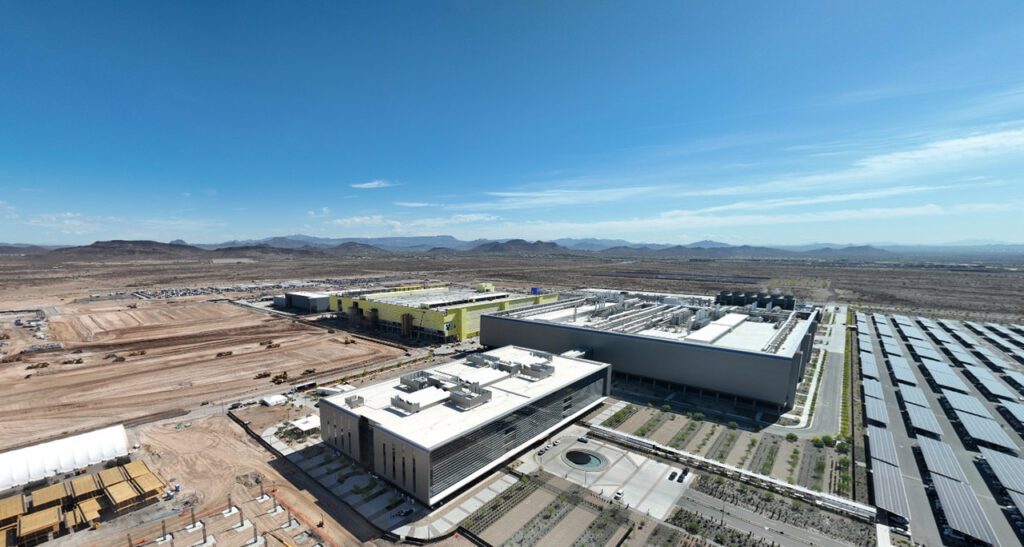
TSMC (Taiwan Semiconductor Manufacturing Company) is the world’s largest contract chipmaker. In 2020 it committed an initial $65 billion in Arizona. In March 2025 it added another $100 billion, bringing the figure to $165 billion. On July 16, 2026 it added $100 billion more. The US Department of Commerce confirmed the total: $265 billion.
With this latest expansion, TSMC will build four additional factories in Arizona. The company will then operate twelve manufacturing and advanced packaging facilities in the country. The announcement came a few months after the trade and investment agreement between the United States and Taiwan. Both governments signed it in January 2026 through the American Institute in Taiwan and the Taipei Economic and Cultural Representative Office.
TSMC chairman and CEO C.C. Wei tied the decision to demand from its major American customers, among them Apple and Nvidia. Commerce Secretary Howard Lutnick presented it as a direct result of the trade deal with Taiwan. He also described it as a lever to bring advanced semiconductor manufacturing back to the United States.
Why the company is raising its investment now
Three reasons explain the pace of this expansion, and none of them is purely political. The first is demand. TSMC makes the world’s most advanced chips for customers such as Apple, Nvidia and AMD. That demand has grown faster than its installed capacity in Taiwan.
The second is the trade agreement Washington and Taipei signed in January 2026. The pact tied tax incentives and investment commitments on both sides. According to the Department of Commerce, it covers $250 billion in direct investment by Taiwanese semiconductor companies and another $250 billion to bring the rest of the supply chain to the United States.
The third is American industrial policy. The CHIPS Act has spent years pushing to bring advanced chip manufacturing to US soil. Talks between the current administration and the big technology companies have added to that pressure, with mixed results.
The global race for semiconductors and artificial intelligence
No artificial intelligence model runs without chips. And a handful of factories in Taiwan produce nearly all of the world’s advanced chips. That is the geopolitical knot behind the contest between Washington, Beijing, Brussels and Taipei. Each has spent half a decade trying to control a larger share of this supply chain.
Taiwan remains, by a wide margin, the industry’s center of gravity. TSMC itself acknowledges it: the island accounts for more than 90 percent of global production of the most advanced semiconductors. That concentration is both its greatest commercial strength and its greatest strategic weakness. The Chinese military threat over the island makes the point.
The United States has spent years trying to reverse decades of offshoring. Its tools are the CHIPS Act and bilateral agreements, such as the one it signed with Taiwan. The Department of Commerce has set a clear target for 2030. It wants the country to make roughly 20 percent of the world’s leading edge logic chips, up from zero in 2022.
China has answered with its own drive for self-sufficiency in chips. It is speeding upstate investment in its manufacturers while Washington restricts exports of key equipment and technology.
Europe has tried to attract investment of its own through the European Chips Act. But no announcement on the continent comes close to the figures in the United States.
How it compares with other major recent investments
The TSMC figure does not appear in a vacuum. It coincides with the largest wave of industrial and technology investment in the United States in decades.
One clarification is in order: these figures do not all measure the same thing. The TSMC, Intel and Samsung numbers are direct investment in physical semiconductor plants. The Amazon, Alphabet, Microsoft and Meta numbers are annual capital expenditure. Most of that money goes to data centers, not chip manufacturing. And the Apple figure mixes manufacturing, suppliers and four-year investment programs.
Even so, the comparison serves a purpose. In barely two years, the United States has drawn the largest industrial and technology capital bets on the planet. It makes no difference whether they come from Taiwan, from South Korea or from its own companies.
Expected economic impact
TSMC itself has released official employment figures. The total investment in Arizona will create more than 6,000 direct manufacturing jobs. It will also add more than 20,000 cumulative construction jobs. On top of that come tens of thousands of indirect jobs over the decade. TSMC made its own estimate in March 2025. That $100 billion expansion alone would create 40,000 construction jobs over four years.
The impact goes beyond direct employment. The Greater Phoenix Economic Council analyzed the first $65 billion TSMC put into Phoenix. It calculated $32.9 billion in economic output. It also projected $1.4 billion in tax revenue for Arizona over 13 years. TSMC went further in its March 2025 announcement. It expects more than $200 billion in indirect economic output over the next decade, and the investment has since grown again.
For the artificial intelligence industry, the effect is structural rather than numerical. More advanced manufacturing capacity in the United States reduces dependence on a single region. That region currently produces the chips that train and run the large AI models. The same logic drives Amazon, Alphabet, Microsoft and Meta. It is why they spend hundreds of billions a year on their data centers. Without chips there is no AI infrastructure. And without factories nearby, there are no guaranteed chips.
Why this investment could change the industry over the next decade
This expansion does not, on its own, solve the industry’s geographic concentration. Taiwan will keep making the vast majority of the most advanced chips for years. But it does mark a turning point. For the first time, a meaningful share of leading-edge capacity will exist off the island. It will be twelve factories, not one or two, on American soil and under a different legal framework.
That changes the risk calculus for everyone in the chain. TSMC customers such as Apple and Nvidia gain a more secure source of supply. They depend less on a single geopolitical point of failure. Washington gains a strategic card it never held over the past decade. And the rest of the world, from China to Europe and South Korea, gets a clear message. The race to control advanced chip manufacturing remains open. It has just entered its most expensive and most contested phase.
Frequently asked questions
How much will TSMC invest in the United States? A total of $265 billion. TSMC and the US Department of Commerce confirmed the figure on July 16, 2026.
Is it the largest foreign investment in US history? Yes. The Department of Commerce and TSMC chief executive C.C. Wei describe it as the largest foreign direct investment ever announced in the country.
How many factories will TSMC build in Arizona? Twelve in total. The figure includes the existing facilities and the four new ones announced in July 2026.
How many jobs will the investment create? More than 6,000 direct manufacturing jobs and more than 20,000 construction jobs, according to TSMC’s own figures. Add to that tens of thousands of indirect jobs over the decade.
How does it compare with Intel or Samsung’s investment in the United States? It is far larger. Intel has committed more than $100 billion and Samsung more than $37 billion. Both figures fall well short of TSMC’s $265 billion.
Why does it matter so much for artificial intelligence? Because AI models depend on advanced chips, and today Taiwan makes most of them. More manufacturing in the United States reduces that geographic dependence for the companies that train and run those models.
The Expenditure® 2026