Record Data Sheet
Five years. Two crises. One smart decision and one that wasn’t.
In the second quarter of 2020, Coca-Cola lost 28% of its revenue. Its most valuable customers, bars, stadiums, restaurants and airports, shut down overnight. PepsiCo barely noticed: when the world locked down at home, snacks sold themselves.
Five years later, the story flipped. In 2025, Coca-Cola’s operating income rose 38%. PepsiCo closed factories, agreed with an activist investor to cut its product range, cut prices by up to 15% and saw its operating income drop 11%. The same architecture that protected it in 2020 was dragging it down in 2025.
THE NUMBERS
| PepsiCo | Coca-Cola | |
|---|---|---|
| Revenue, 2020 | $70.4B | $33.0B |
| Revenue, 2025 | $93.9B | $47.9B |
| Operating income, 2020 | $10.1B | $9.0B |
| Operating income, 2025 | $11.5B | $13.8B |
| Net income, 2025 | $8.2B | $13.1B |
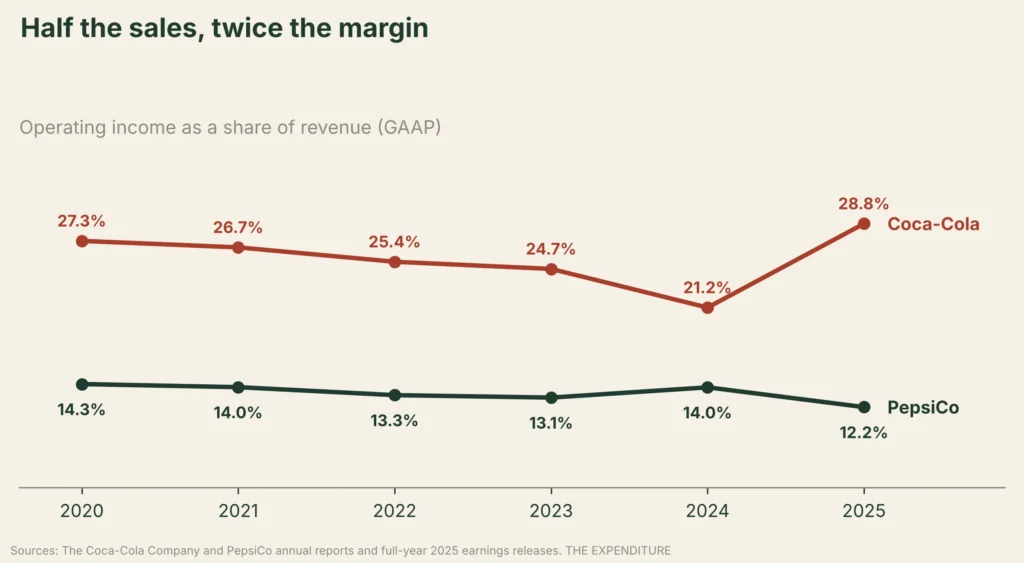
| Operating margin, 2020 | 14.3% | 27.3% |
| Operating income per $100 of sales, 2025 (our metric) | $12.20 | $28.80 |
2020: the pandemic
Coca-Cola took the bigger hit, but it knew exactly why. About half of its revenue came from channels that closed overnight: restaurants, bars, stadiums, cinemas and airports. Unit case volume fell 25% in April 2020 and 16% across the second quarter, and net revenue fell 28%.
PepsiCo didn’t have that problem. Its snacks sell in supermarkets, the one channel that grew during lockdown. In May 2020, PepsiCo launched Snacks.com and PantryShop.com, two direct-to-consumer sites it said were built from concept to execution in less than 30 days.
The smart move for Coca-Cola in 2020 wasn’t surviving. It was using the crisis to do what no company does in good times: kill products. In October 2020, chief executive James Quincey announced the elimination of about 200 brands, half the portfolio, including TaB, Odwalla and Zico. The brands he cut had little to no scale and together made up about 2% of revenue. With the away-from-home channel closed, there was little to lose. With a simpler portfolio, there was a lot to gain when it reopened.
2021 to 2022: inflation. Who raised prices better?
When inflation hit, both companies raised prices. Coca-Cola sells concentrate to its bottlers and negotiates the price with them; it does not directly absorb the cost of most raw materials. PepsiCo manufactures, packages and distributes much of what it sells: every increase in the cost of corn, oil or packaging hits its income statement directly.
Between 2020 and 2022, Coca-Cola grew revenue 30%, with its operating margin between 25% and 27%. PepsiCo grew revenue 23%, with its margin between 13% and 14%.
2023 to 2024: two companies, two different problems
In late 2023, PepsiCo’s Quaker Oats business recalled granola bars, cereals and snacks in North America over possible salmonella contamination. Quaker Foods North America volume fell 8% in the fourth quarter of 2023, and chief executive Ramon Laguarta said the recall would weigh on results at least through the first half of 2024. PepsiCo had bought Quaker for $13.8 billion in 2001, mainly for Gatorade. This wasn’t a strategy problem. It was an operational failure in its own manufacturing.
Coca-Cola had its own problem in 2024, but of a different kind. Free cash flow dropped 51%, from $9.7 billion to $4.7 billion, because it deposited $6.0 billion with the IRS in a tax dispute that has been running through the courts for years. Excluding that deposit, free cash flow grew 11%, to $10.8 billion. A tax problem, not an operational one. The difference matters.
2025: the year that explains everything
In 2025, Coca-Cola’s operating income rose 38%, to $13.8 billion, on revenue of $47.9 billion, and net income reached $13.1 billion. PepsiCo’s operating income fell 11%, to $11.5 billion, on revenue of $93.9 billion, weighed down by an impairment of almost $2 billion, mostly on the Rockstar energy drink brand.
In December 2025, PepsiCo reached an agreement with the activist fund Elliott Investment Management, which had built a stake of about $4 billion. PepsiCo said it would cut about 20% of its product range in the United States and lower prices. In February 2026 it cut prices on Lay’s, Doritos, Cheetos and Tostitos by up to 15% on some pack sizes, funded by closing plants in Florida, New York and California. “Lowering prices is one step, an important one, in our commitment to deliver for consumers and strengthen our brands for the future,” said Rachel Ferdinando, chief executive of PepsiCo Foods U.S.
PepsiCo raised prices during inflation and was too slow to bring them back down. By 2025, consumers had found cheaper alternatives.
Coca-Cola raised prices too. But its bottlers absorb the execution. When consumers push back, Coca-Cola negotiates with about 200 bottling partners. PepsiCo has to close its own factories. Coca-Cola’s own capital decisions run through the same system, as its $10 billion US infrastructure plan shows.
The case for PepsiCo
PepsiCo has something Coca-Cola can’t easily buy: a snacks business that grows on its own, alongside beverages. It has more than 20 brands that each generate more than $1 billion a year in estimated retail sales. Its revenue is still twice Coca-Cola’s, and its core operating profit, which excludes items such as the Rockstar impairment, rose 2% in 2025.
The corrections are also familiar. The price cuts, factory closures and product cuts are close to what Coca-Cola did in 2020 with its 200 brands. Owning factories is expensive when demand falls, but it also lets a company control costs directly when it decides to cut them.
Verdict
- Size: PepsiCo, with $93.9 billion of revenue against $47.9 billion.
- Operating income: Coca-Cola, $13.8 billion against $11.5 billion, on half the sales.
- Margin: Coca-Cola, $28.80 of operating income per $100 of sales against $12.20.
- Resilience in the pandemic: PepsiCo. Its supermarket sales held up while Coca-Cola lost 28% of its revenue in a quarter.
- Use of a crisis: Coca-Cola. It cut half its brands in 2020; PepsiCo is cutting its range in 2026.
The open question
Coca-Cola won these five years through architecture, not execution. The concentrate model protected it from inflation, the recall and the activism. But that same model has a ceiling: it depends on the world continuing to drink its beverages at the same rate. The question isn’t who won 2020 to 2025. It’s whether the strategy that won those five years works for the next five. If PepsiCo executes its correction well, 2026 to 2030 could look very different, and the first test is whether lower prices bring back volume in its 2026 results. For a very different company that learned what its structure costs when sales slow, see LVMH and Goiko.
Frequently asked questions
By revenue, yes: $93.9 billion in 2025 against $47.9 billion. By operating income, no: Coca-Cola earned $13.8 billion against PepsiCo's $11.5 billion.
Mostly because of its model. Coca-Cola sells concentrate to independent bottlers, which handle production and distribution. PepsiCo makes and distributes much of its own product, which costs more and exposes it directly to raw material prices.
After years of price increases, volume fell. In February 2026 PepsiCo cut prices on Lay's, Doritos, Cheetos and Tostitos by up to 15% on some pack sizes, after an agreement with the activist investor Elliott in December 2025.
In the second quarter of 2020, its net revenue fell 28% and unit case volume fell 16%, because about half its revenue came from restaurants, bars, stadiums and other places that closed.
Because it deposited $6.0 billion with the IRS in a long-running tax dispute. Excluding that deposit, free cash flow rose 11%, to $10.8 billion.
Notes. All figures are in US dollars, GAAP, as reported in each company’s annual reports and earnings releases unless stated otherwise. Operating margins and the operating income per $100 of sales are our calculations from reported revenue and operating income. Coca-Cola’s net income for 2025 is as reported with its full-year results; PepsiCo’s figures are net income attributable to PepsiCo.
Sources
- The Coca-Cola Company, Q4 and full-year 2025 results, February 10, 2026: https://www.sec.gov/Archives/edgar/data/21344/000162828026006642/a2025q4earningsreleaseex-9.htm
- The Coca-Cola Company, Q4 and full-year 2024 results: https://www.sec.gov/Archives/edgar/data/21344/000002134425000005/a2024q4earningsreleaseex-9.htm
- The Coca-Cola Company, Q2 2020 results, July 21, 2020: https://www.sec.gov/Archives/edgar/data/21344/000002134420000037/a2020q2earningsrelease.htm
- PepsiCo, Q4 and full-year 2025 results, February 3, 2026: https://www.sec.gov/Archives/edgar/data/77476/000007747626000009/q420258-kxexhibit991.htm
- PepsiCo, “PepsiCo launches new direct-to-consumer offerings,” May 11, 2020: https://www.pepsico.com/newsroom/press-releases/2020/pepsico-launches-new-direct-to-consumer-offerings-to-deliver-food–beverage-products-and-meet-increased-demand-amid-pandemic
- CNN, Coca-Cola cuts 200 brands including Tab and Zico, October 22, 2020: https://amp.cnn.com/cnn/2020/10/22/business/coke-zico-tab
- FoodNavigator, PepsiCo’s net revenues and the Quaker Oats recall, February 9, 2024: https://www.foodnavigator.com/Article/2024/02/09/pepsico-s-net-revenues-decline-for-first-time-since-2020-impacted-by-pricing-and-quaker-oats-recall/
- CNN Money, “PepsiCo-Quaker complete,” August 2, 2001: https://money.cnn.com/2001/08/02/deals/pepsico/
- Fortune, PepsiCo and Elliott agree to cut the product mix by 20%, December 8, 2025: https://fortune.com/2025/12/08/pepsi-activist-elliott-4-billion-shareholder-cut-product-mix-20-percent/
- Food Dive, “PepsiCo cutting prices on Doritos and other snacks by up to 15%,” February 3, 2026: https://www.fooddive.com/news/pepsico-cutting-prices-on-doritos-and-other-snacks-by-up-to-15/811238/
- The Coca-Cola Company, how many bottling partners: https://coca-colacompany.com/about-us/faq/how-many-bottling-partners-coca-cola
- World Economic Forum, PepsiCo profile (billion-dollar brands): https://www.weforum.org/organizations/pepsico-c6b4e2d284
- Macrotrends, annual revenue and operating income, 2020 to 2024: https://www.macrotrends.net/stocks/charts/KO/cocacola/operating-income and https://www.macrotrends.net/stocks/charts/PEP/pepsico/operating-income