Record Data Sheet
On September 8, 2026, the UK government published its new Space Strategy, led by a headline of £7.8 billion, about $10.5 billion, of funding through 2030. Adding up every individual funding line the government has published gets to about £4.86 billion, 62% of the total. Reaching even that figure required a correction the government made the following day, after being asked about a number that did not add up.
What the government itemized
The largest piece is £2.8 billion for connectivity, covering the Connectivity in Low Earth Orbit program and the military’s SKYNET satellite communications. Space control and intelligence, surveillance and reconnaissance account for £880 million. UK Research and Innovation’s contribution to astronomy and space science is more than £500 million.
The other published figures are much smaller:
| Line | Amount |
|---|---|
| Science and exploration missions, including the Rosalind Franklin Mars rover | £163M |
| ESA’s Vigil space weather mission | £149M |
| European rocket programs | £148M |
| National Space Operations Centre | £85M |
| Department for Transport, rail connectivity | £57M |
| In-orbit servicing and manufacturing | £40M |
| SaxaVord Spaceport, Shetland | £30M |
| Met Office space weather forecasting | £9M |
Added together, every published figure comes to about £4.861 billion, against a headline of £7.8 billion. That leaves about £2.94 billion, 38% of the total, without a line item in the announcement.
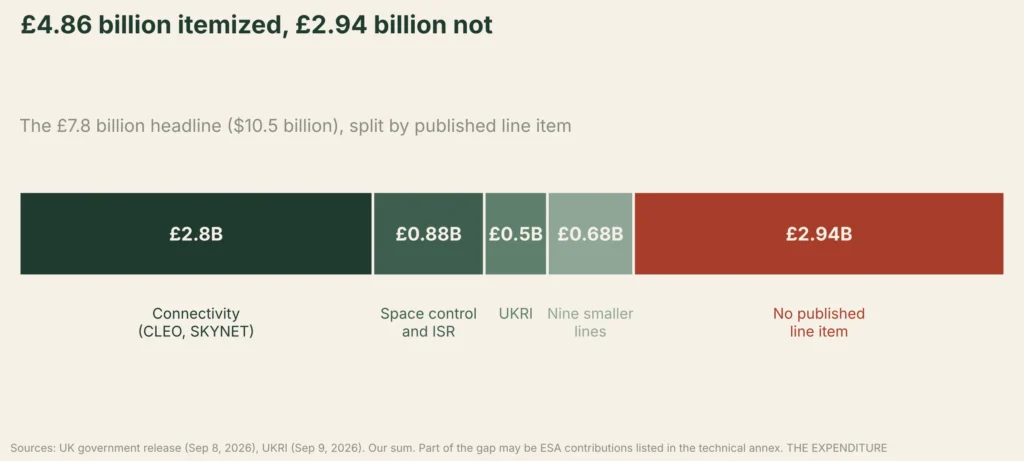
Part of the gap may be explained by contributions to the European Space Agency. The strategy’s technical annex, as reported by The Next Web, lists more than £1.6 billion flowing through ESA programs. Some of that overlaps with ESA-linked lines already counted, such as Vigil, the rocket programs and the Mars rover. If the rest is additional, the unexplained gap would shrink to roughly £1.8 billion. The annex does not break the figures down clearly enough to say.
Officials have also said more than £3 billion of the package goes to defense capabilities in space. That figure very likely overlaps with the £880 million for space control and part of the £2.8 billion for connectivity, since SKYNET is a military system, rather than adding to them.
The correction
The UKRI figure above is not the one in the original announcement. The government’s release of September 8 gave UKRI’s contribution as £190 million. After Research Professional News asked about it against UKRI’s own space portfolio, the figure was revised: on September 9, UKRI said it was investing more than £500 million over the current spending review period, more than 2.6 times the original number.
That matters beyond the £310 million difference. The government’s first public account of its own strategy undercounted one of its funding partners by a wide margin, and the error was fixed only after outside questions. For anyone checking a headline against its parts, it is direct evidence that the original paperwork was incomplete, not merely hard to read.
What the money is measured against
The UK space sector generates about £18.6 billion of income a year and supports more than 55,000 jobs, according to the government. At face value, £7.8 billion over about four years equals roughly 42% of one year of the sector’s income. It is a bet on growing an existing industry, not on building one from nothing.
Against a whole economy, the £7.8 billion, about $10.5 billion, is just under half of Malta’s gross domestic product in 2024, according to World Bank data, spread over about four years rather than spent in one.
Critics have pointed out that neither the strategy nor its annex says how much of the £7.8 billion is new money rather than spending already planned. And the largest single program inside it carries risk: SKYNET 6, valued at £8.35 billion overall, was given a “red” delivery rating in July, meaning successful delivery appeared unachievable in its current form.
Why it matters
Government spending headlines are built to be quoted as a single number, and single numbers are where the useful questions get lost. Adding up the published parts of £7.8 billion surfaced a correction the government itself had to make. The exercise works for any announcement in any country: total the published line items, compare the sum with the headline, and treat the gap as a specific question rather than rounding. Another public figure that changes once it is taken apart is Charlotte’s stadium deal.
Frequently asked questions
£7.8 billion, about $10.5 billion, through 2030, according to the announcement of September 8, 2026.
About £4.86 billion, including £2.8 billion for connectivity, £880 million for space control and more than £500 million from UKRI.
Yes. Its release gave UKRI's contribution as £190 million. UKRI later confirmed it was more than £500 million.
Officials have said more than £3 billion, which overlaps with several of the published defense-related lines.
About £18.6 billion of annual income and more than 55,000 jobs.
The 2021 National Space Strategy.
Notes. Sterling figures are converted at about $1.3508 per pound, derived from the ECB reference rates on September 11, 2026 ($1.1592 and £0.85815 per euro, Banca d’Italia). The £4.861 billion total, the 62% and 38% shares, the £1.8 billion estimate and the 42% comparison are our calculations. UKRI’s £500 million may include some of the mission lines listed separately; if so, the itemized total would be lower and the gap larger.
Sources
- UK government, “New space strategy will bolster UK defences against threats from space,” September 8, 2026, via Wired-Gov: https://www.wired-gov.net/wg/news.nsf/articles/New+space+strategy+will+bolster+UK+defences+against+threats+from+space+08092026131000
- UKRI, “UKRI investment supports new UK Space Strategy,” September 9, 2026: https://www.ukri.org/news/ukri-investment-supports-new-uk-space-strategy/
- Research Professional News, “Bist underplayed UKRI space strategy spend by over £350m,” September 2026: https://www.researchprofessionalnews.com/rr-news-uk-politics-2026-9-bist-underplayed-ukri-space-strategy-spend-by-over-350m/
- The Next Web, “UK space strategy puts £7.8bn behind defence, satellites and ESA to 2030”: https://thenextweb.com/news/uk-space-strategy-7-8bn-defence-esa
- UK Defence Journal, “Billions for space defence under new national strategy”: https://ukdefencejournal.org.uk/billions-for-space-defence-under-new-national-strategy/
- World Bank via FRED, Gross Domestic Product for Malta: https://fred.stlouisfed.org/data/MKTGDPMTA646NWDB
- Banca d’Italia, euro reference rates, September 11, 2026: https://www.bancaditalia.it/compiti/operazioni-cambi/cambio/cambi_rif_20260911