Record Data Sheet
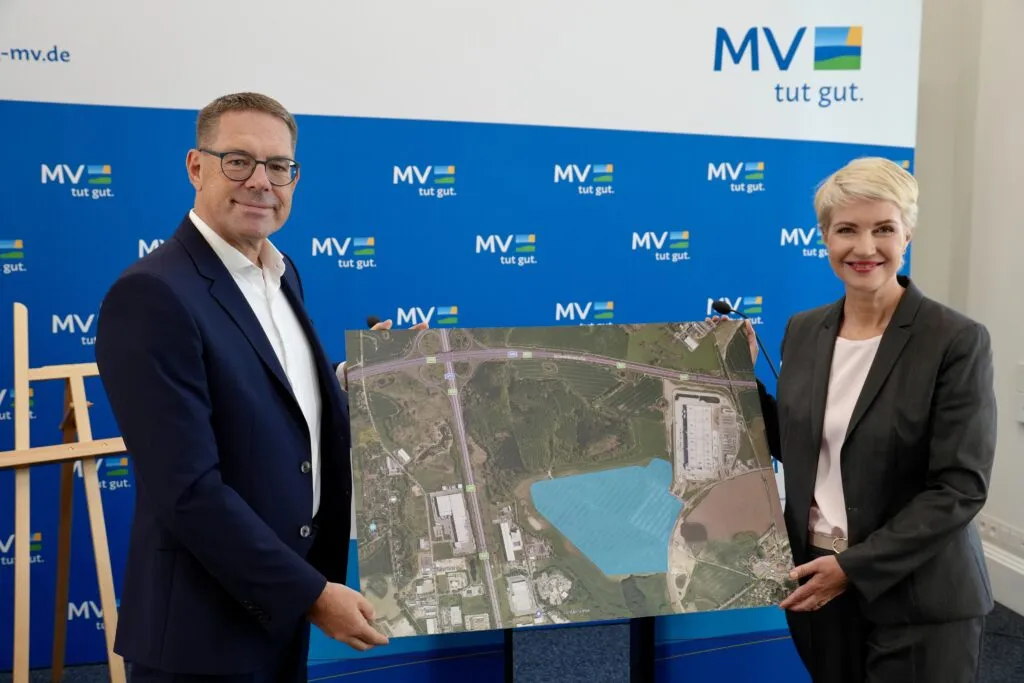
On August 27, 2026, the state government of Mecklenburg-Vorpommern and the companies of Schwarz Group announced a planned investment of up to 5.6 billion euros in a data center at Dummerstorf, near Rostock, according to their joint official statement. Schwarz Group owns Lidl and Kaufland, and most of its revenue still comes from groceries. This particular commitment has nothing to do with either chain, and it’s large enough on its own to rank among the bigger infrastructure investments announced in Germany this year.
What was actually announced
The facility will launch with 240 megawatts of capacity in 2033, with the site designed to scale up to 1 gigawatt by 2045, according to the official statement from Mecklenburg-Vorpommern and Schwarz Group. The project includes a connection to the 380 kilovolt high-voltage grid, a renewable power supply, and a letter of intent already signed with Rostock’s municipal utility to capture and reuse the facility’s waste heat, the same waste-heat arrangement Schwarz Group has already established at a separate project in Brandenburg.
Schwarz Group is not a landlord here. It intends to use the capacity itself, primarily through Schwarz Digits, the group’s cloud, cybersecurity, and IT division, which already operates STACKIT, a cloud platform the company markets specifically on European data sovereignty grounds. Gerd Chrzanowski, a partner at Schwarz Group, framed the investment in exactly those terms in the official announcement, arguing that digital sovereignty is built through capital commitments rather than declarations.
The number nobody has explained yet
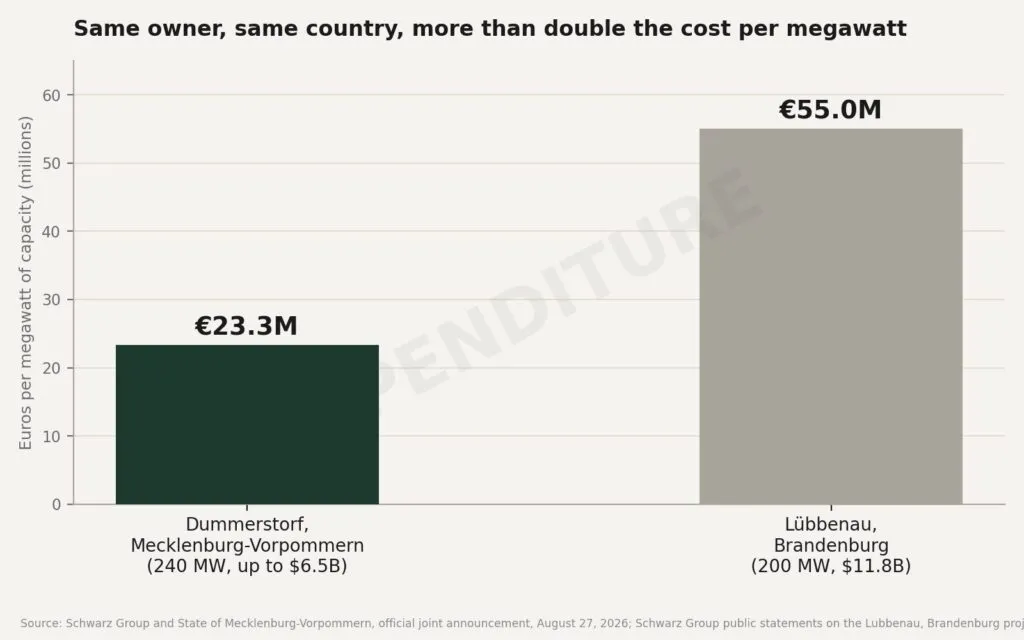
Here is where this stops being a routine infrastructure announcement. Schwarz Group is simultaneously building a similarly scaled data center at Lübbenau, in Brandenburg, a project the company itself has put at approximately 11 billion euros for a facility in the same broad capacity range. Divide each project’s disclosed cost by its capacity and the Dummerstorf site works out to roughly 23.3 million euros per megawatt, while the Lübbenau site works out to roughly 55 million euros per megawatt, better than double.
Same company, same country, a comparable order of magnitude in scale, and a cost per unit of capacity that differs by more than a factor of two. Neither Schwarz Group’s own statement on Dummerstorf nor its prior public remarks on Lübbenau reconcile that gap. It may reflect different build phases being compared at different points in each project’s life, different scope included in each headline figure, or genuinely different site economics, land, power connection costs, construction timelines. Without an official breakdown from Schwarz Group explaining the difference, the honest position is to flag the gap rather than guess at its cause.
Why a grocery company is the one writing this check
Schwarz Group employs more than 600,000 people worldwide and operates as a private, family-controlled group, which matters here specifically because it means this capital commitment did not have to clear the kind of public shareholder scrutiny a listed company’s board would apply to an eight-figure-per-megawatt infrastructure bet. Retailers do not typically become data center developers. Schwarz Group’s rationale, on the company’s own account, is that Schwarz Digits already exists as an internal technology backbone serving the group’s own retail and logistics operations, and the company is now scaling that backbone into a standalone sovereign cloud business rather than continuing to buy capacity from US hyperscalers.
That reframes the announcement. This is not a supermarket chain diversifying into an unrelated business on a whim. It is a company that already runs one of Europe’s largest private IT operations, built to support grocery logistics at enormous scale, choosing to sell that operational capability externally as European governments and companies look for cloud and AI infrastructure options outside of Amazon, Microsoft, and Google.
Sizing 5.6 billion euros against something concrete
At current exchange rates, 5.6 billion euros converts to approximately 6.5 billion dollars, a figure equivalent to roughly 81% of Montenegro’s entire 2024 gross domestic product of 8.07 billion dollars, according to World Bank data. A privately held German retail group is committing, to a single data center project, capital equivalent to four-fifths of what an entire sovereign economy produces in a year.
Why we consider this relevant
The retail-to-infrastructure pivot is worth watching beyond this one project. Any company that has already built a large, complex, capital-intensive logistics or IT operation to run its core business is sitting on a capability that can, in principle, be sold externally once internal demand alone no longer justifies further investment in it. Schwarz Group’s move suggests that European retailers with serious internal technology infrastructure may increasingly see AI and cloud infrastructure not as a cost center to manage down, but as a second business line to scale up.
The unexplained cost gap between Dummerstorf and Lübbenau is the more immediate lesson. Two data center commitments from the same company, disclosed months apart, are not automatically comparable just because they are both measured in euros and megawatts. Anyone sizing up a company’s infrastructure spending needs the same discipline applied here: check whether the headline figures for similar-sounding projects are actually measuring the same scope before treating them as comparable.
Frequently asked questions
Up to 5.6 billion euros, approximately 6.5 billion dollars, according to the official joint statement from
the State of Mecklenburg-Vorpommern and Schwarz Group on August 27, 2026.
240 megawatts when it launches in 2033, with the site designed to scale up to 1 gigawatt of capacity by 2045, according to the official announcement.
Schwarz Group already operates Schwarz Digits, an internal cloud, cybersecurity, and IT division built to support its Lidl and Kaufland retail operations. The company is now scaling that capability externally through its STACKIT sovereign cloud platform.
Schwarz Group’s Lübbenau, Brandenburg project has been put by the company at approximately 11 billion euros for a similarly scaled facility, more than double the cost per megawatt of the Dummerstorf project, based on each project’s own disclosed figures. The company has not explained the difference.
Schwarz Group has signed a letter of intent with Rostock’s municipal utility to capture and reuse the facility’s waste heat, mirroring a similar arrangement already in place at its Brandenburg project, according to the official announcement.
Sources
State of Mecklenburg-Vorpommern and Schwarz Group, official joint press statement on the Dummerstorf data center investment, August 27, 2026
Schwarz Group, public statements on the Lübbenau, Brandenburg data center project and its disclosed investment cost
The World Bank, GDP data for Montenegro (current US dollars, 2024), World Bank national accounts data