Record Data Sheet
Two rivals, one question: how does China’s largest memory maker measure up against America’s, on the day it went public?
THE NUMBERS
| CXMT | Micron | |
|---|---|---|
| Market value | About ¥3.7T (about $544B) at the debut-day high, July 27; ¥3.3T (about $488B) at the close | About $1.19T (June 2, 2026) |
| Global DRAM market share | 7.7% (Q4 2025) | 22.4% (Q1 2026) |
| Latest quarter revenue | ¥50.8B (about $7.5B), January to March 2026 | $23.86B (December to February); $41.46B (March to May) |
| Net income, same quarter | ¥33B (about $4.9B) | $13.79B; $28.24B |
| Net margin | About 65% | About 58%; about 68% |
| High bandwidth memory | In development | HBM4 in high-volume shipments |
| Market value per point of DRAM share (our metric) | About $71B | About $53B |
The debut
Today, July 27, CXMT shares rose as much as about 470% on their first day of trading on the Shanghai Stock Exchange and closed 466% higher, at 49 yuan. CXMT, based in Hefei, is China’s largest maker of DRAM, the memory chips that store and move data in computers, phones, servers and AI systems.
The company sold its shares at 8.66 yuan each and raised 57.92 billion yuan, about $8.6 billion, rising to 66.61 billion yuan if the over-allotment option is used in full. It was the largest offering by a semiconductor manufacturer on a mainland Chinese exchange, ahead of the $7.5 billion SMIC raised in 2020, according to Reuters.
At the offer price, CXMT was valued at about 579 billion yuan, roughly $85.5 billion. At the day’s high of 55.03 yuan, it was worth about 3.7 trillion yuan, roughly $544 billion. At the close, its market value was 3.3 trillion yuan, about $488 billion, making it China’s most valuable listed company, ahead of ICBC. Only 6.73% of its shares were free to trade, which amplified the move.
Share of the market: Micron, by three to one
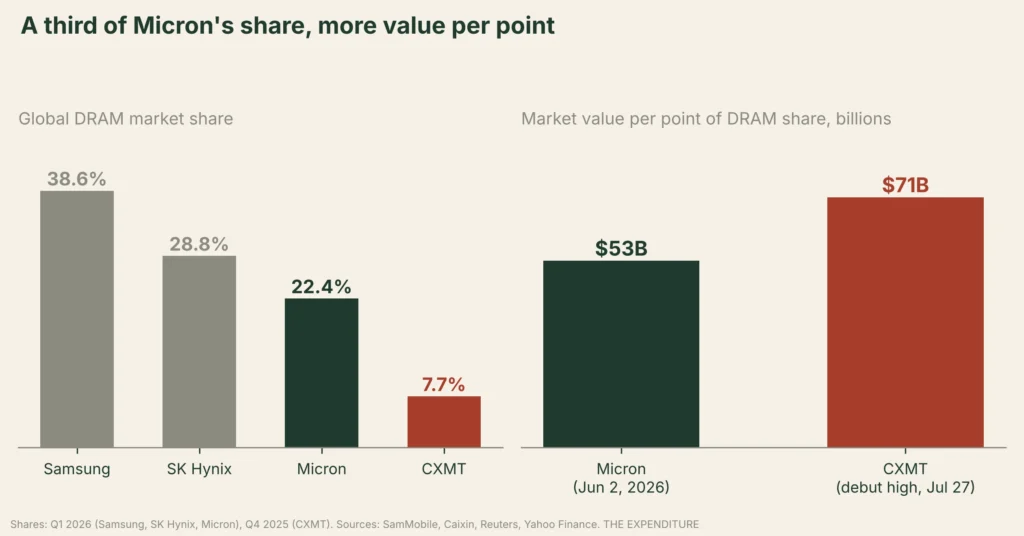
In DRAM, Micron held 22.4% of the global market in the first quarter of 2026, third behind Samsung (38.6%) and SK Hynix (28.8%). CXMT held 7.7% at the end of 2025, making it the fourth-largest DRAM maker in the world.
The gap in scale is just as wide in revenue. CXMT reported 50.8 billion yuan, about $7.5 billion, for January to March 2026, roughly eight times its revenue a year earlier. Micron reported $23.86 billion for December to February, and $41.46 billion for the following quarter, to the end of May. The quarters do not line up exactly, but on either measure Micron sells three to six times as much.
Value per point of share: CXMT, by a third
Investors, however, paid more for each point of CXMT’s market than for Micron’s. At its debut-day high, CXMT was worth about $71 billion for every percentage point of global DRAM share it holds. Micron, at its June valuation of about $1.19 trillion, was worth about $53 billion per point.
That premium reflects growth and scarcity more than size. CXMT’s revenue grew eightfold in a year, and Chinese investors had few ways to own a domestic memory maker before July 27. Institutional orders for the offering exceeded the shares available by more than 500 times, according to TechNode.
Why now
The short answer is the same factor behind Micron’s US expansion: demand for AI memory. AI data centers need vast amounts of DRAM and high bandwidth memory, and DRAM contract prices rose 93% to 98% year over year in the first quarter of 2026, according to Caixin. That turned CXMT from a loss of 2.8 billion yuan a year earlier into a profit of 33 billion yuan in a single quarter.
CXMT plans to spend 29.5 billion yuan of the proceeds on upgrading its production lines and DRAM technology. It does not yet make high bandwidth memory at commercial scale, though it has said it is developing it. Micron’s own plans, more than $250 billion of US investment through 2035, are the subject of Micron raises its US investment.
The case for Micron
Micron’s lead is in the part of the market that matters most for AI. Its newest high bandwidth memory, HBM4, is in high-volume shipments to a lead customer, and its next generation is due in 2027. CXMT has yet to ship the product at scale.
Micron also earns more in absolute terms and at least as much per dollar: its net margin reached about 68% in the quarter to May. And its valuation rests on years of results rather than a first day of trading with less than 7% of shares available.
Verdict
- Market share: Micron, 22.4% against 7.7%.
- Revenue: Micron, three to six times larger.
- Growth: CXMT, revenue up about eightfold in a year.
- Value per point of share: CXMT, about $71 billion against $53 billion.
- AI memory: Micron, with HBM4 in volume production.
The open question
The verdict on share would change if CXMT used its new capital to double its capacity while export controls held back its rivals’ sales in China. The verdict on value would change much sooner, the first time CXMT’s share price settles below its debut. With memory now the second front of the chip race after processors, the subject of TSMC’s $265 billion US investment, the next test is CXMT’s first results as a listed company.
Frequently asked questions
57.92 billion yuan, about $8.6 billion, and up to 66.61 billion yuan, about $9.8 billion, if the over-allotment option is exercised in full.
As much as about 470%, closing 466% higher at 49 yuan. At the day's high, the company was worth about $544 billion; at the close, about $488 billion.
CXMT held 7.7% at the end of 2025. Micron held 22.4% in the first quarter of 2026, behind Samsung and SK Hynix.
On a mainland Chinese exchange, yes. It surpassed the $7.5 billion SMIC raised in Shanghai in 2020.
About $1.19 trillion on June 2, 2026, after passing $1 trillion for the first time in May.
Not yet at commercial scale. It has said it is developing the technology. Micron is shipping its latest version, HBM4, in high volume.
Notes. Yuan figures are converted at about 6.77 yuan per dollar, the rate implied in Reuters’ report of the debut (3.3 trillion yuan for $487.73 billion). The debut-day high valuation is our calculation: the 55.03 yuan high multiplied by the share count implied by the offering (579 billion yuan at 8.66 yuan). Micron’s fiscal quarters end in late February and late May, so they do not align exactly with CXMT’s calendar quarter. Market value per point of share divides each company’s market value by its DRAM market share; the dates and shares differ slightly, as shown in the table.
Sources
- BusinessDay, citing Reuters, “CXMT surges 466% in blockbuster Shanghai stock market debut,” July 27, 2026: https://www.businessday.co.za/world/international-companies/2026-07-27-cxmt-surges-466-in-blockbuster-shanghai-stock-market-debut/
- The Star, “China chipmaker CXMT’s shares surge 470% in Shanghai trading debut,” July 27, 2026: https://thestar.com.my/business/2026/07/27/china-chipmaker-cxmt039s-shares-surge-470-in-shangai-trading-debut
- Caixin Global, “Memory shortage works out for Chinese chipmaker CXMT,” May 19, 2026: https://www.caixinglobal.com/2026-05-19/memory-shortage-works-out-for-chinese-chipmaker-cxmt-102445435.html
- SamMobile, DRAM market share in Q1 2026: https://www.sammobile.com/news/samsung-is-the-only-memory-maker-to-increase-dram-share-so-far-this-year/
- Micron Technology, results for the third quarter of fiscal 2026, June 2026: https://www.sec.gov/Archives/edgar/data/0000723125/000072312526000013/a2026q3ex991-pressrelease.htm
- Yahoo Finance, Micron’s market value on June 2, 2026: https://finance.yahoo.com/markets/stocks/articles/micron-just-surpassed-1-16-150303893.html