Record Data Sheet
Two rivals, one question: why is the largest bank in the world worth so much less than the second?
THE NUMBERS
| ICBC | JPMorgan Chase | |
|---|---|---|
| Total assets, end of 2025 | ¥53.48T (about $7.64T) | $4.4T |
| Net income, 2025 | ¥370.77B (about $53.0B) | $57.0B |
| Return on assets | About 0.72% | About 1.3% |
| Net interest margin | 1.28% | Not comparable (diversified income) |
| Market value, June 2026 | About $328B | About $853B |
| Market value per $100 of assets (our metric) | About $4.30 | About $19.40 |
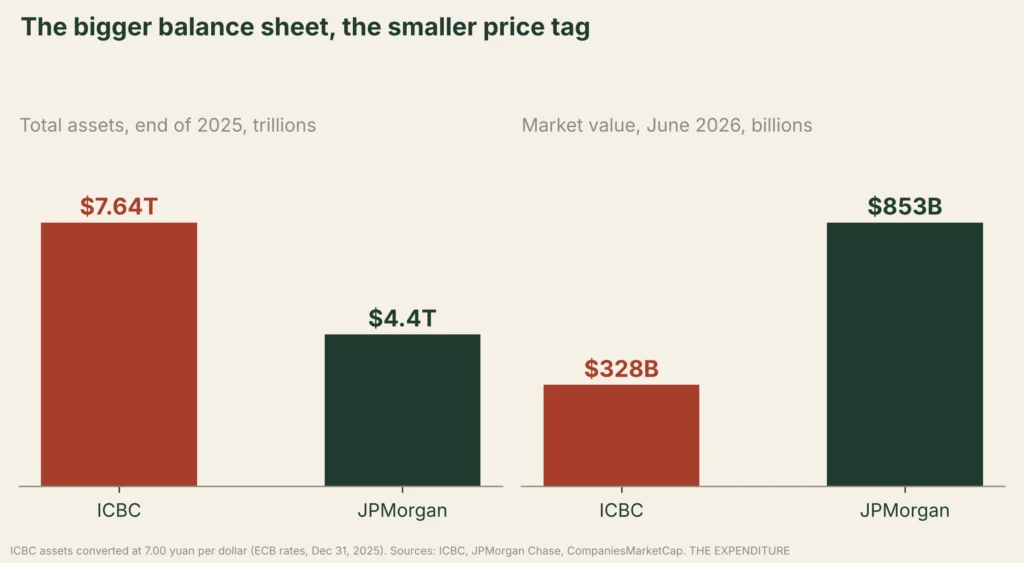
The number that misleads
ICBC closed 2025 with ¥53.48 trillion in assets, making it the first bank in history to cross the ¥50 trillion mark. JPMorgan closed the year at $4.4 trillion. Converted at the year-end exchange rate, about 7.00 yuan per dollar, ICBC’s balance sheet is about $7.64 trillion, roughly 74% bigger than JPMorgan’s.
That’s not because it runs a better business. It’s because in China, nearly all of the country’s credit flows through the balance sheets of a handful of state-owned banks, and ICBC is the largest of them. In the United States, much of that financing happens outside the banking system entirely, through bond markets and asset managers. ICBC’s size doesn’t measure a stronger bank. It measures an entire financial system compressed into a single set of books.
Profitability tells a different story
On profit, the two banks are close: ICBC earned ¥370.77 billion in 2025, about $53 billion, up 1%, and JPMorgan earned $57.0 billion. The difference is how many assets each needs to earn it. JPMorgan earned about 1.3 cents for every dollar of assets. ICBC earned about 0.72 cents, a little more than half.
The gap shows in the margins. ICBC’s net interest margin, the difference between what it earns on loans and pays on deposits, fell to 1.28% in 2025, down 14 basis points in a year. Beijing wants its state banks to keep credit cheap to support manufacturing and domestic spending, and ICBC gives up margin to make that happen. JPMorgan answers to its shareholders. It reported a 20% return on tangible common equity in 2025, and its asset and wealth management arm earned a 40% return on equity with $4.8 trillion under management.
What the market is actually paying for
With a balance sheet about 40% smaller, JPMorgan had a market value of about $853 billion in June 2026. ICBC, the largest bank in the world, was valued at about $328 billion. For every $100 of assets on its books, the market pays about $19.40 for JPMorgan and about $4.30 for ICBC.
The market isn’t paying for size. It’s paying for the certainty that capital can leave a country and come back without a government deciding otherwise, and for profits that belong first to shareholders. For a different version of the same contest between two governments’ priorities, see US vs China defense spending.
One more data point puts both banks in perspective. HSBC, the bank historically built as a bridge between East and West, reported $29.9 billion of profit before tax in 2025. JPMorgan’s $57 billion is after tax, so on a like-for-like basis the gap is even wider.
The case for ICBC
ICBC has what no Western bank can match: scale of population. It serves more than 700 million individual customers and over 10 million corporate customers, according to its World Economic Forum profile. JPMorgan, with 318,512 employees at the end of 2025, has the international reach ICBC lacks, partly because the yuan still isn’t a freely convertible currency.
ICBC’s lower returns are also a choice made for it. A bank asked to keep credit flowing through slowdowns will earn less in good years, but it is also less likely to be allowed to fail. Its non-performing loan ratio fell for a fifth consecutive year in 2025, to 1.31%. Investors pay less for that stability, but the bank’s depositors and the state get what they want from it.
Verdict
- Total assets: ICBC, about $7.64 trillion against $4.4 trillion.
- Net income: JPMorgan, $57.0 billion against about $53.0 billion.
- Return on assets: JPMorgan, about 1.3% against 0.72%.
- Market value: JPMorgan, about 2.6 times ICBC.
- Customer reach: ICBC, with more than 700 million individual customers.
JPMorgan wins on everything the market can price today: profitability, valuation and the freedom to move capital. ICBC wins on the one thing the market can’t replicate overnight: being the credit infrastructure for a country of 1.4 billion people.
The open question
JPMorgan needs the world to keep needing dollars. ICBC needs the world to eventually start needing yuan. Both are spending heavily on technology, including AI, to defend their position, and both talk about it to investors. What would flip the market-value verdict is not a bigger balance sheet in Beijing but higher returns, which would require Beijing to let its banks charge more for credit. For a comparison of two companies chasing the same AI spending race, see Microsoft vs Alphabet.
Frequently asked questions
By assets, ICBC, with ¥53.48 trillion at the end of 2025, about $7.64 trillion. By market value, JPMorgan Chase, at about $853 billion in June 2026.
By assets, yes, about 74% bigger. By profit, slightly smaller: about $53.0 billion in 2025 against JPMorgan's $57.0 billion.
Because it earns more on each dollar of assets, about 1.3% against 0.72%, and investors value its profits and the free movement of its capital more than ICBC's state-directed lending.
It earned ¥370.77 billion in 2025, up 1%, with a net interest margin of 1.28%, down 14 basis points in the year.
$57.0 billion, with a 20% return on tangible common equity.
Notes. ICBC’s figures are converted at about 7.00 yuan per dollar, derived from the ECB reference rates on December 31, 2025 (8.2262 yuan and $1.1750 per euro). Return on assets is our calculation, net income divided by the average of opening and closing total assets; ICBC’s 2024 assets of about ¥48.8 trillion are derived from the reported 9.5% growth. Market values are from CompaniesMarketCap, as listed on June 12, 2026. HSBC’s figure is profit before tax; JPMorgan’s and ICBC’s are net income.
Sources
- China Daily, “ICBC bolsters profit quality in 2025 as assets exceed 50t yuan mark,” March 28, 2026: https://www.chinadaily.com.cn/a/202603/28/WS69c74424a310d6866eb4064d.html
- JPMorgan Chase, fourth-quarter and full-year 2025 results: https://www.sec.gov/Archives/edgar/data/19617/000162828026001902/a4q25erfexhibit991narrative.htm
- JPMorgan Chase, 2025 Form 10-K: https://www.sec.gov/Archives/edgar/data/19617/000162828026008131/jpm-20251231.htm
- Yahoo Finance, JPMorgan Chase headcount at the end of 2025: https://finance.yahoo.com/markets/stocks/articles/many-employees-does-jpmorgan-chase-001132736.html
- WealthBriefing, HSBC 2025 pre-tax profit: https://www.wealthbriefing.com/html/article.php/notable-items-cut-2025-pre_dash_tax-profit-at-hsbc%3B-wealth-results-shine
- World Economic Forum, ICBC profile: https://weforum.org/organizations/industrial-and-commercial-bank-of-china-icbc
- Wikipedia, list of largest banks by market capitalization (CompaniesMarketCap data): https://en.wikipedia.org/wiki/List_of_largest_banks
- Banca d’Italia, euro reference rates, December 31, 2025: https://www.bancaditalia.it/compiti/operazioni-cambi/cambio/cambi_rif_20251231