
Record Data Sheet
A sphere 366 feet high off the Las Vegas Strip, wrapped in 580,000 square feet of LED on the outside and lined with 160,000 more on the inside. It cost $2.3 billion. It seats 17,600.
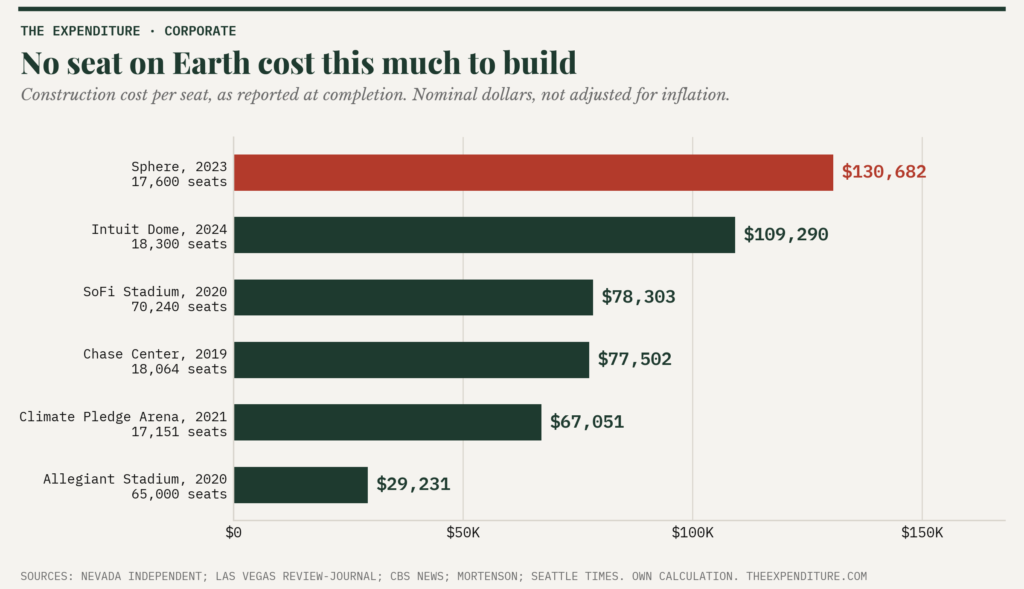
That is $130,682 a seat, the most expensive seat ever built in a venue with a published construction cost. The figure is ours: the cost as reported when the building topped out, divided by its seated capacity.
The question everyone asks next is whether it paid off, and Sphere Entertainment publishes two answers to it. For calendar 2025 the Sphere segment reported operating income of $144.6 million. For the same twelve months it reported an operating loss of $268.2 million. Both numbers are real, both are audited, and the distance between them is $412.8 million. That distance is the right question, because it is the building. (More Corporate records here.)
What does a seat at Sphere cost to build?
$130,682, against $109,290 at the Intuit Dome, which opened a year later and is the closest thing to a rival. Below those two the field drops away fast: $78,303 a seat at SoFi Stadium, $77,502 at San Francisco’s Chase Center, $29,231 at Allegiant Stadium a mile down the road from Sphere itself.
The comparison is unkind to Sphere in one way and kind in another. Unkind, because Allegiant Stadium cost less money and holds nearly four times as many people. Kind, because Sphere can sell those 17,600 seats most nights of the year, and a stadium sells 65,000 about a dozen times.
Count the standing capacity of 20,000 rather than the seated 17,600 and the figure falls to $115,000 a seat. It still leads.
Is Sphere profitable?
It depends which of its own numbers you read, and the answer is published both ways.
The reported figure, the one prepared under standard accounting rules, is an operating loss of $268.2 million for 2025. The other figure, adjusted operating income of $144.6 million, is a non-GAAP measure the company defines as operating income before depreciation, amortization and impairments, share-based compensation, restructuring charges and merger costs.
Neither is a trick. The adjusted number tells you whether the business of filling the room works. The reported number tells you what it costs to have built the room in the first place. In 2025 the answer to the first question turned positive for the first time: adjusted operating income went from a loss of $19.7 million in 2024 to a gain of $144.6 million, on revenue up 27 percent to $781.4 million.
What is in the gap between the two?
Depreciation, mostly. Of the $412.8 million that separates the two figures, $327.8 million is depreciation and amortization and $60.3 million is share-based compensation. The remaining $24.7 million is the other adjustments the company lists, derived here by subtraction.
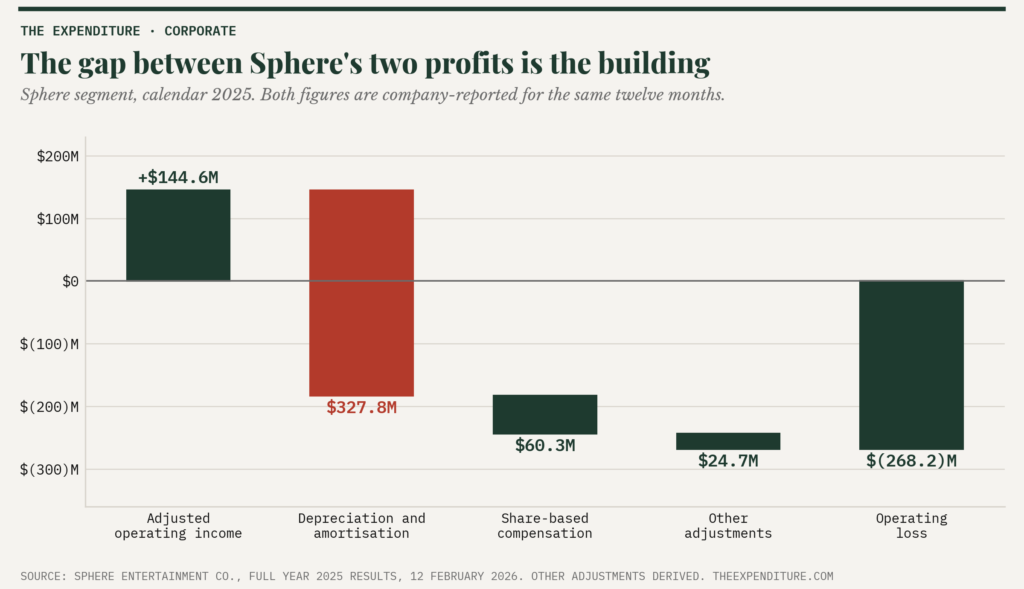
Depreciation is how an accountant records a building being used up. Sphere’s own accounts write down $327.8 million a year, which is about $898,000 a day, every day, whether there is a show or not.
Set that against what the venue earns before the charge, and the record looks different from a distance than it does up close. The building wears out at $327.8 million a year. It earns $144.6 million. The wear is running at more than twice the earnings.
How long until the $2.3 billion comes back?
At the 2025 rate, just under sixteen years, and that is before interest on the venue’s own debt, which the adjusted figure also excludes.
The trend is better than the level. In the first half of 2026 the Sphere segment earned adjusted operating income of $114.2 million, three times the $38.1 million of the same period a year earlier, on revenue of $492.3 million. Annualize the half and the payback drops to about ten years. Annualizing half a year of a business built on residencies is a generous thing to do, and we flag it as such.
Sixteen years is a long time to hold a format that depends on being the only one of its kind, and Sphere Entertainment knows it: the only other full-size Sphere now under way is being paid for by somebody else.
Is the second Sphere cheaper?
For Sphere Entertainment, it is free.
On May 14, 2026, the company announced Sphere Abu Dhabi on Yas Island, with the Department of Culture and Tourism Abu Dhabi investing $1.7 billion in the construction phase and Sphere Entertainment operating the venue. Capacity of up to 20,000, completion targeted for the end of 2029. The fee or royalty structure between the two parties has not been published.
A second, smaller venue was announced for National Harbor, Maryland, in January 2026, at about 6,000 seats and with roughly $200 million of state, local and private incentives disclosed. The total project cost has not been published.
The pattern is the same in both announcements. Having proved what $2.3 billion of its own capital buys, Sphere has stopped supplying the capital.
Is there a case for reading it the other way?
There is, and it is a good one: depreciation is a bookkeeping entry, not a bill.
Nobody writes a check for $327.8 million. The cash is already spent, it was spent in 2023, and what matters from here is whether the venue throws off cash against its operating costs, which it now does and increasingly so. On that reading, adjusted operating income is the honest measure of a business whose capital cost is sunk, the 2025 swing from minus $19.7 million to plus $144.6 million is the only trend that counts, and the reported operating loss is an artefact of having built something expensive rather than evidence that building it was wrong. The Exosphere strengthens the case further: advertising on the outside of the building carries almost no marginal cost, and the company has cited higher Exosphere advertising revenue as a driver of its growth.
Here is what weakens it. Depreciation is not an arbitrary charge in this building. Most of the $2.3 billion is not masonry, it is 740,000 square feet of LED, speakers and haptic seats, and hardware of that kind has a finite life and a replacement cost that will arrive as cash, not as an accounting entry. Interest is excluded from the adjusted figure too, and the venue’s operating company refinanced in January 2026 with a $275 million term loan and a $275 million revolver. And the model rests on an occupancy nobody has held for long: one venue, one city, 17,600 seats to fill on most nights of the year, against a residency calendar that has to keep producing acts big enough to do it.
What did we count, and what did we leave out?
The $2.3 billion is press-reported, by the Nevada Independent and the Las Vegas Review-Journal in August 2023, and we have not found it stated in a Sphere Entertainment filing. The project’s earlier estimates, about $1.2 billion in 2018 rising to $1.66 billion in early 2020, are likewise press-reported. Seated capacity of 17,600 and maximum capacity of 20,000 come from press coverage at the opening; the 20,000 figure also appears in the company’s own Abu Dhabi announcement.
The financial figures are company-reported for the Sphere segment, not for Sphere Entertainment Co. as a whole, which also owns MSG Networks. The $24.7 million of other adjustments in the bridge is derived by subtracting the disclosed depreciation and share-based compensation from the total gap. Adjusted operating income is a non-GAAP measure, defined by the company and reconciled in its results release.
Costs in the per-seat table are nominal, as reported in the year each venue was completed, and are not adjusted for inflation: SoFi Stadium’s $5.5 billion in 2020 dollars would be a larger number today. Per-seat figures use seated capacity, which favors no venue consistently, since some report a single capacity and others report several by configuration. The Intuit Dome figure uses the press-reported “more than $2 billion” as $2 billion, which if anything understates it. Renovations are excluded, so Madison Square Garden’s $1 billion refit of an existing arena does not appear.
The record claim is limited to venues with a published construction cost. Etihad Arena in Abu Dhabi and Resorts World Theatre in Las Vegas have no published cost at all and cannot be ranked.
Key figures
- $2.3B: reported construction cost, against an original estimate of about $1.2 billion
- $130,682: cost per seated place, the highest of any venue with a published cost. Our calculation
- 17,600 / 20,000: seated capacity and maximum capacity
- $781.4M: Sphere segment revenue, 2025, up 27 percent
- $144.6M / $(268.2)M: adjusted operating income and operating loss, same twelve months
- $327.8M: depreciation and amortization in 2025, about $898,000 a day
- 2.3x: how much faster the building depreciates than it earns before the charge
- 15.9 years: payback on $2.3 billion at the 2025 rate; about 10 on the first half of 2026 annualized
- $1.7B: what Abu Dhabi is investing to build the second Sphere, which Sphere Entertainment will operate
The open question
Sphere has proved the format works and has not yet proved the ownership does. Abu Dhabi is paying to build the next one; Maryland is assembling incentives for a smaller one. If that is the pattern, the company’s future is a licensing and operating business whose most valuable asset is a design and a film studio, and the $2.3 billion in Las Vegas was the demonstration model rather than the template. The number that will answer it has not been published: what Sphere Entertainment is paid to run a venue it does not own.
Frequently asked questions
$2.3 billion, reported in August 2023, against an original estimate of about $1.2 billion in 2018. Across its 17,600 seats that is $130,682 a seat, more than any other venue with a published construction cost.
17,600 seated, and up to 20,000 with standing room. About 10,000 of the seats have haptic transducers built into them.
Its owner published both a profit and a loss for the same year. For 2025 the Sphere segment reported adjusted operating income of $144.6 million and a reported operating loss of $268.2 million, on revenue of $781.4 million. The $412.8 million between the two is mostly depreciation on the building.
16,000 by 16,000 pixels, about 256 million in total, across 160,000 square feet of interior display assembled from roughly 64,000 LED tiles supplied by SACO Technologies of Montreal. The 16K label is accurate on the horizontal count, but the format is square rather than the 16:9 shape the term normally describes.
Through a beam forming system called Sphere Immersive Sound, built by the German company Holoplot: about 1,600 loudspeaker modules permanently installed, plus 300 mobile ones. Beam forming means the system controls where sound lands rather than filling the room with it, so different sections can be sent different audio at the same time, different languages or different mixes, with little bleed between them.
It was refused. A Sphere was proposed for Stratford in east London, and on November 20, 2023, the Mayor of London, Sadiq Khan, directed the development corporation to refuse the application, citing unacceptable harm to nearby residents from the light and glare of the exterior screen, together with the building’s height and bulk and its energy consumption. The developer withdrew the application on January 9, 2024.
Notes. Currency note: all figures are in US dollars. No conversion was needed.
Sources
Sphere Entertainment (primary)
- Sphere Entertainment Co. reports fourth quarter and full year 2025 results (Sphere segment: revenue $781.4M vs $617.7M, operating loss $268.2M vs $421.0M, adjusted operating income $144.6M vs loss of $19.7M, depreciation and amortization $327.8M, share-based compensation $60.3M)
- Second quarter 2026 earnings release (H1 2026 revenue $492.3M, adjusted operating income $114.2M vs $38.1M, definition of adjusted operating income, quarterly depreciation of $82.3M)
- Yas Island to be home of Sphere Abu Dhabi (DCT Abu Dhabi investing $1.7 billion in construction, capacity up to 20,000, completion end of 2029)
Construction cost and specifications
- Nevada Independent: final cost for Las Vegas Sphere is $2.3 billion
- Las Vegas Review-Journal: MSG Sphere construction costs grow again, now $2.3B
- Las Vegas Review-Journal: the Sphere by the numbers (17,600 seats, 20,000 maximum, 160,000 sq ft interior LED, 580,000 sq ft Exosphere, 10,000 haptic seats)
Comparable venues
- CBS News: Steve Ballmer and the Intuit Dome (more than $2 billion, 18,300 seats)
- Mortenson: Chase Center ($1.4 billion)
- Mortenson: Allegiant Stadium ($1.9 billion)
- Seattle Times: Climate Pledge Arena after a $1.15 billion renovation
Specifications, systems and the London application
- Sphere Entertainment: Sphere Immersive Sound, powered by HOLOPLOT (July 24, 2023; about 1,600 permanent modules and 300 mobile)
- Mix: To hear the Sphere, first peek at the landmark Vegas venue’s immersive sound (July 24, 2023; module and driver counts)
- NotebookCheck: Sphere Entertainment reveals the technology behind the 16,000 by 16,000 pixel LED display (March 17, 2024; company statements on resolution)
- VFX Voice: Las Vegas Sphere, the world’s largest high-resolution LED screen (April 15, 2024; about 64,000 tiles, SACO Technologies)
- Dezeen: Sadiq Khan rejects plans for MSG Sphere in east London (November 20, 2023; grounds for refusal)
- Dezeen: MSG Sphere creators withdraw plans for London venue (January 9, 2024)
Other venues and debt
- Commercial Observer: Sphere at National Harbor (about 6,000 seats, roughly $200 million of incentives)
- Gulf News: Sphere Abu Dhabi construction contract
- TipRanks: Sphere Entertainment secures new long-term credit facilities (MSG Las Vegas $275 million term loan and $275 million revolver, January 2026)