Record Data Sheet
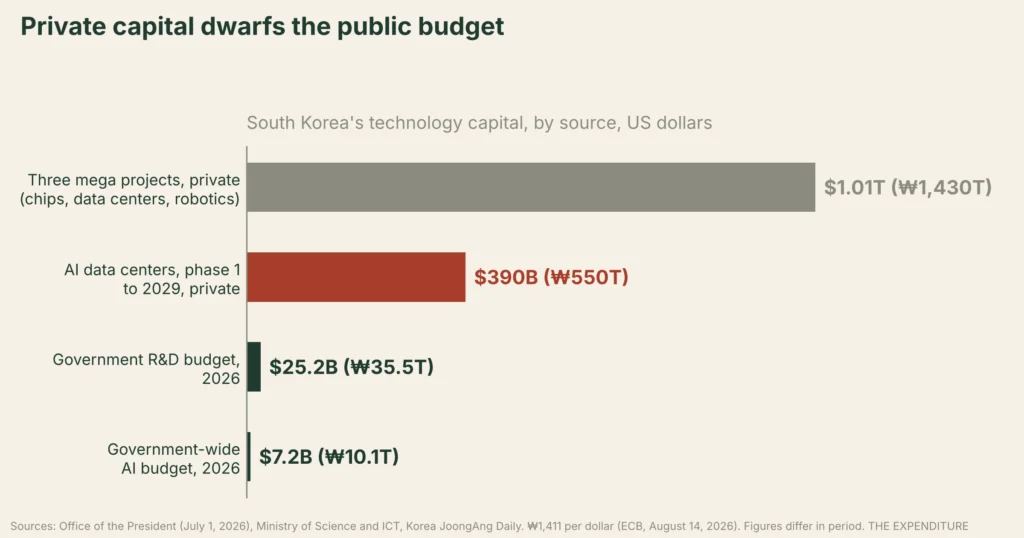
On July 1, 2026, President Lee Jae Myung presented a plan for three private megaprojects worth about ₩1,430 trillion, roughly $1 trillion, covering memory chips, AI-powered robotics and AI data centers. The first phase of the data centers alone, 8.4 gigawatts of capacity by 2029, accounts for about ₩550 trillion, around $390 billion. SK is to build 5 gigawatts, GS Group 2.4 gigawatts at Donghae and Dangjin, and Naver 1 gigawatt at Sejong.
Those are corporate commitments. The government’s own budget is far smaller, and that gap is the key to how South Korea’s technology strategy works.
The public layer: $7.2 billion for AI
The government has set a total AI budget of ₩10.1 trillion, about $7.2 billion, for 2026, more than three times the ₩3.3 trillion of 2025. The Ministry of Science and ICT manages about ₩5.1 trillion of it, within a final 2026 budget of ₩23.74 trillion, about $16.8 billion.
The money covers computing infrastructure, AI chips, talent and public sector adoption. The government plans to buy 15,000 high-performance GPUs, adding to the 10,000 it already has, and expects to control 35,000 government GPUs within two years, plus 15,000 from the private sector. It also plans a National AI Computing Center, developed with private partners, with a budget of up to ₩2 trillion, about $1.4 billion.
The question is whether publicly funded computing lowers the cost of entry for Korean companies, researchers and startups, or whether the state ends up paying for capacity that is hard to commercialize.
The research layer: $25 billion
South Korea’s total government R&D budget for 2026 is ₩35.5 trillion, about $25.2 billion, up 19.9% from ₩29.6 trillion in 2025 and about 4.9% of government spending. Within the science ministry, about ₩5.9 trillion goes to what it calls NEXT strategic technologies: semiconductors, advanced biotechnology, quantum computing and related fields.
Seoul is not betting on a single winner. It is buying exposure to several technologies that could become strategic industries, while strengthening the computing and energy base beneath them.
The targets: quantum, energy and space
On August 12, 2026, Lee and Science Minister Bae Kyung-hoon presented seven long-term technology projects with dated targets:
- Quantum: a domestic error-corrected 100-qubit processor by 2029, and world-leading quantum chip manufacturing by 2035.
- Nuclear energy: commercial small modular reactors by 2035, and electricity from fusion in the late 2030s.
- Space: a lunar landing in 2030, a second lander in 2032 and an independent low Earth orbit satellite network by 2035.
- Biotechnology: AI-bio infrastructure by 2030 and commercial brain-computer interfaces by 2035.
- Critical minerals and materials: ₩10 trillion, about $7.1 billion, through 2030.
A hundred qubits will not make South Korea a commercial quantum leader by itself. The goal is the manufacturing and research base needed to move from laboratory demonstrations to an industry, and the know-how, patents and suppliers that make later private investment less risky.
Energy runs through all of it. AI data centers and chip factories need large amounts of reliable power, and gigawatt-scale data centers will strain South Korea’s grid. That is why the AI, energy and industrial strategies now overlap.
The people behind it
Bae Kyung-hoon, the science minister, came to government from industry: he was president of LG AI Research from 2021, after AI and technology roles at LG, SK Telecom and Samsung Thales. That background helps explain why the strategy keeps linking research, computing, industrial use and commercialization, rather than treating basic research as a separate silo.
What the money is trying to buy
The structure has four layers. At the bottom is public research funding. Above it is infrastructure: computing, data centers, power and test facilities. Around it are supplier development and industrial policy. At the top is private capital, which scales technologies once the risk is acceptable.
South Korea’s large industrial groups can build at extraordinary scale, but its economy remains exposed when key materials, equipment or upstream technology are controlled abroad. The policy tries to move the country further up the value chain, to own more of the inputs that decide whether a finished product can be built at all.
How to judge it
There is a clear risk: governments can back technologies long before markets show which ones pay. A program spread across quantum computing, fusion, reactors, space, biotechnology, AI and materials creates options, but it can also spread capital thin.
A useful scorecard would track four things: private capital attracted per won of public money, export revenue created, the domestic share of critical inputs, and the number of globally competitive suppliers that emerge. For a sense of scale, South Korea’s private data center pledge alone is larger than the $265 billion TSMC has committed to the United States.
Figures we could not confirm
An earlier version of this article cited several further targets and estimates that we could not find in current official sources. We list them as unconfirmed: a domestic 50-qubit quantum computer during 2026; a lunar orbit communications satellite in 2029; 1,200 aerospace companies and a 3% share of the global market by 2035; national AI adoption of 70% in industry and 95% in the public sector by 2030; about ₩310 trillion of economic impact from nationwide AI deployment by 2026; and next-generation semiconductor work at the 1-nanometer level with advanced stacked memory.
Frequently asked questions
₩10.1 trillion, about $7.2 billion, across ministries, more than three times the 2025 figure.
₩35.5 trillion, about $25.2 billion, up 19.9% from 2025.
The planned private investment in the first phase of AI data centers, 8.4 gigawatts by 2029, led by SK, GS and Naver. It is about $390 billion.
No. One is private investment over several years, the other a single year of government spending.
An error-corrected 100-qubit processor by 2029, according to the plan presented on August 12, 2026.
In 2030, with a second lander in 2032.
Notes. Won figures are converted at about ₩1,411 per dollar, derived from the ECB reference rates on August 14, 2026 (₩1,632.42 and $1.1567 per euro, Banca d’Italia). The ₩550 trillion is part of the ₩1,430 trillion megaproject total, not in addition to it. Budget figures are the final 2026 budget as confirmed in December 2025.
Sources
- Data Center Dynamics, “South Korea announces $919bn investment into three mega projects, plans to build 18.4GW worth of data centers by 2035,” July 2026: https://www.datacenterdynamics.com/en/news/south-korea-announces-919bn-investment-into-three-mega-projects-plans-to-build-184gw-worth-of-data-centers-by-2035/
- Korea JoongAng Daily, “Government allocates 10.1 trillion won for AI in budget,” August 29, 2025: https://www.koreajoongangdaily.com/korea/government-allocates-101-trillion-won-for-ai-in-budget/12407041
- Byline Network, “2026 science ministry budget confirmed at ₩23.7 trillion,” December 2025: https://byline.network/2025/12/3-360/
- The Star, citing Reuters, “South Korea unveils future technology drivers, targets moon landing by 2030,” August 12, 2026: https://www.thestar.com.my/tech/tech-news/2026/08/12/south-korea-unveils-future-technology-projects-targets-moon-landing-by-2030
- Banca d’Italia, euro reference rates, August 14, 2026: https://www.bancaditalia.it/compiti/operazioni-cambi/cambio/cambi_rif_20260814