Record Data Sheet
On August 10, 2026, Siemens announced it would invest more than $200 million in two new US manufacturing facilities, one in Pendergrass, Georgia and one in Grand Prairie, Texas, according to the company’s official press release. Neither site will make a single chip, server, or GPU. Both exist to produce the low voltage switchgear and power distribution equipment that lets a finished data center actually draw electricity. Four days later, Siemens’s own Q3 earnings release explained exactly why that capital is going in now, not next year.
What Siemens is actually spending on
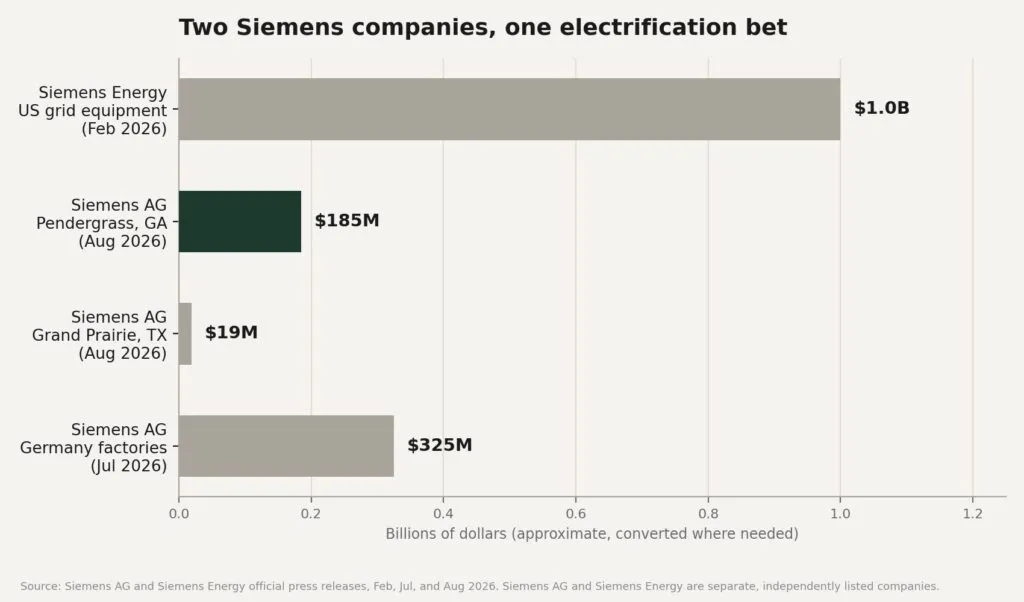
The larger commitment, $185 million, funds a 550,000 square foot facility near Pendergrass, Georgia, set inside a former Sears distribution warehouse, according to Siemens’s release. It will manufacture low voltage electrical infrastructure products, the switchgear, panels, and distribution equipment that route power from a data center’s incoming grid connection to the racks of servers actually running AI workloads. Construction starts in November 2026, with hiring for engineering, fabrication, assembly, and testing roles beginning in 2027.
The smaller commitment, $19 million, expands a facility in Grand Prairie, Texas, adjacent to Siemens’s existing flagship switchgear plant, adding dedicated testing and warehousing capacity. Hiring there begins in late 2026. Both projects build on what Siemens describes as more than $1 billion invested in US manufacturing over the past five years.
The evidence for the bottleneck, straight from Siemens’s own numbers
Here is the part most coverage of this announcement missed. Four days after the Georgia and Texas news, Siemens published its Q3 fiscal 2026 earnings release, and the Smart Infrastructure division, the unit responsible for exactly this kind of electrical equipment, reported orders of €8.0 billion for the quarter, up 42% year over year and a record for the division. Its book to bill ratio, orders received divided by revenue delivered in the same period, came in at 1.25. Any ratio above 1.0 means new orders are arriving faster than the company can turn them into shipped, billed product. That gap is now sitting in a record order backlog of €23.7 billion for Smart Infrastructure alone, up from prior quarters, according to the same release.
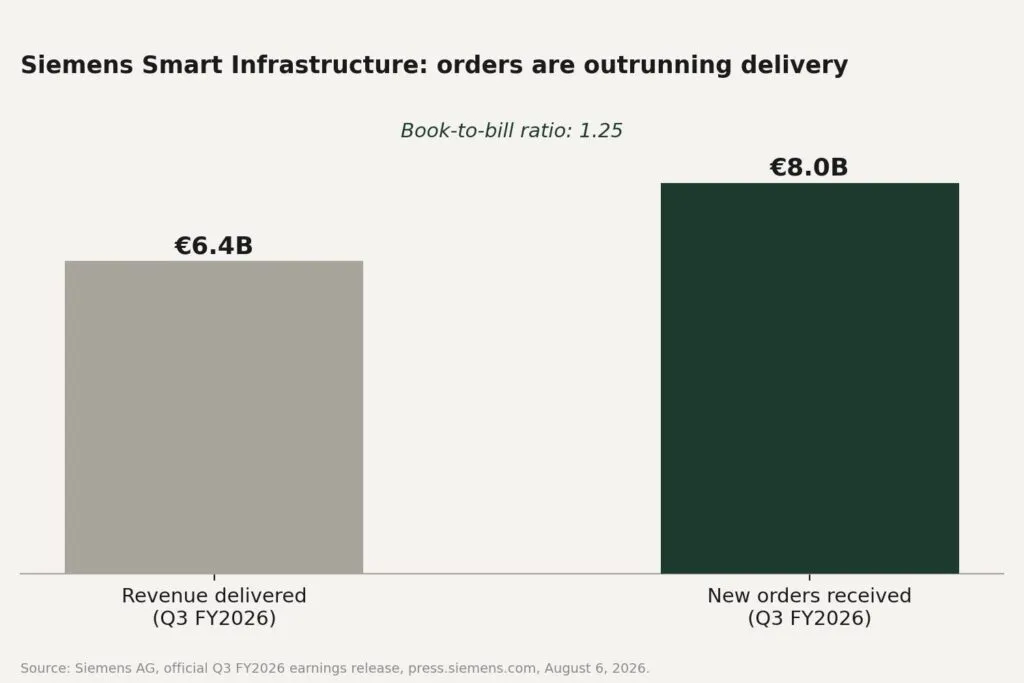
The regional detail matters even more for this specific story: orders in the United States rose 81% in the quarter, which Siemens attributed directly to data center and semiconductor customer wins. On the earnings call, CEO Roland Busch said the order pipeline gives the company visibility “well into 2027 and even beyond,” while flagging that large data center orders can be volatile quarter to quarter, a caveat management included in the same call, not one this publication is adding after the fact.
Put those two disclosures together and the $204 million US manufacturing announcement stops looking like a routine capacity expansion and starts looking like a company converting a demonstrated, self-reported order backlog into physical output capacity, four days apart, in its own official filings.
Two Siemens companies, the same underlying bet
Here’s a distinction worth getting right, because the two companies are easy to conflate and are not the same stock. Siemens AG, the company behind this week’s announcement, spun off its energy business in 2020 to create Siemens Energy, now a separately listed company. In February 2026, Siemens Energy announced its own $1 billion US investment, including a new high voltage switchgear plant in Mississippi, aimed at grid scale equipment, the transformers and transmission gear that move power from generation to the grid.
Siemens AG’s new spending sits one level downstream: low voltage equipment that distributes power once it is already inside a facility. Two independently listed companies, sharing a brand and a century of common history, are deploying capital into adjacent layers of the same electrification demand without any shared capital budget between them. For anyone pricing exposure to the AI buildout through either stock, that is the detail that actually matters, which specific layer of the power delivery chain each company’s capex is targeting, not the headline dollar figure.
What this is worth next to the rest of the AI capex wave
$204 million is small next to the hundred billion dollar commitments dominating AI infrastructure headlines this year, TSMC’s $265 billion Arizona buildout, Micron’s $250 billion memory expansion. That contrast is the point, not a weakness in the story. Siemens is not trying to out-invest the chipmakers. It is deploying capital into a specific segment where its own backlog data shows demand already outrunning supply, at a scale calibrated to what that segment can actually absorb, rather than a scale calibrated to headlines.
Reusing an existing Sears warehouse for the Pendergrass site rather than building fully from the ground up reinforces that reading: Siemens is optimizing for speed to production, consistent with a company trying to close a book to bill gap it has already disclosed to its own shareholders, not one staging a showcase project for press coverage.
Frequently asked questions
More than $204 million combined, $185 million for a new facility in Pendergrass, Georgia and $19 million to expand an existing facility in Grand Prairie, Texas, according to Siemens’s official press
release from August 10, 2026.
81% in the third quarter of fiscal 2026, which Siemens attributed to data center and semiconductor
customer wins, according to its own earnings release.
More than 1,500 combined, according to
Siemens, with hiring in Grand Prairie beginning in late 2026 and hiring in Pendergrass beginning in 2027.
Yes. On the Q3 fiscal 2026 earnings call, CEO Roland Busch noted that large data center orders can be volatile quarter to quarter, even while describing the overall order pipeline as giving visibility
well into 2027 and beyond.
Yes. In July 2026, Siemens announced an additional 300 million euro investment in its German factories to support the same category of AI and data center related electrical infrastructure demand, according to its official release.