Record Data Sheet
On March 13, 2023, Pfizer announced it would buy Seagen, a company that makes antibody-drug conjugates, cancer treatments that deliver chemotherapy directly to tumor cells. The price was $229 a share in cash, an enterprise value of about $43 billion. Pfizer said it would pay for most of it with $31 billion of new long-term debt, and the deal closed in December 2023.
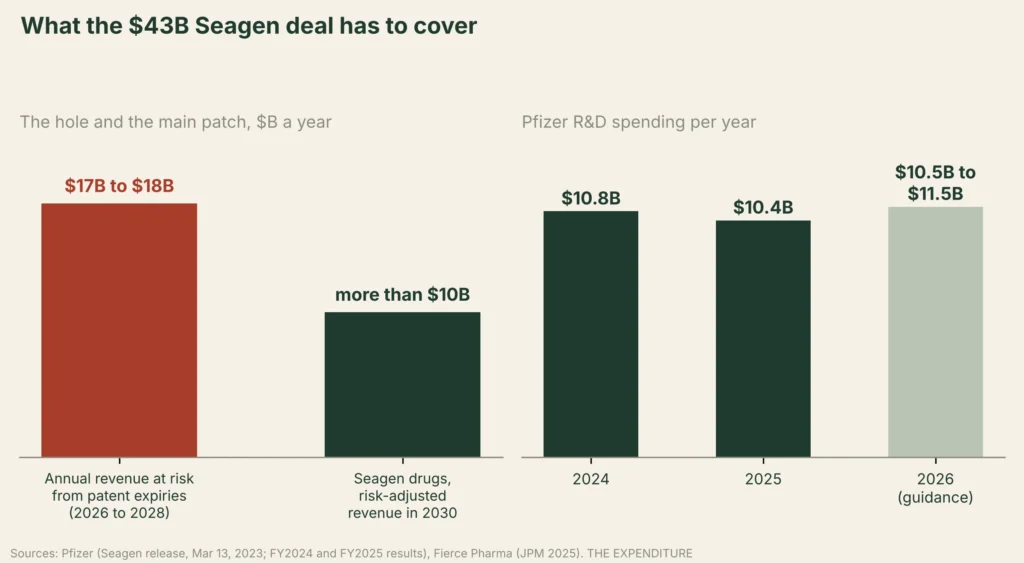
The press release set out what the money was meant to buy: Seagen’s medicines were expected to bring in more than $10 billion of risk-adjusted revenue in 2030. At the time of the announcement, Seagen expected about $2.2 billion of revenue for 2023.
What Pfizer bought was a portfolio already on the market, not only research. Seagen came with four approved cancer medicines: Adcetris, Padcev, Tivdak and Tukysa. It also came with a technology Pfizer wanted to own. “Everybody wants ADCs,” Bourla told PharmaVoice after the deal closed, describing the technology as Pfizer’s big bet. The price reflected that view: $43 billion for a company with about $2.2 billion of annual sales, close to twenty times its revenue.
The hole the money was meant to fill
The reason for the deal sits in Pfizer’s own planning. Several of its best-selling drugs are losing patent protection in the United States in the second half of the decade, among them the blood thinner Eliquis, the breast cancer drug Ibrance, the prostate cancer drug Xtandi, the kidney cancer drug Inlyta and the arthritis drug Xeljanz.
At the J.P. Morgan Healthcare Conference in January 2025, chief executive Albert Bourla put the size of what he called the coming wave at $17 billion to $18 billion of annual revenue, arriving gradually between 2026 and 2028. A patent expiring does not always bring generic competition the next day, so the timing of the losses can vary, but the total is the company’s own estimate.
Set side by side, the two company figures show the gap. Seagen is expected to cover more than $10 billion a year by 2030. The patents put $17 billion to $18 billion a year at risk. The rest has to come from Pfizer’s own laboratories, other acquisitions or cost cuts.
What Pfizer spends on research every year
The internal side of the effort shows up in research and development spending. Pfizer reported $10.8 billion of R&D expenses in 2024 and $10.4 billion in 2025. Its guidance for 2026 is between $10.5 billion and $11.5 billion.
That is a steady line, not a surge. Pfizer has kept research spending roughly flat while cutting elsewhere. In February 2025, it said its cost realignment program was on track to deliver about $4.5 billion of net savings by the end of 2025, and that a separate manufacturing program would save another $1.5 billion by the end of 2027.
Acquisitions continued as well. In 2025, Pfizer spent about $8.8 billion on business development, mainly the purchase of the obesity drug developer Metsera and a licensing deal with the Chinese company 3SBio, according to its full-year results.
The cliff has started
The losses are no longer a forecast. Pfizer’s guidance for 2026 includes a year-over-year revenue hit of about $1.5 billion from products losing exclusivity. Its revenue was $63.6 billion in 2024 and $62.6 billion in 2025, and it guides to between $59.5 billion and $62.5 billion for 2026.
The pattern in the figures is clear enough. Revenue is drifting down as patents expire, research spending is holding at around $10 billion to $11 billion a year, and the $43 billion bet on Seagen is meant to grow into the largest single piece of the replacement.
What we could not confirm
We could not find an official Pfizer commitment of $43 billion in research and development for 2025 to 2028, as this article originally stated. The $43 billion figure belongs to the Seagen acquisition. Pfizer’s annual R&D guidance, if repeated for four years, would add up to a similar amount, but the company has not announced a multi-year research budget. We also could not find a recent update from Pfizer on how far Seagen’s medicines have progressed toward the $10 billion target.
What to watch
The next numbers that matter are in Pfizer’s quarterly reports: the oncology revenue line, where Seagen’s drugs are reported, and the revenue lost each year to generics. If the first grows faster than the second shrinks, the $43 billion will have done what it was bought to do.
For a different way large companies split their spending between research and other uses of cash, see how much Apple actually spends on marketing.
Frequently asked questions
The acquisition of Seagen, a maker of antibody-drug conjugates for cancer, announced on March 13, 2023, at $229 a share and closed in December 2023.
A group of top-selling drugs losing patent protection, including Eliquis, Ibrance, Xtandi, Inlyta and Xeljanz. Pfizer estimates $17 billion to $18 billion of annual revenue at risk between 2026 and 2028.
$10.8 billion in 2024 and $10.4 billion in 2025. Guidance for 2026 is $10.5 billion to $11.5 billion.
More than $10 billion of risk-adjusted revenue in 2030, according to Pfizer's announcement of the deal.
Slightly. It was $63.6 billion in 2024 and $62.6 billion in 2025, and guidance for 2026 is $59.5 billion to $62.5 billion, including about $1.5 billion lost to patent expiries.
Notes. All figures are in US dollars as reported by Pfizer. “Risk-adjusted” revenue is Pfizer’s own term for a forecast weighted by the probability of each drug succeeding.
Sources
- Pfizer, “Pfizer Invests $43 Billion to Battle Cancer,” March 13, 2023: https://www.pfizer.com/news/press-release/press-release-detail/pfizer-invests-43-billion-battle-cancer
- PharmaVoice, Pfizer and Seagen after the deal closed: https://www.pharmavoice.com/news/pfizer-seagen-covid-vax-antiviral-sales-adc/706222/
- Fierce Pharma, “JPM25: BMS, Pfizer and Merck CEOs address key patent cliffs”: https://www.fiercepharma.com/pharma/jpm25-bms-pfizer-and-merck-ceos-address-key-patent-cliffs-and-plans-backfill-sales
- Business Wire, “Pfizer Reports Strong Full-Year 2024 Results And Reaffirms 2025 Guidance,” February 4, 2025: https://www.businesswire.com/news/home/20250204537410/en/Pfizer-Reports-Strong-Full-Year-2024-Results-And-Reaffirms-2025-Guidance
- Business Wire, “Pfizer Reports Solid Full-Year 2025 Results And Reaffirms 2026 Guidance,” February 3, 2026: https://businesswire.com/news/home/20260203145333/en/Pfizer-Reports-Solid-Full-Year-2025-Results-And-Reaffirms-2026-Guidance