Record Data Sheet
In June 2018, Spanish and international press reported that Goiko Grill, a Madrid burger chain with 44 restaurants, had been bought by the fund of Louis Vuitton. Some headlines went further and named Bernard Arnault, the richest man in France, as the buyer. The deal was real. The buyer, strictly speaking, was L Catterton, a private equity firm in which LVMH and the Arnault family are major partners, which is why almost every outlet in the world presented it as an LVMH purchase.
The transaction documents, as reported at the time, put the price at €120 million, about $140 million at the June 2018 exchange rate. Most reports, including Expansión, described a controlling stake of 80%. One legal trade publication, Iberian Lawyer, described it as a full acquisition for the same amount.
What was paid per restaurant
The question in the headline has two honest answers, depending on how the stake is read.
The cash paid was €120 million for a business with 44 restaurants. That works out to about €2.7 million per restaurant, or about $3.2 million.
If the €120 million bought 80%, the whole company was valued at about €150 million. On that basis, each restaurant was worth about €3.4 million, or about $4.0 million.
Either way, the price reflected growth that had not happened yet. Goiko was valued as a brand ready to multiply, not as 44 burger restaurants.
What the money was meant to buy
The plan, as described by the buyers in 2018, was to take Goiko from Spain to the rest of Europe. Part of the purchase was financed with debt: Capza, a French investment fund, provided €39 million in mezzanine financing, a form of loan that ranks behind bank debt and is paid back at a higher rate.
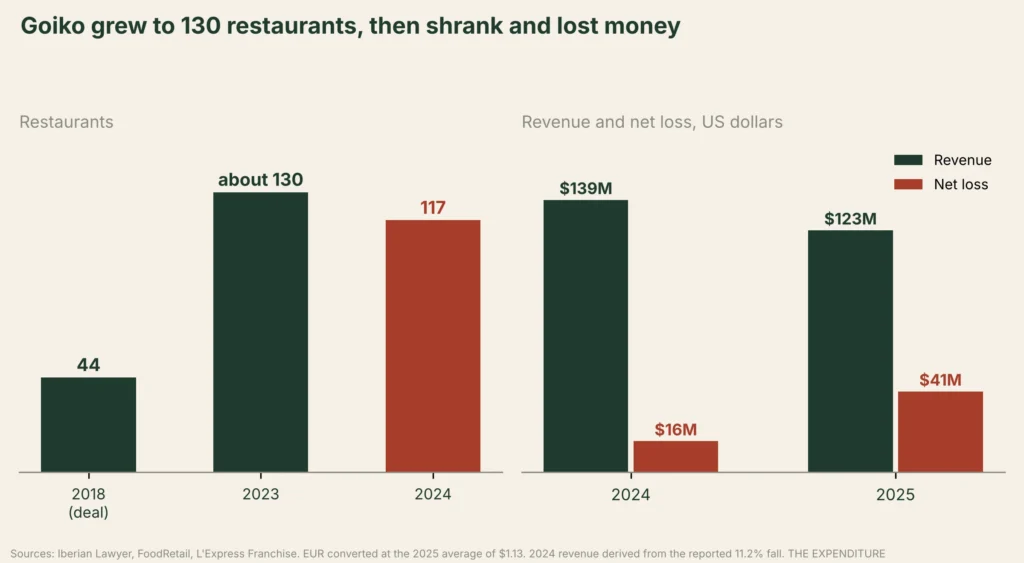
The chain did grow. By 2023 it had about 130 restaurants, including openings in Portugal, and reported revenue of €138.6 million, according to FoodRetail. By the same account, its debt had passed €100 million.
What happened next
Growth did not turn into profit. Revenue fell in 2024 and again in 2025, to €109 million, a decline of 11.2% in the last year, according to accounts reported by L’Express Franchise. The restaurant count dropped to 117. Net losses rose from €14 million in 2024 to €36.4 million in 2025.
In January 2025, L Catterton put its 80% up for sale and hired Rothschild and Arcano to run the process, according to Business People. At that point Goiko had 129 restaurants, six of them under a smaller format called Basic, and 2023 revenue of about €138 million, up 8.6% on the year before. Its operating result was negative. The chief executive, Alejandro Hermo, a former McDonald’s executive who had joined less than a year earlier, said the timing could be right, with consumer spending in Spain improving.
The sale did not happen, and refinancing talks failed. In September 2025, FoodRetail reported that control would pass to Capza, the lender from 2018, because the owner could not repay the financing. Goiko said in a statement that the change of shareholder was routine for a fund-backed company and that its management and direction would not change. Later that year, Capza converted about €60 million of debt into shares and injected €5 million of new capital, according to L’Express Franchise.
The number that matters
The headline number in 2018 was the price: about $140 million. The number that explains the outcome is per restaurant. Paying more than $3 million for each burger restaurant only works if the chain keeps opening restaurants that earn more than the ones before. Goiko more than doubled its size, but between 2023 and 2025 its sales fell by about 21% while its restaurant count fell by about 10%, so each restaurant was bringing in less. The debt taken on to buy it was still there when that happened.
What we could not confirm
We could not confirm whether the 2018 deal was for 80% or 100% of the company. Most Spanish reports say 80%, and one legal trade publication says 100%. We give both calculations above. We also found no source for the figure of €800 million that circulated later in connection with LVMH and Goiko, and no record of a new LVMH purchase of the chain in 2026.
What to watch
Goiko’s next published accounts will show whether the debt-for-shares swap gives the chain enough room to stop losing money, and whether Capza keeps it or looks for a buyer of its own.
For another company that learned how much its structure costs when sales slow, see PepsiCo vs Coca-Cola.
Frequently asked questions
Not directly. In June 2018, L Catterton, a private equity firm in which LVMH and the Arnault family are major partners, bought control of Goiko. Most coverage presented it as an LVMH or Louis Vuitton purchase.
About €120 million, roughly $140 million at the time. Most reports describe it as an 80% stake.
About $3.2 million per restaurant on the cash paid, or about $4.0 million per restaurant on the implied value of the whole company, which had 44 restaurants at the time.
Capza, the French fund that lent part of the money for the 2018 purchase. It took control in late 2025 after the owner could not repay the financing, converting about €60 million of debt into shares.
No. It reported a net loss of €36.4 million in 2025, up from €14 million in 2024, on revenue of €109 million.
Notes. 2018 figures are converted at $1.1648 per euro (ECB reference rate, June 22, 2018). Figures from 2023 to 2025 are converted at $1.13 per euro, the 2025 annual average (Bank of Finland, from ECB reference rates). The 2024 revenue used in the chart (about €122.7 million) is derived from the reported 11.2% decline to €109 million in 2025.
Sources
- Capital Riesgo, citing Expansión, “L Catterton compra el 80% de Goiko Grill por 120 millones de euros”: https://capital-riesgo.es/en/articles/la-restauraci-n-sector-de-moda-para-los-inversores-financieros/
- Iberian Lawyer, “EY and PwC instructed on €120m Goiko Grill deal”: https://iberianlawyer.com/ey-and-pwc-instructed-on-120m-goiko-grill-deal
- Alimarket, “L Catterton adquiere el 80% de Goiko Grill”: https://www.alimarket.es/restauracion/noticia/271382/l-catterton-adquiere-el-80–de-goiko-grill
- Directo al Paladar, “El hombre más rico de Francia compra el 80% de Goiko Grill”: https://www.directoalpaladar.com/viajes/hombre-mas-rico-francia-compra-80-goiko-grill-que-se-lanzara-conquista-mundo/amp
- FoodRetail, “Goiko pasará a manos de Capza tras la operación fallida del fondo de Louis Vuitton,” September 3, 2025: https://www.foodretail.es/horeca/restauracion-organizada/goiko-pasara-a-manos-de-capza-tras-la-operacion-fallida-del-fondo-de-louis-vuitton.html
- Business People, “L. Catterton se despide de Goiko tras casi 7 años en el negocio”: https://business-people.es/economia/l-catterton-se-despide-de-goiko-tras-casi-7-anos-en-el-negocio/
- Restauración News, “Goiko aclara su situación ante los rumores del cambio en su accionariado,” September 11, 2025: https://restauracionnews.com/2025/09/goiko-rumores-cambio-accionariado/
- L’Express Franchise, “Goiko aumenta sus pérdidas hasta los 36,4 millones de euros”: https://lexpress-franchise.com/es/ultimas-noticias/goiko-dispara-perdidas-36-millones/
- Banca d’Italia, euro reference rates, June 22, 2018: https://www.bancaditalia.it/compiti/operazioni-cambi/cambio/cambi_rif_20180622/
- Bank of Finland, average annual exchange rates for 2025: https://www.suomenpankki.fi/en/statistics/interest-rates-and-exchange-rates/exchange-rates/average-annual-exchange-rates-for-the-year-2025/