
Record Data Sheet
The question people ask about AOL Time Warner is how a company managed to lose $99 billion in a year. It is the wrong question, because nobody lost $99 billion in 2002. The money had already gone, two years earlier, when one company paid $164.75 billion for another with a market capitalization of $83 billion. What happened in 2002 was that the accounts caught up. The question worth asking, and the one this site asks of every corporate record, is what forced the admission, and why it arrived all at once rather than spread over four decades as the rules had previously allowed.
What is the largest write-off in corporate history?
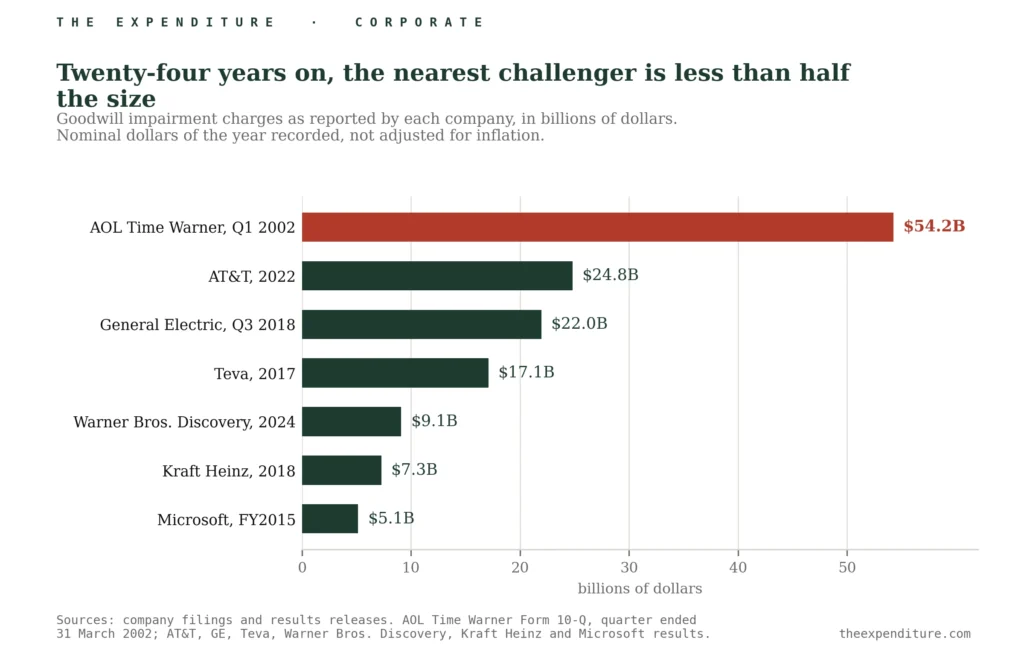
$54.239 billion, recorded by AOL Time Warner in the first quarter of 2002 as a cumulative effect of an accounting change. The company’s Form 10-Q for the quarter ended March 31, 2002, carries the line “Cumulative effect of accounting change (54,239)” in millions of dollars, and describes it in prose as “a one-time, noncash charge of approximately $54 billion to reduce the carrying value of its goodwill.”
Later filings restate it marginally, to $54.235 billion, a difference of $4 million that the filings do not explain and that changes nothing material. We use the figure as originally filed and note the restatement.
The 10-Q is unusually direct about the cause: “The amount of the impairment primarily reflects the decline in the Company’s stock price since the Merger was announced and valued for accounting purposes in January of 2000.” Goodwill is the premium a buyer pays above the identifiable value of what it bought. AOL had paid an enormous premium in its own shares, those shares had collapsed, and the premium no longer existed.
Nothing since has come close. AT&T recorded goodwill impairments of $24.8 billion in 2022, General Electric $21.973 billion against its power business in the third quarter of 2018, Teva $17.1 billion in 2017, Warner Bros. Discovery $9.1 billion in its networks segment in 2024, Kraft Heinz $7.272 billion of goodwill in 2018 and Microsoft $5.144 billion on Nokia’s devices business in its 2015 financial year. The largest of those is less than half the AOL charge.
Why did the write-off happen in 2002 rather than 2001?
Because the rule changed. Until the end of 2001, American companies amortized goodwill, writing it down gradually over a period that could run to forty years. Statement of Financial Accounting Standards No. 142 ended that. Goodwill was no longer to be amortized at all. Instead it was to be tested for impairment, and written down to its fair value whenever that value had fallen.
AOL Time Warner adopted the standard on January 1, 2002, and recorded the transitional charge in the first quarter. A rule designed to make balance sheets more honest produced, in its first application at one company, the largest write-down in the history of corporate accounting.
How much did the full year come to?
$98.696 billion. That is the net loss for 2002 as it appears in Time Warner’s own trending schedules, filed later as an exhibit to a Form 8-K. The first-quarter charge accounted for 54.9 percent of it.
The second installment arrived in December. The company announced a further write-off of $45.5 billion, of which about $33.5 billion sat at the America Online unit, $10.5 billion at cable and $1.5 billion at music. In the restated schedules the full-year impairment of goodwill and other intangible assets appears as $44.039 billion, with $33.489 billion at AOL and $10.550 billion at cable in the fourth quarter alone. The difference between the two presentations is the music segment, later treated as a discontinued operation.
Put the two charges together and AOL Time Warner wrote off close to $99 billion of acquired value in twelve months.
Was this the largest annual loss in corporate history?
It was, for seven years, and then it was not. AIG’s net loss for 2008 was $99.289 billion, which the company stated in its results release of March 2, 2009: “AIG’s net loss for full year 2008 was $99.3 billion or $37.84 per diluted share.” AOL Time Warner’s was $98.696 billion. AIG’s is larger by $593 million.
This matters because the two records are routinely conflated. AOL Time Warner holds the goodwill write-off record and has held it without challenge for twenty-four years. It does not hold the record for the largest annual loss, and any source still saying it does is working from pre-2009 reporting.
What did the merger cost in the first place?
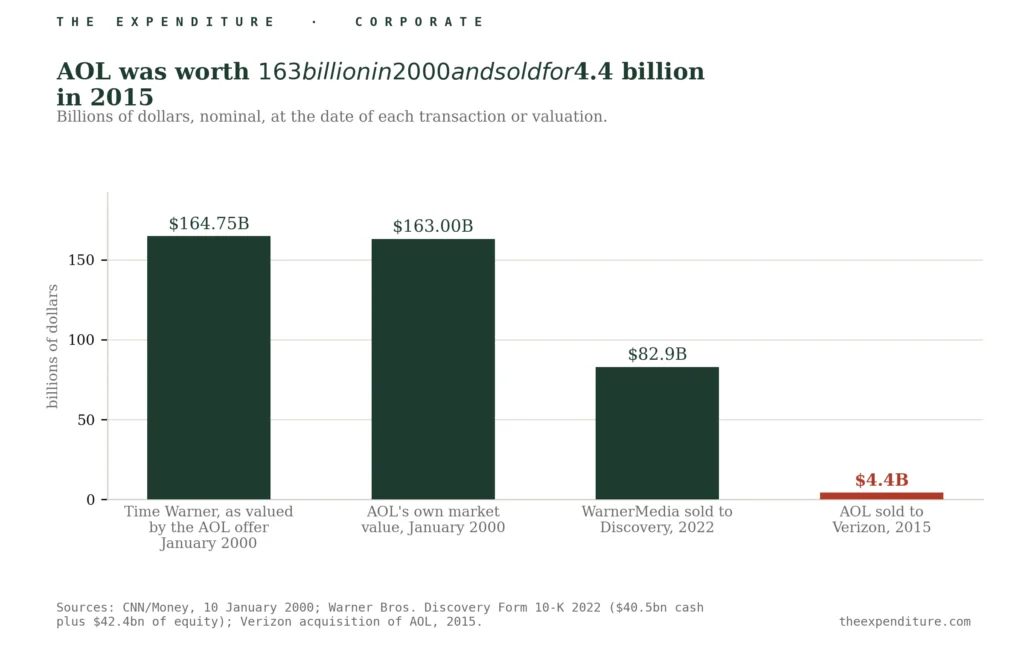
$164.75 billion, for a company whose shares the market valued at $83 billion. On January 10, 2000, AOL announced it would acquire Time Warner in a deal reported at about $182 billion including debt. Time Warner shareholders were to receive 1.5 shares in the new company for each share held, AOL shareholders one for one, and the combined business was expected to open with a market capitalization of $350 billion.
AOL itself entered that Monday worth more than $163 billion. It was the largest deal ever done at the time, well past Vodafone’s $148.6 billion offer for Mannesmann a few weeks earlier. The merger completed on January 11, 2001, and the $54 billion charge landed fifteen months later.
The premium is the whole story. Paying $164.75 billion for an $83 billion company creates roughly $82 billion of goodwill before anything else is counted. Under the old rules that premium would have been amortized quietly into the income statement for decades. Under the new ones it had to be valued, and in 2002 it could not be.
What did the pieces eventually sell for?
AOL went to Verizon in 2015 for $4.4 billion. That is 2.7 percent of the $163 billion the market put on AOL alone on the morning of the announcement in 2000.
The other half traveled further. Time Warner dropped “AOL” from its name on October 16, 2003, per its own 10-K. It was later acquired by AT&T, and in 2022 was sold on again: Warner Bros. Discovery’s 10-K records that on April 8, 2022 “WarnerMedia Holdings, Inc. distributed $40.5 billion to AT&T” and that Discovery “transferred purchase consideration of $42.4 billion in equity to AT&T shareholders in the Merger.” Those two components sum to $82.9 billion, which is what the media half of the 2000 merger was worth twenty-two years later, in dollars that buy considerably less.
Did anyone pay a penalty?
$510 million, four years later. On December 15, 2004 Time Warner announced settlements with the Department of Justice and the Securities and Exchange Commission over how AOL had recognized advertising revenue. The company agreed to “pay a penalty of $60 million and establish a $150 million fund” under the Justice Department agreement, and to “pay a $300 million penalty” to the SEC, requested for a Fair Fund under the Sarbanes-Oxley Act.
The accounting at issue was comparatively small. The company agreed to “adjust its accounting for the $400 million in advertising revenues recognized primarily in 2001 and 2002 in transactions with Bertelsmann, A.G.”, plus about $30 million from two other customers. The write-off was two hundred times larger than the revenue that drew the investigations.
The case that the write-off meant nothing
The strongest argument against treating this as a record of anything is that it records no transaction. No cash moved in the first quarter of 2002. No asset was sold, no creditor was paid, no employee lost a salary because of the charge. Goodwill impairment is a book entry that brings a balance sheet into line with a share price the market had already set, and the market had set it long before. By the time the $54 billion was written down, anyone holding the stock had already taken the loss. On this reading the charge is an artefact of a new accounting standard arriving at a particular moment, and the only real event was the merger.
The argument is correct about the mechanics and wrong about what the number measures. The charge is the first audited statement of how much the premium was worth, and it was made under a rule that removed management’s discretion over timing. That is precisely what makes it a figure rather than an opinion. It also had consequences a share price does not: covenant tests, executive compensation, the credibility of the board and, eventually, the breakup of the company. A loss that exists only on paper is still the loss that forced the name off the door.
What was counted and what was not
The headline figure is the transitional goodwill impairment as filed in the Form 10-Q for the first quarter of 2002, $54.239 billion. Later filings restate it to $54.235 billion and we have flagged that. The full-year net loss of $98.696 billion is from Time Warner’s own trending schedules.
The roughly $99 billion of total write-offs often quoted is the sum of two rounded press figures, $54.2 billion and $45.5 billion, and we have not found a single filed sentence stating a combined annual impairment on that basis. On the restated schedules the equivalent sum is $98.274 billion. Neither total is used as the headline here for that reason.
This is a non-cash figure throughout, and that distinction is not cosmetic. BP’s Gulf of Mexico bill of $65.765 billion is the largest sum any single company has actually paid out over one event, and it is a smaller number than this one. A write-down and a check are different kinds of record and should never be ranked against each other.
Excluded: Vodafone’s impairment of £23.515 billion in the year to March 31, 2006, the largest ever recorded by a British company, which is not converted here because it covers impairment losses rather than goodwill alone and would need a rate and a basis we could not establish. Also excluded are impairments of intangible assets other than goodwill, which several of the comparison companies report alongside goodwill in a single line.
Key figures
- $54.239 billion: the first-quarter 2002 goodwill impairment, the largest single charge on record
- $45.5 billion: the further write-off announced in December 2002
- $98.696 billion: AOL Time Warner’s net loss for 2002
- $99.289 billion: AIG’s net loss for 2008, which is larger
- $164.75 billion: what AOL’s offer valued Time Warner at in January 2000
- $83 billion: Time Warner’s market capitalization at the time
- $4.4 billion: what AOL sold for in 2015
- $510 million: the combined Justice Department and SEC settlements of December 2004
The open question
Twenty-four years on, no company has come within half of AOL Time Warner’s charge. That is not because the discipline improved. It is because no acquirer has since been able to issue enough of its own inflated paper in one transaction to create $82 billion of goodwill. The record is safe for as long as nothing is ever again that overvalued.
Frequently asked questions
The amount a buyer pays above the fair value of the identifiable assets and liabilities it acquires. It sits on the balance sheet as an asset, and it exists only because somebody once agreed to a price.
For fiscal years beginning after December 15, 2001, under Statement of Financial Accounting Standards No. 142. Before that, goodwill was written down gradually over a period that could extend to forty years, regardless of whether its value had actually fallen.
How AOL recognized advertising revenue. The company agreed in December 2004 to restate $400 million of advertising revenue booked mainly in 2001 and 2002 in transactions with Bertelsmann, plus about $30 million from two other customers.
$4.4 billion, in 2015. AOL’s own market value on the day it announced the Time Warner merger in January 2000 was more than $163 billion.
October 16, 2003, when it changed its name to Time Warner Inc. The write-offs had been recorded the previous year and the chief executive who built the merger had already gone.
It was sold again in 2022. AT&T received $40.5 billion in cash from the entity holding WarnerMedia, and its shareholders received $42.4 billion of equity in the company that became Warner Bros. Discovery, leaving them with 71 percent of it.
Notes. Currency note: all figures are in dollars as filed, with no conversion. Vodafone’s figure is left in pounds for the reason given in the exclusions. Figures are nominal and are not adjusted for inflation; a 2002 dollar and a 2022 dollar are not the same thing and are never added together here.
Sources
- AOL Time Warner Inc., Form 10-Q for the quarterly period ended March 31, 2002
- AOL Time Warner Inc., Form 10-Q for the quarterly period ended September 30, 2002
- Time Warner Inc., Form 10-Q for the quarterly period ended March 31, 2003
- Time Warner Inc., Form 8-K exhibit, “2003 Trending Schedules”
- Time Warner Inc., Form 10-K for 2003 and for 2004
- Time Warner Inc., Form 8-K of December 15, 2004, exhibit 99.1
- American International Group, Inc., results release of March 2, 2009
- Warner Bros. Discovery, Inc., Form 10-K for 2022
- AT&T Inc., Form 8-K exhibits for fourth quarter 2020 and fourth quarter 2022 results
- General Electric Company, third quarter 2018 results exhibit
- Teva Pharmaceutical Industries, full year 2017 results, February 8, 2018
- Hewlett-Packard Company, fourth quarter and full year 2012 results exhibit
- Kraft Heinz Company, fourth quarter and full year 2018 results exhibit
- CNN/Money, January 10, 2000, and January 30, 2003 (press)