Record Data Sheet
A €4 million ($4.49 million) initial financing announcement. A €30 million ($33.65 million) original investment ambition. A planned microalgae biorefinery that has moved from Navarra to Alcañiz, Aragón. Microalgas Future is attempting to turn a biotechnology opportunity into an industrial operation. But who has actually provided the capital, which companies are involved, and how much of the proposed investment has been secured?
From a €30 million project in Navarra to a new industrial plan in Aragón
The project was first presented in March 2024 as a major European research and industrial microalgae centre planned for the Ribera region of Navarra, initially associated with Tudela.
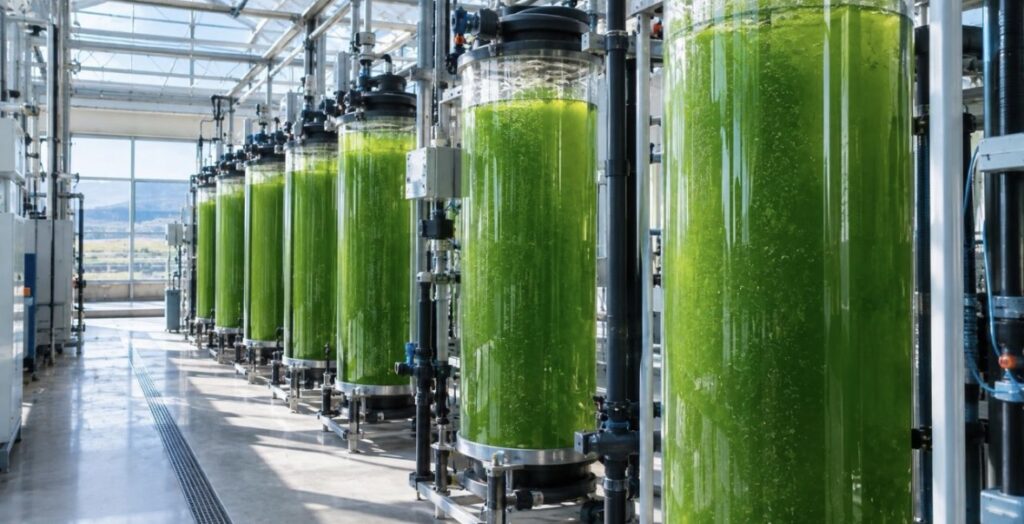
The original proposal envisaged approximately 50,000 square metres of cultivation areas, research laboratories with capacity for 25 researchers and the development of three microalgae strains: spirulina, Haematococcus pluvialis and Schizochytrium.
The initial investment estimate was approximately €30 million ($33.65 million). The project aimed to combine research, large-scale cultivation, extraction and the commercial development of high-value compounds for nutrition, cosmetics, pharmaceuticals and other industrial applications.
By July 2024, the company was communicating a more specific first-stage configuration: 20,000 square metres of cultivation, initial annual capacity of 60 tonnes of spirulina biomass and an initial financing announcement of €4 million ($4.49 million).
The project has since changed location. In October 2026, Microalgas Future selected Alcañiz, in Teruel, as the site for its industrial operation. The revised proposal involves approximately €20 million ($22.43 million) in investment and 30–40 jobs. The company has also indicated that its research activity in Navarra will continue through its subsidiary, Microalgas Navarra Biotech, at CEIN in Noáin.
The current plan is therefore not simply the original Tudela project moved to another address. The configuration has evolved, and the investment figures refer to different stages and plans.
The financing: €4 million announced, €30 million targeted
The most important financial question is not the size of the proposed plant. It is the origin and status of its capital.
In July 2024, Microalgas Future announced that it was starting with €4 million ($4.49 million) in financing. The company also outlined a longer-term capital objective of €30 million ($33.65 million), with an intended structure of:
- €15 million ($16.82 million) in public investment.
- €15 million ($16.82 million) from private investors.
These were the funding targets communicated at the time. They should not be interpreted as evidence that the full €30 million had been raised, approved or disbursed.
The publicly available announcements reviewed do not identify the private investors behind the initial €4 million, provide a complete list of shareholders contributing the funds, or establish that the proposed €15 million public and €15 million private components were subsequently secured.
That leaves an important gap in the investment story: the company announced a financing starting point, but the public record does not provide a complete investor-by-investor breakdown.
What the corporate capital records show
There is, however, a more concrete financial trail.
Microalgas Future SL was incorporated with initial share capital of €6,000 ($6,730). In April 2025, the company registered a capital increase of €1.002 million ($1.124 million), bringing its share capital to €1.008 million ($1.131 million).
A further increase of €56,616 ($63,500) brought the registered share capital to €1.0646 million ($1.194 million).
These figures are relevant because they provide evidence of registered corporate equity. But share capital is not the same as total project financing, and the capital increases do not identify the ultimate investors or establish that the money was used to build the industrial facility.
The distinction is important: the €4 million financing announcement, the €1.0646 million registered share capital and the €30 million project ambition are three different figures. They should not be added together or treated as interchangeable.
The unanswered question is straightforward: who subscribed to the capital increases, and what portion of the original €4 million came from founders, private investors, loans or other financing instruments?
The companies involved: who is developing the project?
The original project was presented as a business and research consortium. Several organisations were identified, although their roles and commitments need to be distinguished from those of future construction contractors and commercial customers.
IDavinci — project coordination
IDavinci, a Madrid-based innovation consultancy, was identified as the coordinator of the original initiative.
Its role was associated with the coordination and development of the project, including the innovation and investment strategy. Public information reviewed does not provide a detailed breakdown of its fees, equity participation or contractual payments.
Algaloop — industrial microalgae expertise
Algaloop, a biotechnology company from the Basque Country, was identified as the industrial partner in the original consortium.
Its role was associated with microalgae cultivation and the industrial development of the project. This is an important distinction: Algaloop was presented as an industrial partner, but the public information reviewed does not disclose a complete contract value, its precise ownership relationship with Microalgas Future or a confirmed allocation of the new Alcañiz plant’s construction work.
University of Valladolid — research and development
The Institute of Sustainable Processes at the University of Valladolid was associated with the original research programme.
There is also a specific financial record worth highlighting. The university’s research portal identifies a private contract funded by Microalgas Future for preliminary laboratory work and a pilot project on the regeneration of industrial water through microalgae cultivation.
The contract was valued at €19,928.70 ($22,353) and ran from 28 January to 30 June 2026. The university identifies researchers Raul Muñoz Torre and Andres Felipe Torres Franco as the project leads.
This is a disclosed research expenditure and a concrete example of money being allocated to technical development. It is not a construction contract and should not be confused with the capital required for the full biorefinery.
Microalgas Navarra Biotech and CEIN — the research operation in Navarra
The company has indicated that its research activity in Navarra will continue through Microalgas Navarra Biotech, its subsidiary, at the Centre for Innovation and Business Development of Navarra (CEIN) in Noáin.
The laboratory is expected to maintain research and development work on microalgae strains, including the more technically demanding cultivation activities.
This creates a distinction between the industrial production site in Aragón and the research activity retained in Navarra. The financial terms of the laboratory arrangement and the subsidiary’s investment commitments have not been fully disclosed in the information reviewed.
TechnoPark MotorLand — the new industrial location
The industrial project is now planned for TechnoPark MotorLand in Alcañiz, a technology and industrial park with a public-sector ownership background.
The location provides an industrial and innovation environment for the new proposal. However, the selection of a site does not itself establish that public funding has been awarded or that construction contracts have been signed.
The company has indicated that administrative procedures for the new facilities have begun. A complete public breakdown of land costs, construction expenditure, equipment suppliers or public incentives has not been identified.
Who is building the plant? And which pharmaceutical companies are involved?
This is one of the most relevant questions for understanding where the project’s capital will ultimately go.
A biorefinery of this type requires more than cultivation areas. It may involve greenhouse structures, controlled cultivation systems, water treatment, pumping and filtration equipment, extraction systems, laboratories, quality-control facilities, storage, energy infrastructure and industrial processing equipment.
Each of these areas can generate contracts for engineering firms, construction companies, equipment manufacturers and specialist technology providers.
However, the public information reviewed does not identify a confirmed construction contractor for the Alcañiz facility, nor does it disclose a supplier-by-supplier capital expenditure budget.
The same applies to pharmaceutical, cosmetics and nutrition companies. Spirulina, Haematococcus and Schizochytrium have potential applications in these markets, but the existence of a potential end market does not establish that a pharmaceutical company has signed a supply agreement or invested in the project.
No named pharmaceutical or cosmetics customer with a publicly disclosed investment or purchase commitment has been identified in the material reviewed.
For investors, this is a material information gap. A company can have an attractive product portfolio and a large addressable market, but commercial agreements are what help turn production capacity into predictable revenue.
Three microalgae strains and three potential markets
The industrial strategy is based on three biological inputs with different commercial applications.
Spirulina: the first strain identified for cultivation and production. It is used in food and nutritional products, with potential applications in protein-rich ingredients and supplements. The later 20,000-square-metre configuration included an initial production target of 60 tonnes of annual biomass.
Haematococcus pluvialis: associated with astaxanthin, a pigment and antioxidant compound used in nutritional and cosmetic applications. Its commercial value depends on cultivation yields, extraction efficiency, purity and the ability to meet customer specifications.
Schizochytrium: a source of omega-3 oils, including DHA, with potential applications in food and nutrition products. Its commercial development depends on production economics, quality standards and customer demand.
The strategic logic is to develop a portfolio of products rather than depend on a single biomass market. Higher-value extracted compounds may offer better economics than selling raw biomass alone.
But the model also adds complexity. Each strain requires specialised cultivation and processing, and each target market has different regulatory, quality and commercial requirements.
The carbon-removal opportunity: what needs to be measured?
Microalgae can absorb carbon dioxide during photosynthesis, and this is one of the environmental arguments associated with industrial cultivation.
The original project was presented as having potential applications in decarbonisation, industrial wastewater treatment and circular-economy processes.
However, a headline claim that one gram of microalgae can absorb a certain quantity of CO₂ should not be treated as proof of permanent carbon removal. The actual result depends on the species, cultivation conditions, measurement method and what happens to the biomass after production.
If the biomass is processed into food, supplements or other compounds, the carbon may eventually return to the atmosphere. A credible environmental assessment therefore requires lifecycle analysis, measurement of emissions across the production process and evidence of any carbon that remains stored.
For a project seeking to attract industrial and institutional capital, independently verified environmental performance could become an important commercial asset.
What investors still need to know
The project has a potentially attractive industrial proposition, but several questions remain unanswered in the public information reviewed.
| Financial question | Public information identified |
|---|---|
| Initial financing | €4 million ($4.49 million) announced in 2024 |
| Original project ambition | €30 million ($33.65 million) |
| Proposed public funding | €15 million ($16.82 million) target |
| Proposed private funding | €15 million ($16.82 million) target |
| Registered share capital | €1.0646 million ($1.194 million) |
| Identified research contract | €19,928.70 ($22,353) |
| New Alcañiz investment proposal | Approximately €20 million ($22.43 million) |
| Named private investors | Not disclosed in the material reviewed |
| Confirmed construction contractor | Not identified |
| Named pharmaceutical or cosmetics customers | Not identified |
| Binding commercial supply agreements | Not identified in the material reviewed |
The figures refer to different dates and financial concepts. They are not additive. The new €20 million Alcañiz proposal should not be added to the original €30 million ambition, and the registered share capital should not be presented as the total amount invested in the project.
The Expenditure’s Verdict
Microalgas Future is an interesting case study in the financing of industrial biotechnology in Spain. The project has evolved from an ambitious research and production centre in Navarra into a new industrial proposal in Aragón, with a different location and a revised investment figure.
There is evidence of corporate capital increases and a specific privately financed research contract with the University of Valladolid. There is also a clearly identified original industrial consortium involving IDavinci and Algaloop.
But the most important financial details remain incomplete. The identities of the private investors behind the initial financing have not been publicly established in the information reviewed. The proposed public-private funding structure has not been demonstrated as fully secured, and the construction contractors, equipment suppliers and pharmaceutical customers have not been identified through disclosed contracts.
The next stage should be judged by measurable milestones: capital actually committed, public grants or loans formally awarded, construction contracts signed, equipment installed, production capacity commissioned and customer agreements secured.
A €20 million ($22.43 million) industrial proposal can attract attention. A financed plant with signed customers, verified production yields and recurring cash flow is what can attract institutional capital.
A question for investors and the biotechnology industry
Spain has research institutions, industrial land, engineering companies and a growing ecosystem of biotechnology ventures. Yet projects that combine biological research with large-scale manufacturing still face a difficult transition from laboratory validation to industrial financing.
What is missing? More patient private capital? Public funding that takes on early-stage technological risk? Industrial customers willing to sign long-term supply agreements? Or greater cooperation between biotechnology companies, pharmaceutical groups and engineering contractors?
What do you think this sector needs to attract €20 million–€30 million ($22.43 million–$33.65 million) investments on a regular basis, rather than as isolated projects?
And perhaps the more important question: who should take the first risk — the public sector, private investors or the industrial customers that may eventually benefit from the technology?
Sources and disclosure
- European Central Bank — Euro foreign exchange reference rates. USD conversions use the 2 November 2026 reference rate of €1 = $1.1216.
- Invest in Navarra — Microalgas Future’s initial financing and original project plan.
- University of Valladolid — privately funded Microalgas Future research contract.
- TechnoPark MotorLand — industrial and technology park selected for the new location.
- Aragón Corporación — Parque Tecnológico del Motor de Aragón — corporate and institutional information on the technology park.
- CEIN — Centre for Innovation and Business Development of Navarra.