Record Data Sheet
On August 17, 2026, Prime Minister Mark Carney stood in St. John’s, Newfoundland and Labrador, with the premiers of Newfoundland and Labrador and Quebec, and announced C$10 billion of federal financing, about $7.2 billion, for what his government calls the largest clean energy investment in North American history: a package of projects worth nearly C$70 billion, about $50.5 billion. The money matters less than what it is paying for. Ottawa is putting public capital behind the replacement of one of the most one-sided long-term contracts in Canadian business history.
What the federal money pays for
According to the government, the financing supports the upgrade and expansion of the Churchill Falls Generating Station, the development of the long-delayed Gull Island hydroelectric project, new transmission lines, and co-investment with the Innu of Labrador in a 2,000-megawatt onshore wind project. Gull Island alone would add about 2,700 megawatts. In all, the utilities are evaluating up to 14,000 megawatts of new and existing hydro capacity, nearly triple what Churchill Falls produces today.
The government did not say whether the C$10 billion takes the form of loans, guarantees or direct investment. Either way, the ratio is the point: about one dollar of federal money for every seven dollars of project value, meant to unlock utility and private capital that would not move at this scale, or at this cost, without Ottawa behind it. The government expects the package to support 23,000 jobs and add C$31 billion, about $22.4 billion, to Canada’s GDP through the early 2040s.
Why the deal needed a government at all
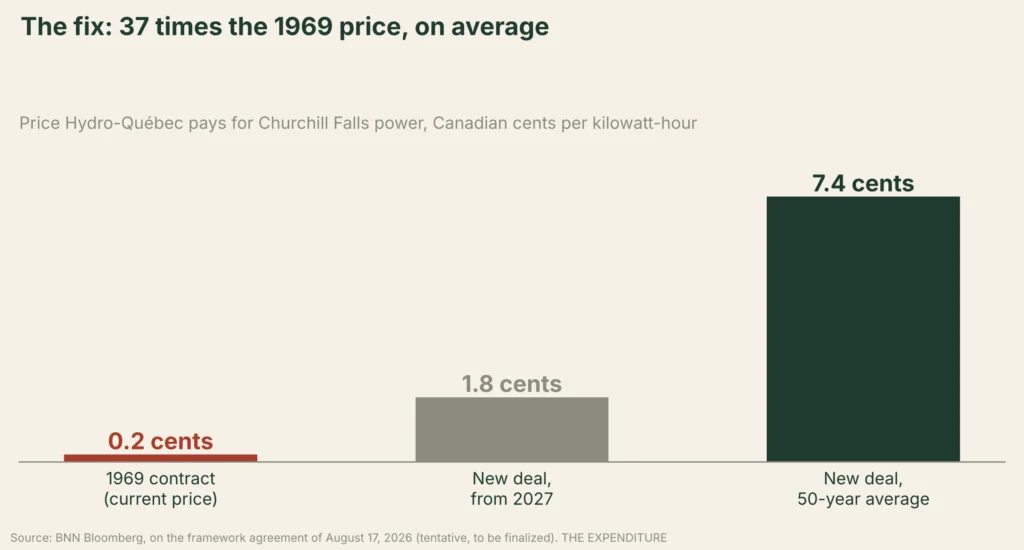
The commercial logic runs through the 1969 Churchill Falls contract, a textbook case of a bad deal. Under it, Hydro-Québec secured most of the plant’s output at a fixed, very low price for 65 years, until 2041, with no adjustment for inflation or market prices. Today it pays about 0.2 Canadian cents per kilowatt-hour. Hydro-Québec has earned tens of billions of dollars reselling that power, while Newfoundland and Labrador, which owns the plant, received a small fraction of its value.
Under the new framework, as reported by BNN Bloomberg, the price rises to 1.8 cents from 2027 and averages 7.4 cents over 50 years, about thirty-seven times today’s level. That is higher than the 5.9-cent average proposed in a 2024 draft. Newfoundland and Labrador expects about C$49 billion, roughly $35 billion, over the 50 years, and the right to send up to 985 megawatts through Quebec to US markets.
Signed, or only announced
The agreement replaces both the 1969 contract and a 2024 memorandum of understanding that had attempted a partial fix. But BNN Bloomberg describes it as a tentative framework, not a binding final agreement, with negotiators aiming to complete the details by the end of 2026. The federal release frames the financing in firmer terms. That gap, between what has been signed and what has been announced, is the thing to watch.
Power first, minerals next
Alongside the energy financing, the government referred the Labrador Trough Clean Power, Critical Minerals and Infrastructure Corridor to its Major Projects Office, which coordinates permitting and financing for large national projects. Natural Resources Canada also funded early work through its First and Last Mile Fund, including the Labrador West transmission expansion and the Kami iron mine partnership. The region holds large high-purity iron ore deposits, and the sequencing is deliberate: build the power first, so the mines that follow do not stall waiting for electricity.
The risk being transferred
Public financing on this scale moves risk from lenders and utility balance sheets toward the federal government. For a multi-decade build-out spanning dams, transmission and wind farms, that is what makes the financing cost workable. It also means the eventual cost to Canadian taxpayers depends on execution: overruns, delays and interest rates over a decade or more, none of which the announcement fixes.
The project’s own history is the warning. The original Churchill Falls deal also looked balanced when it was signed. It became lopsided because nobody priced in six and a half decades of inflation and market change. Whether the new package avoids the same fate depends on whether the final agreements include the price adjustment and review clauses the 1969 contract lacked.
Why it matters
The structure, rather than the size, is the news. Ottawa is acting as a financier that multiplies its capital roughly sevenfold, instead of paying for projects outright. That template is likely to reappear in other energy and critical minerals projects. And the deal is a concrete reminder that very long contracts without review or indexation can cost one side decades of value, a lesson for anyone negotiating supply agreements, leases or offtake contracts. Another public bet on long-lived energy infrastructure is California’s high-speed rail, whose cost has been rising for years.
Figures we could not confirm
We could not confirm the name “Definitive Cooperation and Implementation Agreement” for the utilities’ framework, which appeared in an earlier version of this article.
Frequently asked questions
C$10 billion of financing, about $7.2 billion, toward a package worth nearly C$70 billion, about $50.5 billion.
The Churchill Falls upgrade and expansion, the Gull Island hydro project, new transmission lines and co-investment in a 2,000-megawatt wind project with the Innu of Labrador.
Not yet. It is a framework agreement, which the provinces aim to finalize by the end of 2026.
1.8 Canadian cents per kilowatt-hour from 2027, averaging 7.4 cents over 50 years, against about 0.2 cents under the 1969 contract.
Up to 985 megawatts, transmitted through Quebec.
It fixed a very low price for 65 years with no inflation adjustment, letting Hydro-Québec earn far more reselling the power than Newfoundland and Labrador earned producing it.
Notes. Canadian dollar figures are converted at about $0.7215 per Canadian dollar, derived from the ECB reference rates on August 17, 2026 ($1.1593 and C$1.6067 per euro, Banca d’Italia). Prices per kilowatt-hour are in Canadian cents, as reported. The one-to-seven ratio and the price multiple are our calculations.
Sources
- Prime Minister of Canada, “Prime Minister Carney announces largest clean energy investment in North American history,” August 17, 2026: https://pm.gc.ca/en/news/news-releases/2026/08/17/prime-minister-carney-announces-largest-clean-energy-investment-north
- BNN Bloomberg, “Quebec and Newfoundland and Labrador reach energy agreement,” August 17, 2026: https://www.bnnbloomberg.ca/business/politics/2026/08/17/quebec-and-newfoundland-and-labrador-reach-energy-agreement/
- Lexpert, “North America’s biggest clean energy investment covers Churchill Falls, Gull Island projects”: https://lexpert.ca/news/energy-law/north-americas-biggest-clean-energy-investment-covers-churchill-falls-gull-island-projects/394519
- E&E News, “Trump’s trade threats give Canada’s biggest clean-energy bet new urgency”: https://www.eenews.net/articles/trumps-trade-threats-give-canadas-biggest-clean-energy-bet-new-urgency/
- Banca d’Italia, euro reference rates, August 17, 2026: https://www.bancaditalia.it/compiti/operazioni-cambi/cambio/cambi_rif_20260817