Record Data Sheet
A church on 224 wheels. Twelve thousand people. Two schools, a sports hall, a water tower. One mine that is not finished.
Moving Kiruna, the iron ore town 145 kilometers north of the Arctic Circle, will cost its mining company about $4.4 billion (SEK 43.4 billion) across the two phases costed so far. That total is ours: SEK 20.9 billion paid and reserved for the first phase, plus the SEK 22.5 billion LKAB estimates for the expanded area it announced in 2025. Divided by the 12,000 people those two phases displace, it comes to $365,000 per person moved.
The record needs a definition, and the definition is almost the story. Kiruna is the most expensive mining-driven relocation of a town with a published price. It holds the title partly by default: RWE, which has resettled more than 30,000 people to feed its lignite mines in western Germany, told Mining Monthly it had no figures for the cost. Kiruna has a number because LKAB is owned by the Swedish state and reports it. (More Corporate records here.)
Why is Kiruna moving at all?
LKAB’s underground mine runs beneath the town, and the deeper it goes, the more the ground above it deforms. LKAB says its mining now affects about a third of Kiruna’s urban center. Swedish rules do not allow mining under standing buildings, as press coverage of the church move explained, so the buildings go first.
The move was first planned in 2004 and, according to CNBC, is expected to be completed by 2035, with a new center about three kilometers east of the old one. The mine is not optional for Sweden or for Europe: in 2025 LKAB produced 86 percent of all iron ore mined in the EU.
What does it cost per resident of Kiruna?
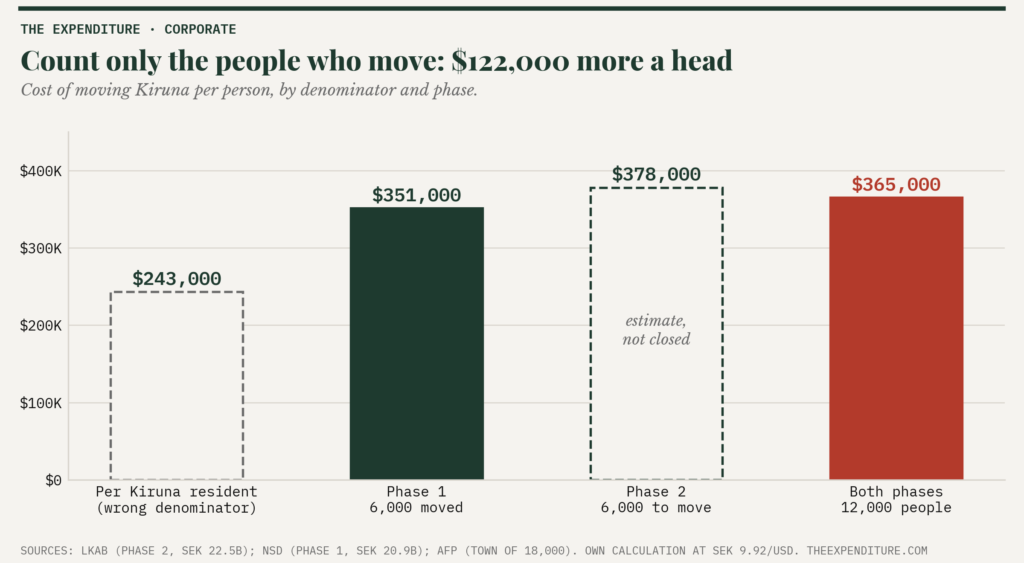
This is the question the number seems to invite, and it gives the wrong answer. Kiruna is a town of about 18,000 people, according to AFP. Spread $4.38 billion across all of them and you get $243,000 a head.
But two thirds of the town is not moving. The residents outside the deformation zone are not part of the bill, and dividing by them makes the move look cheaper than it is. The right question is what it costs per person who actually has to leave.
How much does it cost per person moved?
Twelve thousand people are inside the two costed phases: 6,000 in the first, 6,000 more in the second. At SEK 43.4 billion, that is SEK 3.62 million each, or $365,000 per person displaced. Counting only the people who move adds $122,000 to every head.
The two phases are not priced the same:
- Phase 1: SEK 20.9 billion for 6,000 people is SEK 3.48 million, or $351,000 per person.
- Phase 2: SEK 22.5 billion for 6,000 people is SEK 3.75 million, or $378,000 per person, an estimate over ten years and not a closed figure.
The second phase costs about 8 percent more per head. LKAB does not break down why.
What did $4.4 billion actually move?
The first phase, SEK 20.9 billion ($2.11 billion). The agreements signed in 2015 covered about 3,000 homes, 6,000 people and 450,000 square meters of public and commercial premises, the figures LKAB presented at the time, as cited by local paper NSD. By September 2022, LKAB’s project lead told NSD the company had paid SEK 12 billion in Kiruna and reserved another SEK 8.9 billion. Part of that went to the municipality: by May 2024 LKAB had compensated Kiruna with about SEK 5 billion in cash ($504 million) and properties worth about SEK 2.5 billion ($252 million), and in 2024 agreed to replace the sports hall, two schools and the water tower at a cost of around SEK 2 billion, according to TT.
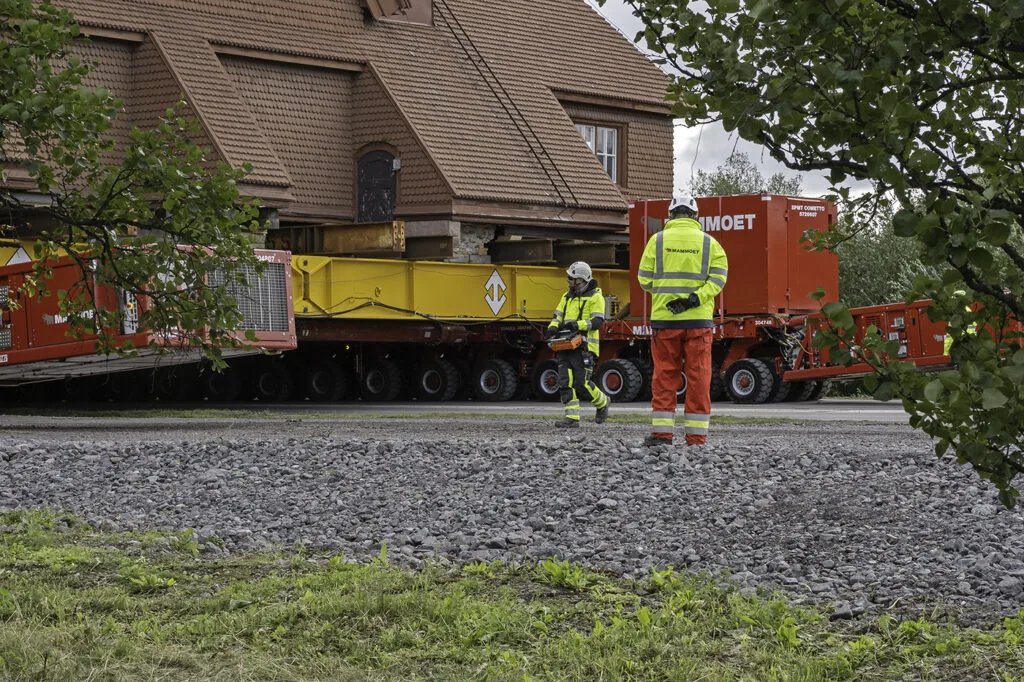
The line item everyone saw was the church. Kiruna Church, 672 tonnes and built between 1909 and 1912, was rolled about five kilometers on self-propelled transporters with 224 wheels on 19 and August 20, 2025, broadcast live on Swedish television. By mid-2025, 23 cultural buildings had already been relocated, and the grave of the town’s founder, Hjalmar Lundbohm, was moved with the church.
The second phase, SEK 22.5 billion ($2.27 billion). On August 28, 2025 LKAB published a new deformation forecast: about 2,700 more homes and 6,000 more people inside the impact zone, to be compensated over the next ten years at an estimated SEK 22.5 billion. In its third-quarter accounts LKAB raised its urban transformation provisions by about SEK 20 billion ($2.02 billion) and charged SEK 4 billion ($403 million) to the quarter, turning a profit into an operating loss of SEK 2.4 billion ($242 million). For scale, the whole group sold about SEK 33 billion ($3.3 billion) of product in 2025, so one quarter’s provision was worth 61 percent of a year’s sales.
The town’s share. The municipality ran short first. In May 2026 Kiruna announced a SEK 1.8 billion gap in the investments it needed to keep the move going. In June, LKAB agreed a package of about the same size ($181 million): SEK 1.1 billion to take over infrastructure and building projects the town could no longer finance, and about SEK 700 million for land and properties in the next phase. The municipality had put its remaining costs at SEK 50,000 per resident, roughly $5,000 each, on top of everything LKAB pays.
Moving a town is expensive. For a miner this size it is still a cost of doing business, and LKAB has been booking it since 2006.
What would it cost to move Chicago?
Take Kiruna’s rate, $365,000 per person displaced, and apply it to an American city.
- Chicago, 2,731,585 people (US Census Bureau estimate for 2025): $996 billion.
- Dallas, 1,385,989 people (North Central Texas Council of Governments, January 2025): $505 billion.
- Chicagoland, 9,434,123 people in the metro area (Census 2025): $3.44 trillion.
- Dallas-Fort Worth, 8,477,157 people: $3.09 trillion.
Chicago alone would be 228 Kirunas’ worth of displaced residents.
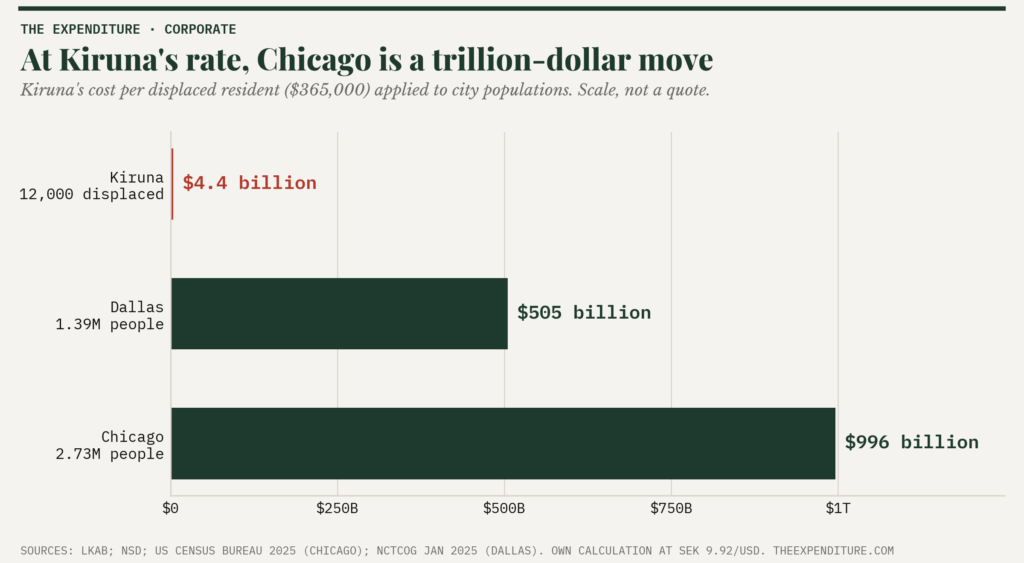
The skeptic’s objection is fair and should be stated. This is scale, not a quote. Kiruna’s per-person figure carries the fixed costs of rebuilding a town hall, schools, heritage buildings and utilities for a small population, and a big city would spread those across far more people. Pulling the other way, land and construction in Chicago or Dallas cost far more than in Arctic Sweden, and dense high-rise housing is harder to replace than detached homes. We do not know which effect wins, so read the trillion as an order of magnitude, not an estimate.
Is the bill closed?
No, and LKAB says so. The company states it cannot say what the urban transformations will cost in the end, because that depends on whether it mines deeper. After the 2025 forecast, CEO Jan Moström said the ore still extends eastward under the old town and remains open at depth to the north.
The group-wide figure shows where this is heading. Across Kiruna and Malmberget, its other mining town, LKAB has paid about SEK 23.7 billion and reserved another SEK 33.2 billion since 2006: SEK 56.9 billion, or $5.74 billion. Our Kiruna total is 76 percent of that.
It is also a floor. We left out three later payments to the municipality (SEK 227 million in 2024, SEK 600 million in 2025 and the SEK 1.8 billion package in 2026), because LKAB does not say whether they sit inside provisions already counted. If all three are new money, Kiruna’s bill rises to about SEK 46 billion, or $4.6 billion.
What did we count, and what did we leave out?
The $4.4 billion total is our calculation, adding LKAB’s estimate for the second phase (SEK 22.5 billion, company-stated, a ten-year estimate) to the first-phase figure of SEK 20.9 billion (SEK 12 billion paid, SEK 8.9 billion reserved), which LKAB’s project lead gave to NSD in September 2022 and which we have not found in an LKAB publication. Head counts are LKAB’s: 6,000 people in the first phase (2015 agreements, as cited by NSD) and 6,000 in the second. Later municipal payments are excluded, as explained above. The record claim is limited to relocations with a published cost; RWE’s Rhineland resettlements are larger in people moved but carry no public figure. The Chicago and Dallas figures multiply our per-person cost by population and are illustrations of scale, not cost estimates. Dallas uses the NCTCOG January 2025 estimate; Chicago and metro figures use the US Census Bureau’s 2025 estimates.
Key figures
- $4.4B (SEK 43.4 billion): cost of moving Kiruna across both costed phases, our sum
- $365,000: cost per person displaced, both phases
- $243,000: the same bill spread over the whole town of 18,000, the wrong denominator
- 12,000: people in the two phases (6,000 each)
- $2.11B / $2.27B: phase 1 (paid and reserved) / phase 2 (estimate, ten years)
- SEK 20 billion: provision increase in one quarter of 2025, 61 percent of LKAB’s annual sales
- 672 tonnes, 5 km, 224 wheels: the Kiruna Church move, August 2025
- $996 billion: Chicago at Kiruna’s rate; $505 billion: Dallas
- $5.74B (SEK 56.9 billion): LKAB’s total paid and reserved for Kiruna and Malmberget since 2006
The open question
Two phases are costed. LKAB says it cannot state a final figure, because that depends on whether it mines deeper, and it says the ore is still open at depth to the north. The forecast that added 6,000 people in 2025 was itself a revision of the one the first phase was built on. Whether $4.4 billion turns out to be most of this bill or a fraction of it depends on a document nobody has written yet.
Frequently asked questions
About $4.4 billion, or SEK 43.4 billion, across the two phases costed so far: SEK 20.9 billion paid and reserved for the first, and an estimated SEK 22.5 billion for the second, announced in 2025. The total is our sum of LKAB’s disclosures. It excludes later payments to the municipality worth up to SEK 2.6 billion more.
LKAB’s underground iron ore mine runs beneath the town, and the deeper it goes the more the ground above it deforms. About a third of the urban center is affected. The move was decided in 2004 and is expected to run to about 2035, with a new center roughly three kilometers east.
Moved, in one piece. The 672 tonne wooden church traveled five kilometers on 224 wheels over two days, 19 and August 20, 2025. It is one of about 23 cultural buildings being relocated rather than demolished, because Swedish rules do not allow mining under standing buildings.
A choice of four, on LKAB’s published terms: a replacement property; a smaller replacement property plus the cash difference; cash at market value plus 25 percent; or cash plus priority access to LKAB’s rental housing. Tenant-owner associations are compensated on the same market-value-plus-25-percent basis. Renters are not offered the property options and receive relocation and new-tenancy compensation instead.
Its main haulage level sits 1,365 meters below the surface and has been in operation since 2013, replacing the 1,045 meter level opened in 1999. LKAB says the orebody is still open at depth and has been assessing whether its sublevel caving method works any deeper. No level below 1,365 meters has been confirmed.
Yes, and it is further along. LKAB is phasing out virtually the whole of Malmberget, in Gällivare municipality: about 3,200 people and roughly 2,200 homes affected, about 1,800 replacement homes already built, and the process expected to run to 2032. LKAB publishes no separate cost figure for Malmberget.
Notes. Currency note: all kronor figures converted at SEK 9.92 per US dollar, the mid-market rate on September 26, 2026. The kronor figures are nominal amounts from different years (2022 to 2026) and are not adjusted for inflation.
Sources
LKAB (primary)
- LKAB: Continued mining affects more of Kiruna (2,700 homes, 6,000 people, SEK 22.5 billion over ten years; ore extends east and open at depth)
- LKAB: Interim report July to September 2025 (provisions up about SEK 20 billion, SEK 4 billion charged, operating loss SEK 2.4 billion)
- LKAB: LKAB is paying (SEK 23.7 billion paid, SEK 33.2 billion reserved since 2006; Minerals Act)
- LKAB: LKAB betalar (2024 version) (final cost cannot be stated; depends on mining deeper)
- LKAB: Urban transformation up to 2035 (a third of the urban center affected)
- LKAB: Agreement on compensation for increased costs, May 2024 (about SEK 5 billion cash and SEK 2.5 billion in property to the municipality; SEK 227 million extra)
- LKAB: Historic agreement with Kiruna municipality, June 2026 (SEK 1.8 billion package)
- LKAB: Annual and Sustainability Report 2025 (SEK 33 billion sales, 86 percent of EU iron ore)
- LKAB: For those affected by the urban transformation, residents (four compensation options; market value plus 25 percent; renters compensated separately)
- LKAB: LKAB in Gällivare and Malmberget (about 3,200 people and 2,200 homes; about 1,800 replacement homes built; to 2032)
- LKAB: The future of sublevel caving is being assessed (no level below 1,365 meters confirmed; method under review)
Press
- NSD: Genomlys samhällsomvandlingen i Malmfälten (opinion piece citing LKAB’s 2022 figures: SEK 12 billion paid and SEK 8.9 billion reserved in Kiruna; 2015 agreements covering 3,000 homes, 6,000 people, 450,000 square meters; later top-ups)
- High North News: LKAB supports Kiruna municipality (SEK 1.1 billion plus SEK 700 million; SEK 50,000 per resident)
- Sweden Herald / TT: LKAB replaces buildings in Kiruna (sports hall, two schools, water tower, around SEK 2 billion)
- CNBC: Kiruna, Swedish city is moving (planned in 2004, completion by 2035, new home 3 km east)
- Gulf News / AFP: Historic Swedish church to relocate (672 tonnes, 5 km, town of 18,000)
- Parametric Architecture: Kiruna Church relocated in one piece (224 wheels, 19 to August 20, 2025, rule against mining under standing buildings)
- Wanderlust: Kiruna Church is being moved (23 cultural buildings relocated, founder’s grave)
- International Railway Journal: LKAB digs even deeper for iron ore (main haulage level at 1,365 meters from 2013; previous level 1,045 meters from 1999)
- Mining Monthly: Thousands resettled in expansion (RWE: more than 30,000 people resettled since 1948, no cost figures)
Populations
- Fox 32 Chicago: Census 2025 estimate (Chicago 2,731,585)
- NCTCOG 2025 Population Estimates (Dallas 1,385,989, January 2025)
- Texas Monthly: 2025 census metro population (Chicago region 9,434,123; DFW 8,477,157)
Currency
- XE: USD to SEK (9.9183, September 26, 2026)