Record Data Sheet
China’s National Development and Reform Commission began deploying the first batch of its 2026 policy financing instrument this week, sending capital to projects in Zhejiang, Yunnan, Sichuan, and Xinjiang, according to Chinese state financial media reporting on the rollout. The headline figure, 800 billion yuan, is real and confirmed. What that money actually does is less a spending story than a financial engineering story, and the engineering is the more interesting part.
What this money is not
It is not a loan to a project, and it is not a grant. China’s “new-type policy-based financial instrument” is capital injected directly into a project’s own equity base, the “registered capital” a project needs on its books before any bank will lend against it. Chinese project finance rules generally require a project to hold a minimum share of its own capital, often 20% to 30% depending on the sector, before commercial loans can legally follow. Plenty of viable infrastructure and industrial projects in China’s slower-growing regions simply don’t have investors willing to supply that first slice of capital. This tool supplies it instead.
The capital itself is raised by three state policy banks, China Development Bank, the Agricultural Development Bank of China, and the Export-Import Bank of China, each issuing their own financial bonds to fund their share, rather than the central government issuing sovereign debt directly. That structure is deliberate: because the policy banks carry the debt on their own books, not the state treasury or local governments, the spending does not register as an increase in official government debt figures, even though the capital originates from state-directed policy banks.
The multiplier is the entire point
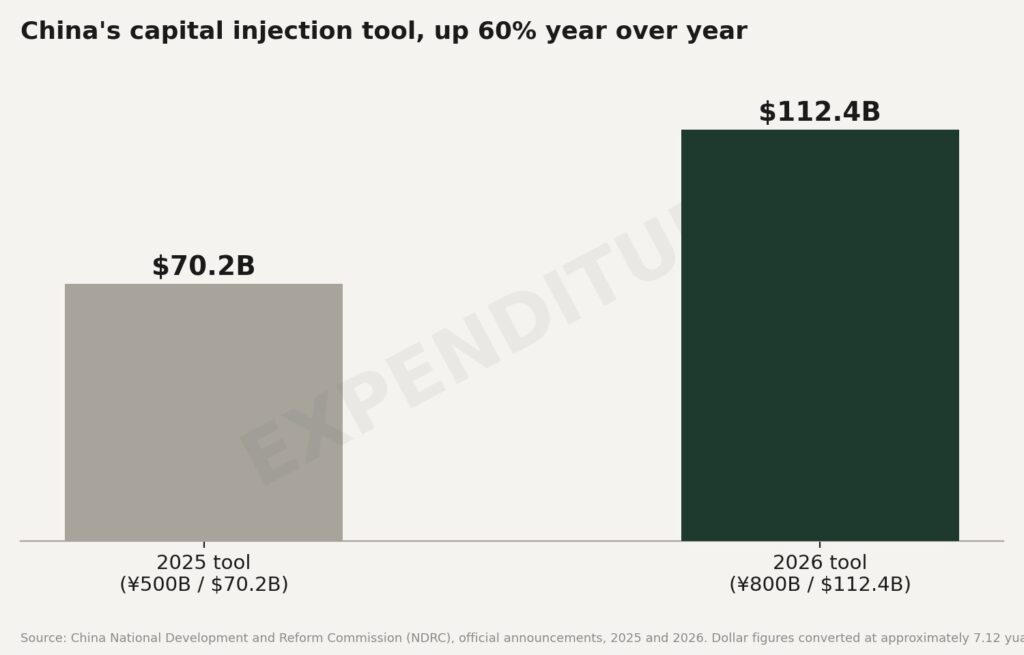
The 2025 version of this tool, sized at 500 billion yuan, leveraged more than 7 trillion yuan in total project investment once bank loans and private capital followed the initial injection, according to NDRC’s own account of the program’s results. That works out to roughly 14 times the original capital injection in total investment activity, an order of magnitude that only makes sense once you remember the injected capital is not the loan, it is the credibility that unlocks the loan.
Scaling the tool to 800 billion yuan for 2026, a 60% increase, some market analysts have projected the total leveraged investment could reach approximately 10 trillion to 11 trillion yuan, though that specific 2026 projection comes from analyst commentary rather than an NDRC figure, and should be read as an estimate, not a confirmed outcome. If the leverage ratio holds anywhere close to 2025’s, even a conservative reading implies China is using 800 billion yuan of policy bank capital to try to catalyze an amount of total investment activity in the range of a trillion dollars or more.
Where the money is actually supposed to go in 2026
NDRC officials have described this year’s rollout as weighted more heavily toward digital economy infrastructure, artificial intelligence, advanced manufacturing, and emerging sectors like the low-altitude economy, drones and electric vertical takeoff aircraft, alongside the traditional infrastructure and public livelihood projects the tool funded in prior years. The first disbursed batch, distributed across Zhejiang, Sichuan, and Yunnan, was directed toward green low-carbon development, new energy, and new materials projects specifically, according to Chinese financial media coverage of the announcement.
Paired with the capital injection, China has also introduced a fiscal interest subsidy for 2026, cutting borrowing costs by 1.5 percentage points annually for up to two years on qualifying small and medium enterprise loans, capped at 50 million yuan per company. That detail matters for reading the whole program correctly: this isn’t only a tool for large state-linked infrastructure projects anymore. Part of the 2026 expansion is explicitly aimed at private, smaller-scale borrowers who would otherwise face higher financing costs.
Why this exists right now
China’s own investment data gives the backdrop. Fixed-asset investment fell year over year in the first seven months of 2026, and private investment specifically fell by a steeper margin over the same period, according to figures reported alongside coverage of this program’s expansion. A tool built to make weak or capital-short projects bankable again is a direct response to that private investment slowdown, not a routine annual infrastructure allocation.
Sizing 800 billion yuan against something concrete
At current exchange rates, 800 billion yuan converts to approximately 112.4 billion dollars, a sum larger than the entire 2024 gross domestic product of Ecuador, which the World Bank put at approximately 118 billion dollars, putting China’s capital injection within range of an entire South American economy’s annual output, before any of the bank lending or private capital this tool is designed to attract is even added on top.
Why we consider this relevant
The mechanism here generalizes well beyond China. Any government facing a private investment slowdown has the same basic menu of tools: spend directly, cut interest rates, or do what China is doing here, inject a comparatively small amount of capital at exactly the point in a project’s financing structure that unlocks a much larger amount of private and bank capital behind it. The leverage ratio is the number that actually matters, not the headline injection, because the headline figure understates the intended economic effect by an order of magnitude if the mechanism works as designed.
It is also a reminder that “government debt” as an official statistic can undercount the state’s real footprint in an economy. Capital routed through policy banks issuing their own bonds, rather than the treasury issuing sovereign debt, can fund enormous state-directed investment activity while leaving the headline government debt figures largely unchanged.
Frequently asked questions
How much is China’s 2026 policy financing instrument worth?
800 billion yuan, approximately 112.4 billion dollars, according to Chinese official figures, up from 500 billion yuan in 2025.
Is this money a loan or a grant to companies?
Neither. It is capital injected into a project’s own registered capital base, the equity a project needs before it can legally qualify for bank loans under Chinese project finance rules.
How much total investment did the 2025 version of this tool generate?
More than 7 trillion yuan in total project investment, once bank loans and private capital followed the
initial 500 billion yuan injection, according to NDRC’s own account, a roughly 14 times multiplier.
Does this program count as Chinese government debt?
Not in official government debt statistics. The capital is raised by three state policy banks issuing their own bonds, rather than the central government issuing sovereign debt directly, which keeps the spending off official government debt figures even though it originates from state-directed institutions.
Which sectors is the 2026 money targeting?
Digital economy infrastructure, artificial intelligence, advanced manufacturing, and the low-altitude economy, alongside traditional infrastructure and public livelihood projects, according to NDRC officials, with the first disbursed batch directed toward green low-carbon development, new energy, and new materials projects.
Why did China expand this tool now?
China’s own fixed-asset investment data showed a year-over-year decline in the first seven months of 2026, with private investment falling by a steeper margin, providing the economic backdrop for expanding a tool specifically designed to make undercapitalized projects attractive to private and bank lenders again.
Sources
- China National Development and Reform Commission (NDRC), official statements and work conference announcements on the 2026 policy-based financial instrument rollout
- China Development Bank, Agricultural Development Bank of China, and Export-Import Bank of China, official bond issuance disclosures funding the 2026 instrument
- The World Bank, GDP data for Ecuador (current US dollars, 2024), World Bank national accounts data