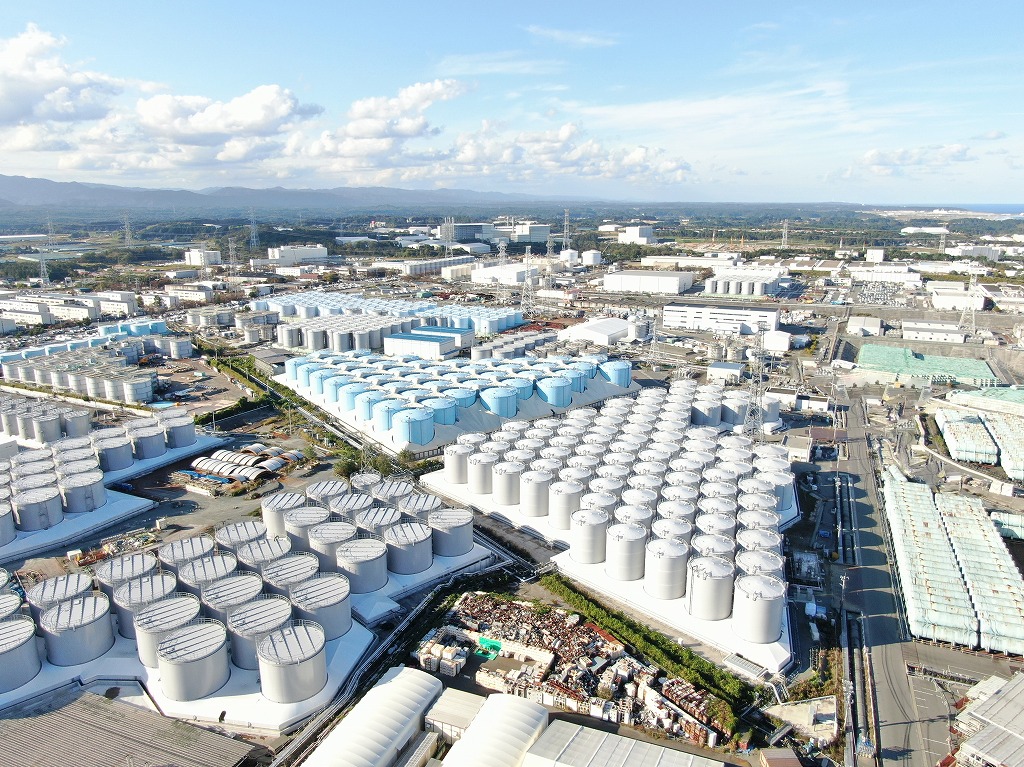
Record Data Sheet
Fifteen years after the meltdowns, Japan’s government puts the bill for the Fukushima Daiichi nuclear accident at ¥23.4 trillion ($156.4 billion). It covers compensation, decontamination, waste storage and the dismantling of the plant itself, and it has gone up with almost every revision.
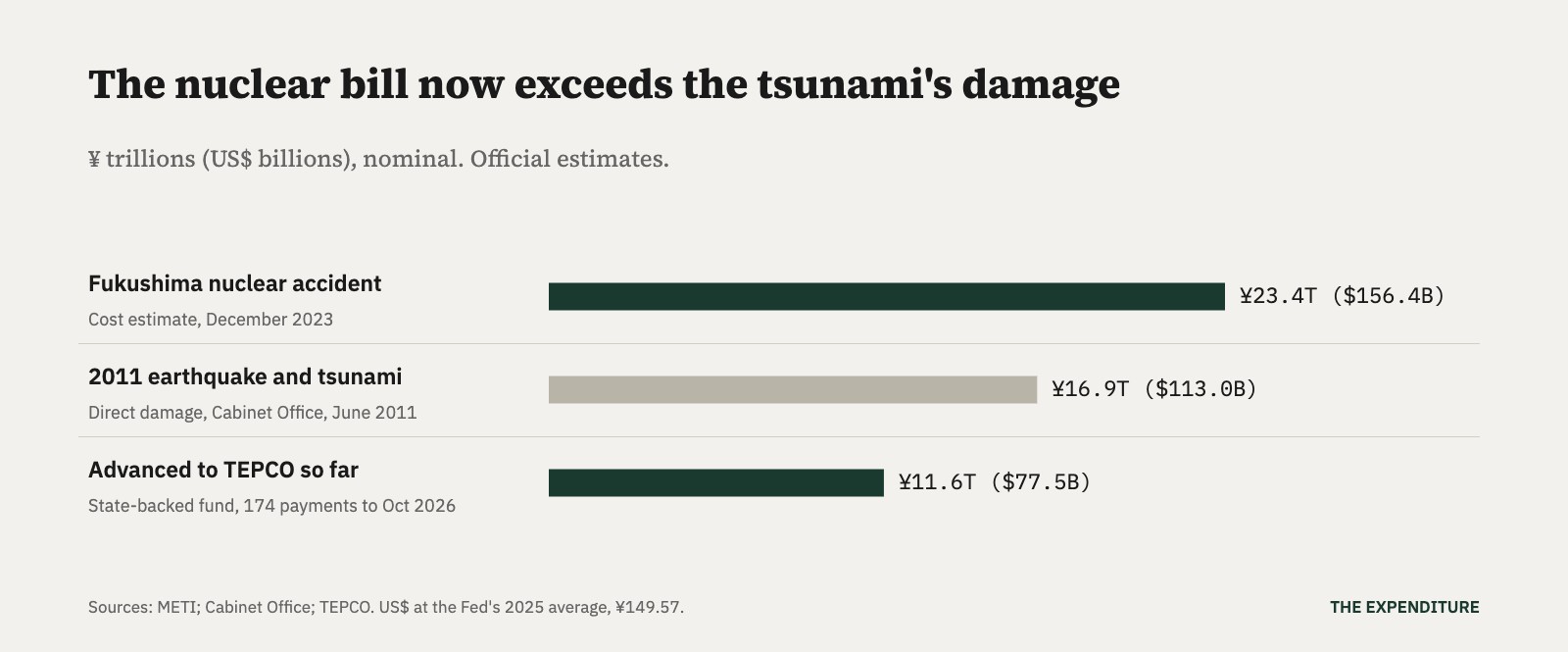
One comparison shows how large that is. In June 2011, the Cabinet Office estimated the direct damage from the entire Great East Japan Earthquake and tsunami at ¥16.9 trillion ($113.0 billion): every destroyed home, road, port and power line across the region. The cleanup of one nuclear plant is now budgeted at 1.4 times that figure. Below, we break the bill down using only official figures from Japan’s government, the Tokyo Electric Power Company (TEPCO), the companies involved, the International Atomic Energy Agency (IAEA) and the Federal Reserve.
THE NUMBERS
What the Fukushima cleanup cost covers
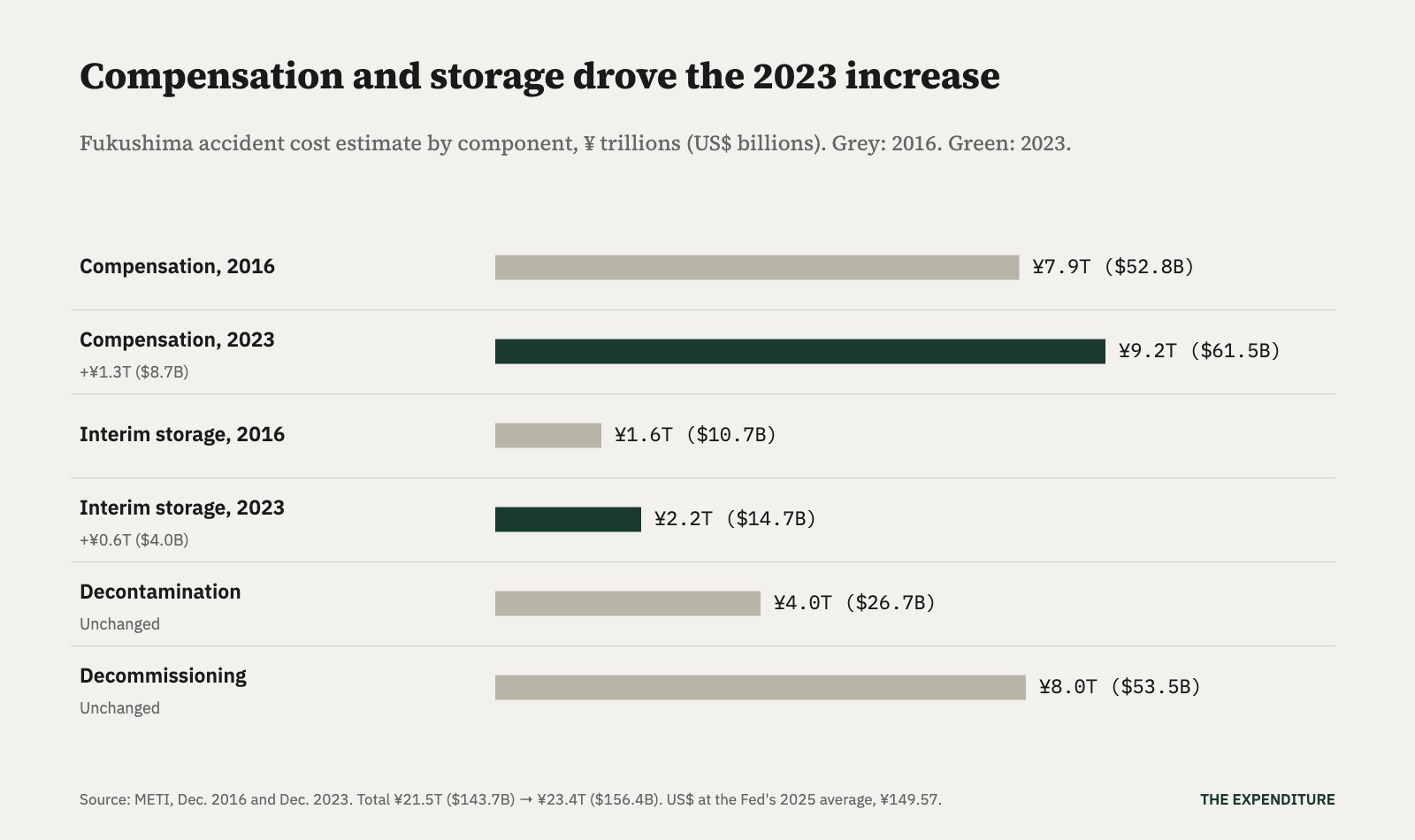
The official estimate comes from the Ministry of Economy, Trade and Industry (METI), which last revised it in December 2023. It has four parts. Compensation to people and businesses is the largest, at ¥9.2 trillion ($61.5 billion). Decommissioning the plant is budgeted at ¥8.0 trillion ($53.5 billion). Decontaminating land and buildings accounts for ¥4.0 trillion ($26.7 billion), and the interim storage facility for removed soil and waste for ¥2.2 trillion ($14.7 billion).
Where the ¥23.4 trillion ($156.4 billion) goes
Japan’s official estimate of the Fukushima Daiichi accident bill, by component, December 2023. Hover for detail.
Source: Ministry of Economy, Trade and Industry (METI), December 2023 revision. US$ at the Federal Reserve’s 2025 average of ¥149.57 per dollar.
All four figures are estimates of money to be spent over decades, in nominal yen. Dollar values throughout this article use the Federal Reserve’s 2025 average exchange rate of ¥149.57 per dollar. If the yen strengthens or weakens, the dollar total moves; the yen bill does not.
How the estimate has grown
In December 2016, METI’s committee on TEPCO reform set the total at ¥21.5 trillion ($143.7 billion). The December 2023 revision added ¥1.9 trillion ($12.7 billion), an increase of about 9%. Two of the four parts drove it:
- Compensation rose from ¥7.9 trillion ($52.8 billion) to ¥9.2 trillion ($61.5 billion). About ¥0.5 trillion ($3.3 billion) followed new compensation guidelines issued after a 2022 Supreme Court decision, which widened payments to roughly 1.48 million people. Another ¥0.5 trillion ($3.3 billion) came from higher-than-expected housing claims. About ¥0.3 trillion ($2.0 billion) is set aside for damage linked to the release of treated water into the sea, which began in August 2023.
- Interim storage rose from ¥1.6 trillion ($10.7 billion) to ¥2.2 trillion ($14.7 billion). The government began decontaminating parts of the “difficult-to-return” zone, which means more soil and waste to haul and store.
- Decontamination, at ¥4.0 trillion ($26.7 billion), and decommissioning, at ¥8.0 trillion ($53.5 billion), were left unchanged.
A bigger bill than the tsunami itself
The Cabinet Office’s ¥16.9 trillion ($113.0 billion) damage estimate, published on June 24, 2011, covers buildings, utilities, roads, ports, farmland and public facilities across the affected prefectures. It does not include the nuclear accident. The disaster left 19,782 people dead and 2,550 missing, according to the Fire and Disaster Management Agency.
The nuclear bill is now larger than that entire physical toll. The two numbers are not perfectly comparable: one is a 2011 snapshot of destroyed assets, the other a running estimate of spending stretched over about 40 years. But both are official, and both are in yen.
How it compares with other nuclear accidents
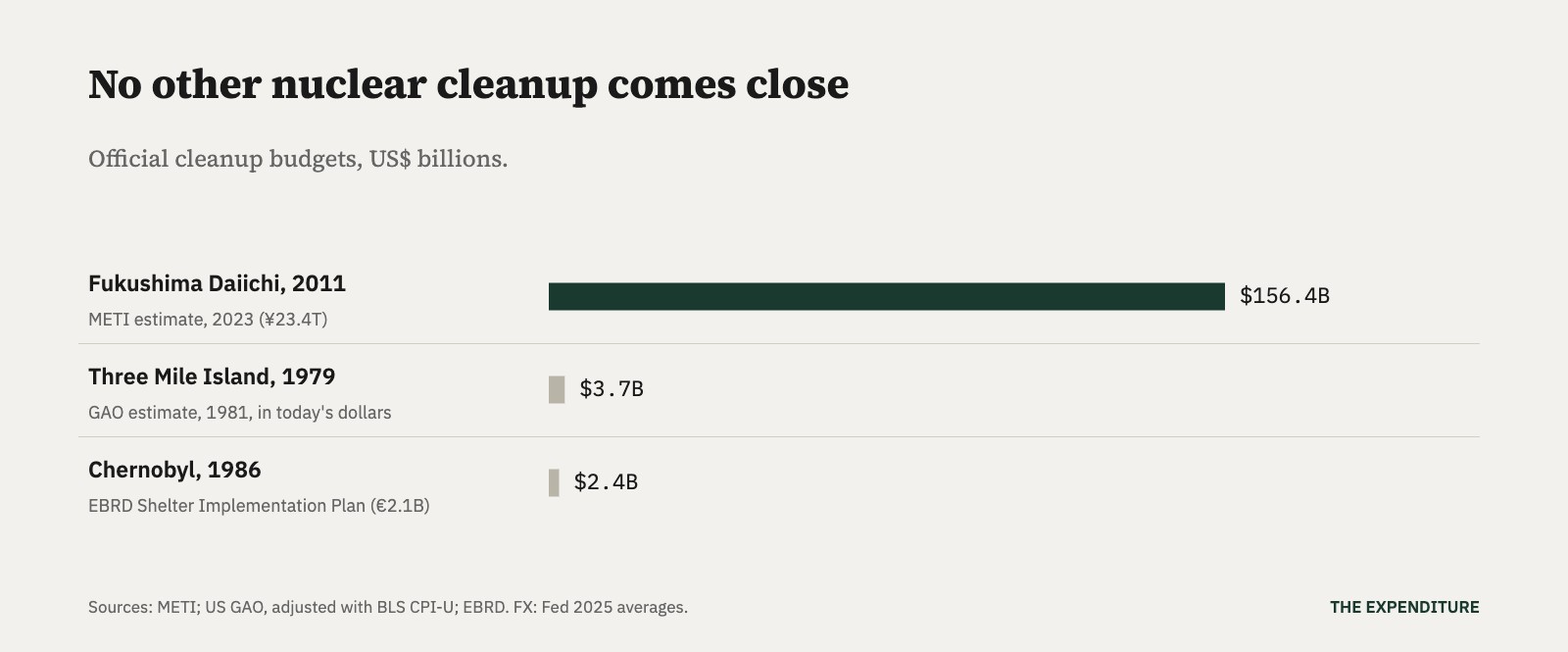
No other nuclear cleanup comes close in official figures. In 1981, the US Government Accountability Office estimated the cleanup of Three Mile Island Unit 2, which partially melted down in 1979, at about $1.03 billion. Adjusted with the US consumer price index, that is about $3.7 billion today.
For Chernobyl, the best-documented international budget is the Shelter Implementation Plan managed by the European Bank for Reconstruction and Development (EBRD). It cost €2.1 billion ($2.4 billion), funded by 45 countries, the European Commission and the EBRD. Its centerpiece, the New Safe Confinement arch over the destroyed reactor, cost about €1.5 billion ($1.7 billion). Chernobyl’s wider costs to Ukraine, Belarus and Russia were never published as a single official figure, so the two are not like-for-like. Even so, the Fukushima estimate is about 42 times the Three Mile Island cleanup and 66 times the Chernobyl shelter program.
How much has been paid so far
Compensation is the part moving fastest. TEPCO pays claims with money advanced by the Nuclear Damage Compensation and Decommissioning Facilitation Corporation (NDF), a state-backed body. On October 22, 2026, TEPCO reported its 174th payment from the NDF, bringing the total to ¥11.5957 trillion ($77.5 billion). The government has authorized up to ¥15.4 trillion ($103.0 billion) in special government bonds to fund these advances, the same amount as the compensation, decontamination and storage budgets combined.
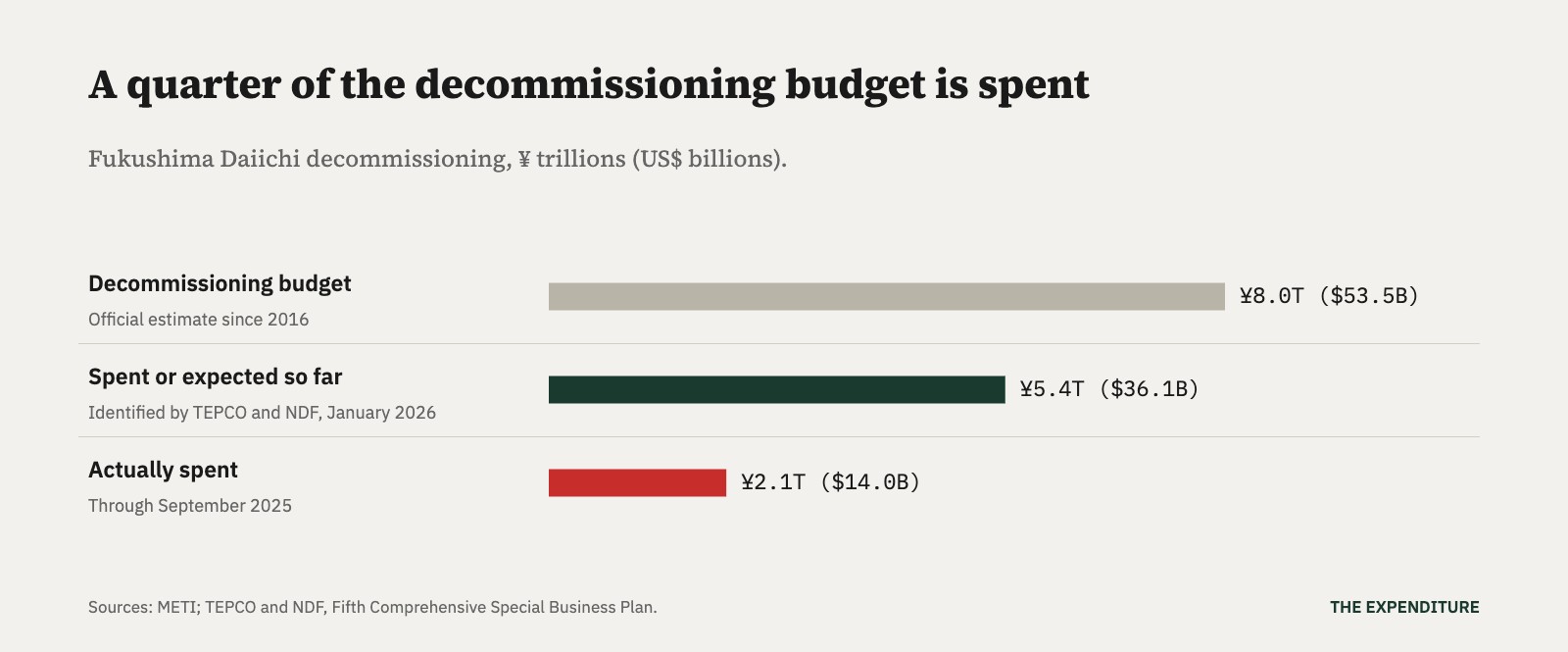
Decommissioning is moving much more slowly. In their January 2026 business plan, TEPCO and the NDF said about ¥2.1 trillion ($14.0 billion) had been spent on decommissioning through September 2025. That is about a quarter of the ¥8.0 trillion ($53.5 billion) budget. The same plan puts the decommissioning costs spent or expected so far at about ¥5.4 trillion ($36.1 billion). That includes about ¥1.0 trillion ($6.7 billion) for fuel-debris retrieval equipment at Unit 3, an estimate made in 2019 that does not reflect recent price increases.
0.88 grams out of 880 tons
The hardest part of the job has barely begun. According to TEPCO, about 880 tons of fuel debris sit inside the three reactors that melted down: 279 tons in Unit 1, 237 in Unit 2 and 364 in Unit 3. Fuel debris is uranium fuel that melted together with metal and concrete and then hardened.
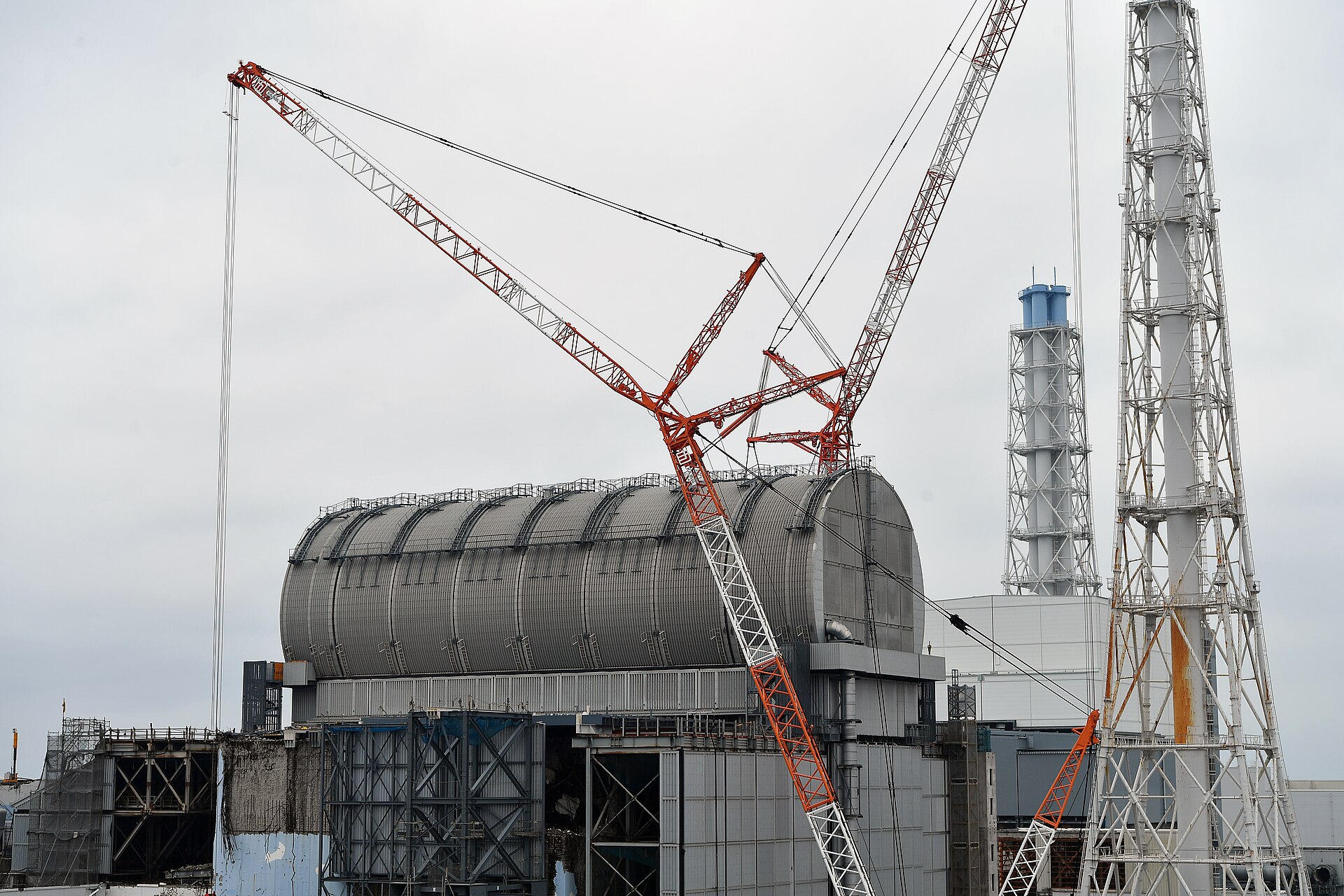
TEPCO has retrieved two samples, both from Unit 2, using a telescopic device. According to METI, the first, taken on November 7, 2024, weighed about 0.693 grams. The second, on April 22, 2025, weighed about 0.187 grams. Together that is 0.88 grams, or one billionth of the debris. The government roadmap still aims to finish decommissioning within 30 to 40 years of the accident, which means by 2051 at the latest. In mid-2025, TEPCO booked a ¥903 billion ($6.0 billion) special loss for preparatory work toward large-scale retrieval, which it expects to take 12 to 15 years.
The private companies involved
TEPCO, a listed company whose shares are partly held by the state-backed NDF, is responsible for the plant. Most of the engineering is done by private Japanese and foreign contractors, many of them working through government-subsidized programs. Those confirmed in official documents include:
- Mitsubishi Heavy Industries (listed, Japan) developed the equipment used in the two fuel-debris trial retrievals, according to the company’s own technical review. It is also developing the larger robot arm for Unit 2, according to METI’s Agency for Natural Resources and Energy, and tested it at its Kobe shipyard, according to IRID.
- Veolia Nuclear Solutions (UK), also known as Oxford Technologies, designs and produces that robot arm and its operating systems in close collaboration with Mitsubishi Heavy Industries, according to the same METI agency. IRID says the equipment was shipped from the UK to Japan in 2021.
- Toshiba Energy Systems & Solutions supplied the original multi-nuclide removal equipment (ALPS) that treats contaminated water, according to Fukushima Prefecture, and TEPCO lists it as its contractor for work on the additional ALPS units.
- Kajima Corporation built the 1.5-kilometer underground “ice wall” of frozen soil that keeps groundwater away from the reactor buildings. TEPCO says the government funded it.
- Toshiba, Hitachi-GE Nuclear Energy, Mitsubishi Heavy Industries and ATOX are the plant makers in the International Research Institute for Nuclear Decommissioning (IRID), a research consortium with Japan’s power utilities, subsidized by METI to develop the retrieval technology.
On the Chernobyl side of the comparison, the EBRD says its arch was built by Novarka, a French consortium of VINCI and Bouygues.
What governments and regulators say
- The Japanese government: in its December 2016 Basic Policy, the Cabinet said the TEPCO group as a whole must use all of its strength to meet its responsibility for decommissioning. That principle is why TEPCO’s grid business now contributes to the decommissioning fund.
- METI on electricity bills: when it raised the estimate in 2023, the ministry said the higher compensation bill would be covered by power companies’ contributions without changing the annual general contribution, so it should not raise electricity rates.
- The IAEA on treated water: in July 2023, the agency concluded that Japan’s plan to discharge ALPS-treated water was consistent with international safety standards and would have a negligible radiological impact on people and the environment. Its task force has since reaffirmed that the discharges continue to meet those standards.
- The Reconstruction Agency on the discharges: for fiscal 2026, Japan plans to release about 62,400 cubic meters of treated water in eight batches, one more than in fiscal 2025.
Who pays for it
TEPCO pays the bills, but most of the money is recovered from others, and the split is set by law:
- Compensation: funded by annual contributions from Japan’s major power companies, including TEPCO, which they recover through electricity rates, plus a special contribution from TEPCO itself.
- Decontamination: to be repaid from the gain when the NDF eventually sells the TEPCO shares it holds.
- Interim storage: paid by the national government from its special energy budget, in other words by taxpayers.
- Decommissioning: paid by TEPCO through a dedicated reserve fund, at a target of about ¥300 billion ($2.0 billion) a year. Its grid subsidiary, TEPCO Power Grid, contributes about ¥120 billion ($802 million) a year on average.
The state advances the money first through the bonds described above and recovers it over the following decades. In practice, the cost is shared by electricity customers across Japan, TEPCO’s shareholders and the national budget.
The bottom line
Japan’s official Fukushima cleanup cost has risen to ¥23.4 trillion ($156.4 billion). It now exceeds the direct damage of the earthquake and tsunami that caused the accident, and it dwarfs every other nuclear cleanup with a published budget. Most of the money spent so far has gone to compensation. The largest technical task, removing 880 tons of melted fuel, has produced less than a gram. The ¥8.0 trillion ($53.5 billion) decommissioning budget is the line most worth watching in the next revision.
Frequently asked questions
Japan’s Ministry of Economy, Trade and Industry estimates ¥23.4 trillion ($156.4 billion), as of its December 2023 revision. That includes compensation, decontamination, interim waste storage and decommissioning the plant.
TEPCO pays, with advances from a state-backed fund. Compensation is recovered from contributions by Japan’s power companies and TEPCO, decontamination from the future sale of TEPCO shares held by the fund, interim storage from the national energy budget, and decommissioning from TEPCO’s own reserve fund.
As of October 2026, the state-backed fund had advanced ¥11.6 trillion ($77.5 billion) to TEPCO for compensation-related payments, in 174 installments. TEPCO had spent about ¥2.1 trillion ($14.0 billion) on decommissioning by September 2025.
Official documents name Mitsubishi Heavy Industries and Veolia Nuclear Solutions (UK) for the fuel-debris retrieval equipment, Toshiba Energy Systems & Solutions for the ALPS water treatment, Kajima for the frozen-soil wall, and Toshiba, Hitachi-GE, Mitsubishi Heavy Industries and ATOX through the IRID research consortium.
In official figures, the Fukushima estimate of about $156.4 billion compares with about $3.7 billion in today’s money for the Three Mile Island cleanup (GAO, 1981) and €2.1 billion ($2.4 billion) for Chernobyl’s EBRD-managed Shelter Implementation Plan.
About 880 tons across Units 1 to 3, according to TEPCO. Two trial retrievals in 2024 and 2025 removed a combined 0.88 grams.
The government roadmap targets completion within 30 to 40 years of the 2011 accident, which means by 2051 at the latest.
Sources
- Ministry of Economy, Trade and Industry (METI): revised cost outlook, December 22, 2023 (Japanese); METI briefing on the cost outlook and bond limit, February 2024 (Japanese); fuel debris trial retrieval at Unit 2; Agency for Natural Resources and Energy on the retrieval robot arm; Electricity and Gas Market Surveillance Commission on decommissioning contributions (Japanese)
- NDF and TEPCO: Fifth Comprehensive Special Business Plan, approved January 26, 2026 (Japanese)
- TEPCO: NDF funding release, October 22, 2026 (Japanese); fuel debris Q&A; land-side impermeable wall; announcement on ALPS contractor, November 16, 2023
- Ministry of Internal Affairs and Communications: White Paper on Local Public Finance 2026, citing the Cabinet Office damage estimate (June 24, 2011) and Fire and Disaster Management Agency casualty figures (Japanese)
- Reconstruction Agency: decommissioning status and treated-water plan (Japanese). Fukushima Prefecture: steps for decommissioning at Fukushima Daiichi
- IRID: members; Unit 2 equipment verification test, March 2022. Mitsubishi Heavy Industries: technical review on the fuel debris trial retrieval
- IAEA: safety review of the treated-water plan, July 2023; task force report, 2025
- US Government Accountability Office: Financial and Operational Problems at Three Mile Island, 1981. EBRD: Chornobyl Shelter Implementation Plan
- Board of Governors of the Federal Reserve System: yen per dollar and dollars per euro, 2025 annual averages. Bureau of Labor Statistics: CPI-U (1981 annual average 90.9; December 2025 324.054)