Record Data Sheet
Dubai International (DXB) handled 95.2 million passengers in 2025, more international travelers than any airport on Earth. Dubai plans to close it anyway. Its replacement is rising at Al Maktoum International (DWC), in Dubai South near Jebel Ali. The Government of Dubai has approved AED 128 billion ($34.9 billion) for it, and says it will be the largest airport in the world.
That makes it one of the largest single public works budgets anywhere. Below, we break down what is known for certain about the money, the builders and the scale, using only government releases, company filings and recognized research firms.
THE NUMBERS
First, a correction to the viral version
Social media clips describe a brand-new $30 billion airport “in the middle of the desert.” Two details are off. The approved figure is AED 128 billion, about $34.9 billion at the dirham’s dollar peg. And the airport is not new: Al Maktoum International opened in 2010 and already handles passengers, more than 1.1 million in 2024. What Sheikh Mohammed bin Rashid Al Maktoum approved on April 28, 2024, is a new passenger terminal complex that turns a small second airport into Dubai’s main one. Once it is ready, all DXB operations will move there.
Where the money stands
Dubai has not published a line-by-line budget, but it has disclosed how much is already committed. As of June 15, 2026, packages worth AED 13 billion ($3.5 billion) were under construction. A further AED 55 billion ($15.0 billion) in packages is due to be awarded by the end of 2026. Together that is AED 68 billion, or 53% of the approved total.
Half the airport’s budget is now committed
Status of the AED 128 billion approved for Al Maktoum International, June 2026. Hover for detail.
Source: Government of Dubai Media Office, June 15, 2026. “Not yet scheduled” is the remainder (128 − 13 − 55). US$ at the AED peg of 3.6725.
The AED 55 billion pipeline, as listed by the Dubai Media Office, includes:
- Substructure works for the Western Passenger Terminal
- The fourth aircraft concourse building
- The automated people mover (APM) and the baggage handling system
- Superstructure for the Western Terminal and concourses one to three
- Long-span structural frames for roughly 1.5 million m² of buildings
- Southern airfield infrastructure, plus power generation and district cooling plants for construction. Façade and roofing packages are planned for later this year.
Progress so far, according to Dubai Aviation Engineering Projects (DAEP): more than 17,000 concrete piles installed, more than 45 million m³ excavated, and over 10 million work hours logged in 15 months. The second runway is complete. About 9,000 workers are on site, and DAEP expects about 120,000 at peak.
The private companies involved
Two listed industrial groups have confirmed the largest award with a public release. On August 20, 2026, Mitsubishi Heavy Industries said it had won the Phase 1 people mover, together with its Dubai subsidiary and India’s Larsen & Toubro. The system runs about 50 km between nine stations. Neither company disclosed the total value. L&T says only that its share is a “large” order, a band it defines as ₹2,500–5,000 crore.
- Mitsubishi Heavy Industries (Japan, listed) leads the people-mover contract, with its Dubai subsidiary MHI Mobility Engineering Services. It supplies the vehicles and signaling and integrates the system.
- Larsen & Toubro (India, listed) handles guideways, power, signaling and telecoms subsystems, platform screen doors and depot equipment on the same contract.
- CCECC and Tristar Engineering & Construction (a Chinese state-owned group and a private Abu Dhabi firm) are reported to have won the West Terminal substructure: seven levels, 800,000 m², 45 million passengers a year. This award is not yet in an official release.
- China Railway Construction Corporation is main contractor, with France’s Artelia as consultant, on Emirates’ $5.1 billion engineering complex next to the airport. That project sits outside the AED 128 billion.
The client on all airport packages is Dubai Aviation City Corporation, a Dubai government entity. Dubai Aviation Engineering Projects delivers them, and Dubai Airports will operate the result.
The trade publication MEED values that West Terminal package at about AED 10 billion ($2.7 billion). More names will follow as the AED 55 billion pipeline is awarded.
Who pays for it
This is a government project. The client is Dubai Aviation City Corporation, a Dubai government entity, and DAEP delivers it. Dubai has not published a financing plan for the 2024 design. What is on the record:
- The government’s own framing. Dubai Finance’s director general describes the airport as a sovereign asset expected to generate long-term value and attract investment, linked to the emirate’s fiscal sustainability strategy.
- UK Export Finance: a $3.5 billion expression of interest (November 2025) to back UK suppliers on the project. That is about 10% of the cost, and an expression of interest is not yet a loan.
- The precedent: for an earlier version of the plan, Dubai’s Department of Finance, the Investment Corporation of Dubai and DACC raised $3 billion in 2017. The money came through conventional and Islamic facilities from 12 banks, via a dedicated vehicle, Airport Financing Company (FINCO).
- Separate private-side spending. Emirates’ $5.1 billion engineering complex at Dubai South is not part of the AED 128 billion.
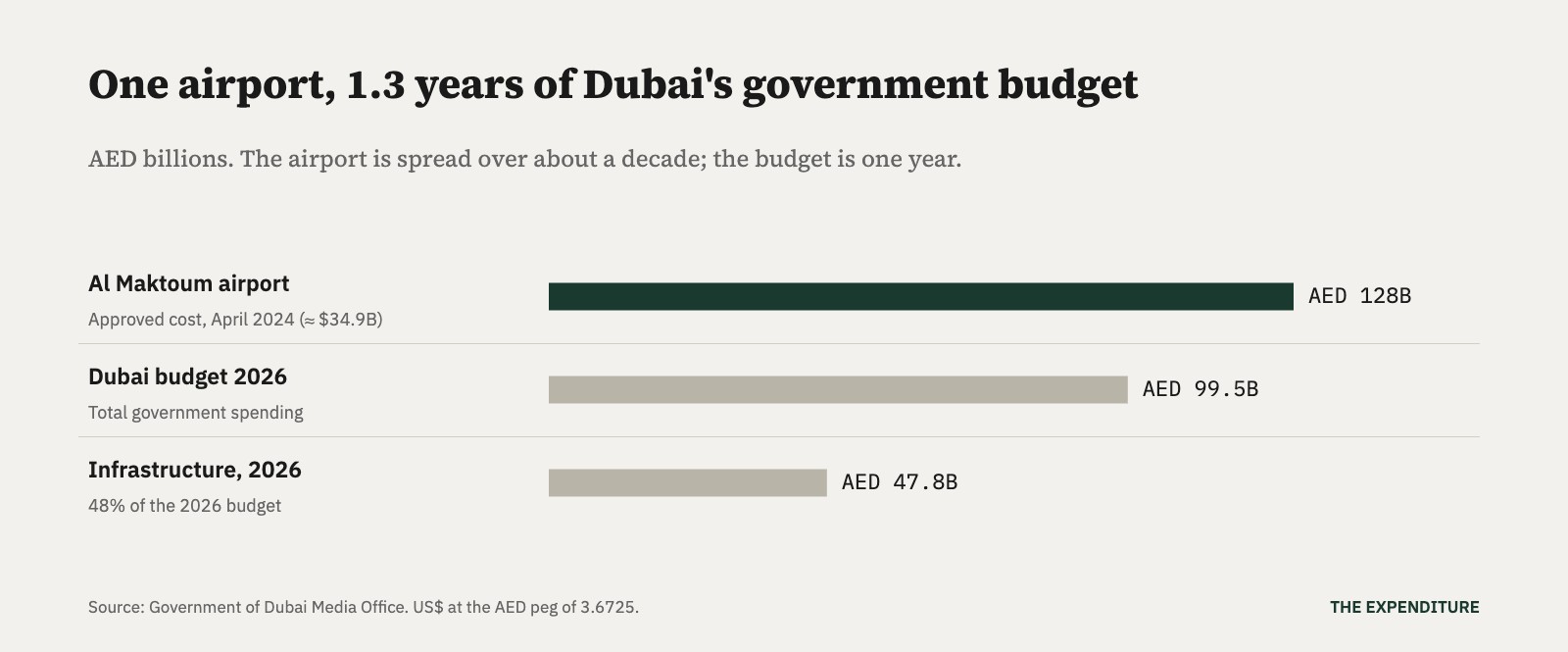
For scale, Dubai’s entire 2026 government budget is AED 99.5 billion, with 48% going to infrastructure. The airport budget is therefore 1.3 times a full year of Dubai government spending, although it is spread over roughly a decade and is not all funded through the general budget.
How much bigger than DXB
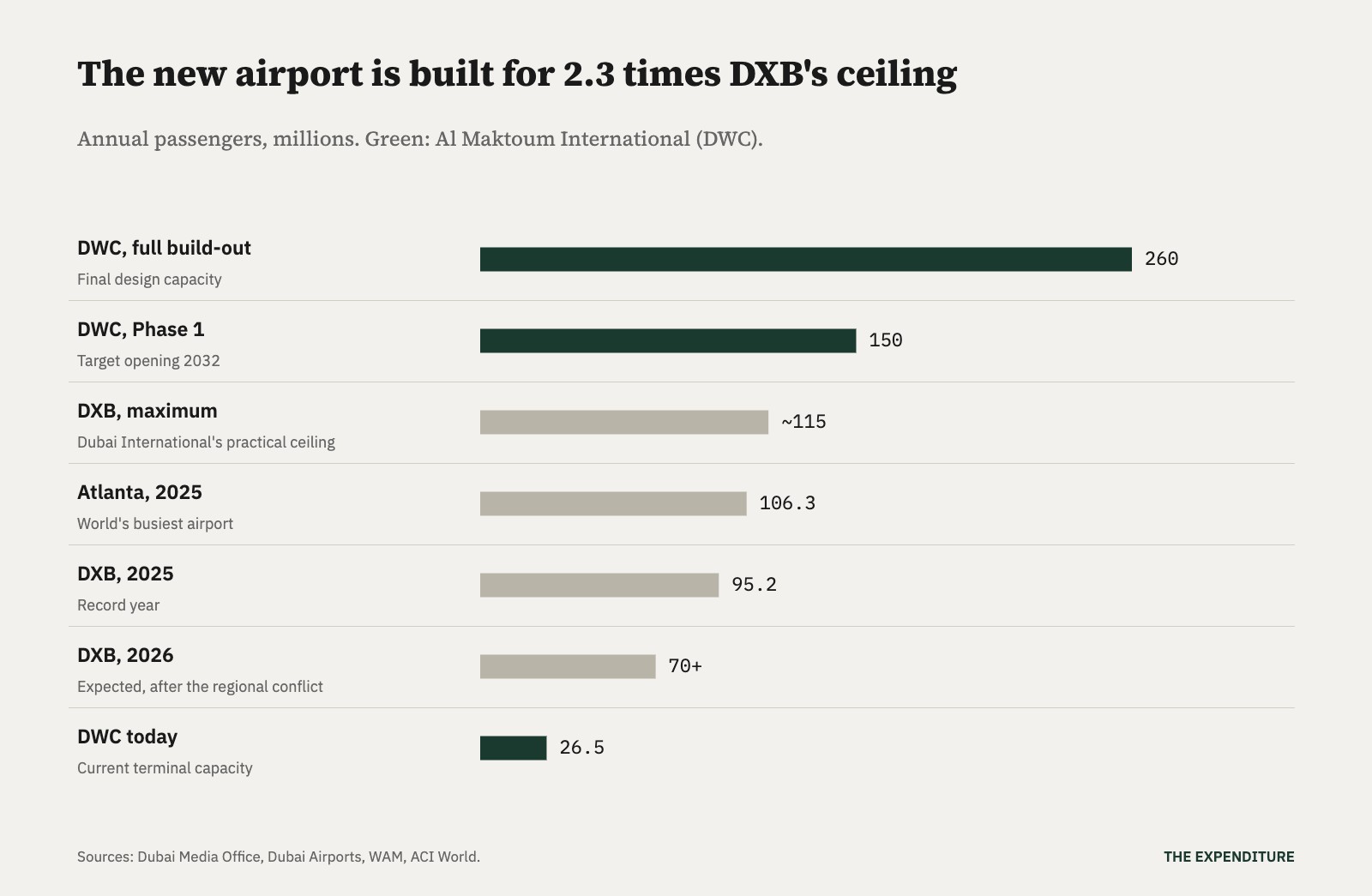
DXB sits on a tight city-center site. The Dubai Airports CEO puts its maximum capacity at around 115 million passengers a year. Phase 1 of DWC alone adds 150 million. The finished airport, at 260 million, would hold 2.3 times DXB’s ceiling and almost 2.5 times what Atlanta, the world’s busiest airport, handled in 2025.
The physical gap is just as wide. DWC will cover 70 km², about five times DXB’s area, with five parallel runways against DXB’s two. It will have more than 400 contact stands and a cargo capacity of 12 million tonnes a year, against 3.1 million at DXB’s cargo facility.
On cost per unit of capacity, $34.9 billion for 260 million annual passengers works out to about $134 per passenger of yearly capacity. As a rough reference, Hong Kong’s three-runway system cost HK$141.5 billion (about $18.1 billion) for an airport sized for 120 million, or about $151 per passenger. The two projects differ in scope, timing and land costs, so treat this as a sense of scale, not a like-for-like benchmark.
How many passengers it will actually move
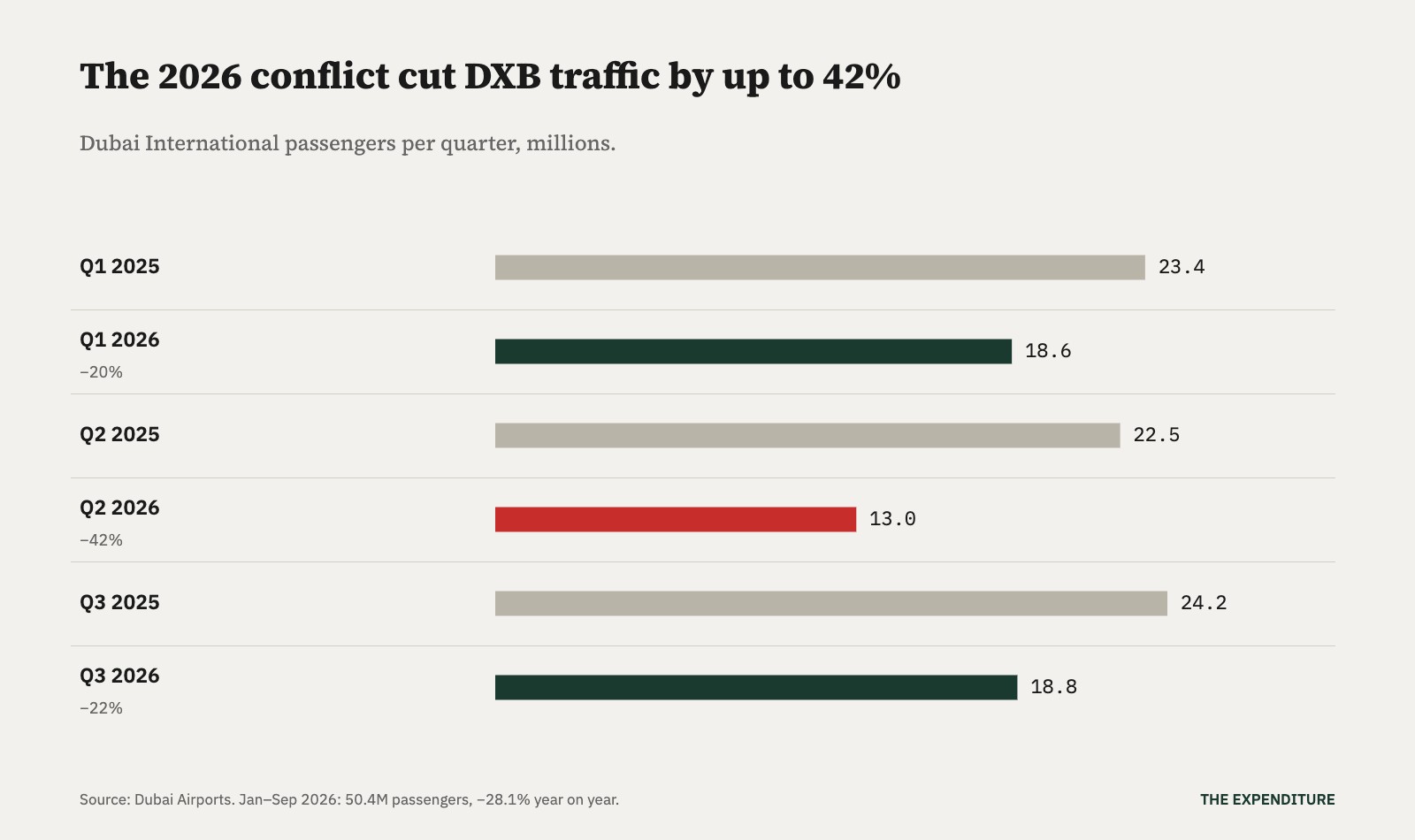
Capacity is not traffic. The official plan is phased: about 150 million passengers of capacity over the next decade, with 260 million as the long-term ceiling. Dubai Airports’ own outlook shows how fragile near-term demand can be. The regional conflict in 2026 closed Gulf airspace for weeks, and DXB traffic fell 28.1% in the first nine months to 50.4 million. Dubai Airports now expects just over 70 million passengers for 2026, and has pushed its 100-million target to the end of 2027.
Our conservative reading: Phase 1’s 150 million is the realistic planning number for the 2030s. The full 260 million depends on traffic growth that, at DXB’s long-run pace, would take decades to arrive.
What it means for the global economy
The headline numbers are large, but the measurable global effect is modest, and we think it should be described that way.
- Locally, it matters a lot. An Oxford Economics study for Emirates Group and Dubai Airports estimates that aviation supported AED 137 billion of Dubai’s output in 2023, or 27% of GDP. It projects 32% by 2030. The DWC construction alone is estimated to add AED 6.1 billion of value in 2030, about 1% of Dubai’s forecast GDP, and 132,000 jobs.
- Globally, it is a hub, not a new market. Most of DWC’s future traffic is traffic that would otherwise have gone through DXB, or through rival hubs such as Doha, Istanbul and Riyadh. The global gain comes from connectivity, not from passengers who would not otherwise fly.
- The share of world traffic is small. Even full, 260 million passengers would be about 2.7% of 2025 global airport traffic. Against ACI World’s 2053 forecast of 22.3 billion, it is about 1.2%. Dubai aviation’s $37.3 billion of output is under 1% of the $4.1 trillion that ATAG attributes to aviation worldwide.
- Contractors and suppliers get the clearest near-term effect. About AED 60 billion of work is not yet scheduled, on top of the AED 55 billion pipeline.
What it means for business
- Contractors and equipment makers. The AED 55 billion pipeline includes baggage systems, façades, roofing and power plants. UK Export Finance’s letter shows export credit agencies competing to get their suppliers in.
- Airlines. Emirates and flydubai are the anchor tenants. The planned transfer is a once-in-a-generation operational risk, and a cost line.
- Real estate. DACC expects the project to create housing and workforce demand for more than one million people in Dubai South.
- Risk. 2026 showed that a regional conflict can cut a third of a hub’s traffic within months. A 260-million-passenger airport concentrates that exposure.
The bottom line
Dubai is not building an airport from scratch in the desert. It is spending $34.9 billion to replace one that will soon hit its limits. About half of that money is now committed or about to be. The real test is not construction; it is whether traffic recovers fast enough to justify Phase 1 in 2032.
Frequently asked questions
The Government of Dubai approved AED 128 billion, about $34.9 billion at the dirham’s dollar peg, in April 2024.
Not from scratch. Al Maktoum International (DWC) has operated since 2010. Dubai is building a new passenger terminal complex there, and all Dubai International (DXB) operations will move to it.
Phase 1, with about 150 million passengers of yearly capacity, is targeted to begin operations in 2032. The full 260-million capacity comes later.
Officially confirmed: Mitsubishi Heavy Industries and Larsen & Toubro, for the automated people mover. The West Terminal substructure has been reported as going to a CCECC–Tristar joint venture. More than AED 55 billion of contracts are due to be awarded by the end of 2026.
It is a Dubai government project, run by Dubai Aviation City Corporation. No full financing plan has been published. UK Export Finance has issued a $3.5 billion expression of interest, and an earlier phase used $3 billion of bank loans.
About five times the area, with 260 million passengers of capacity against DXB’s maximum of around 115 million, and five runways against two.
Sources
- Government of Dubai Media Office: design approval, April 28, 2024; project update, June 15, 2026; UK Export Finance letter, November 18, 2025; Dubai government budget 2026–2028 (November 2025)
- Dubai Airports: fact file; Jan–Sep 2026 traffic; quarterly traffic releases, 2025–2026
- WAM (Emirates News Agency): Dubai Airports CEO briefing, September 11, 2026
- Mitsubishi Heavy Industries and Larsen & Toubro: press releases on the Al Maktoum APM contract, August 20, 2026
- Emirates: engineering complex, May 18, 2026; Oxford Economics, economic impact of aviation in Dubai (for Emirates Group and Dubai Airports, October 2024)
- Government of Dubai Department of Finance: airport financing announcement, 2016–2017
- ACI World: 2025 world airport traffic rankings (April 2026) and traffic forecasts 2024–2053. ATAG: Aviation: Benefits Beyond Borders, 2024
- Airport Authority Hong Kong: three-runway system. West Terminal award: MEED (trade publication), October 2026; not yet confirmed in an official release.