Record Data Sheet
Forty-eight teams. A hundred and four matches. One prize of $51 million. That is what the 2026 World Cup looks like once you stop counting goals and start counting what each federation took home.
How the payout works
On April 28, 2026, the FIFA Council raised the money for the 48 national teams to $871 million, up from the $727 million it had approved in December 2025 and almost double the $440 million paid at Qatar 2022. The increase followed complaints from federations about the cost of hotels, travel and training across three host countries, according to Inside World Football.
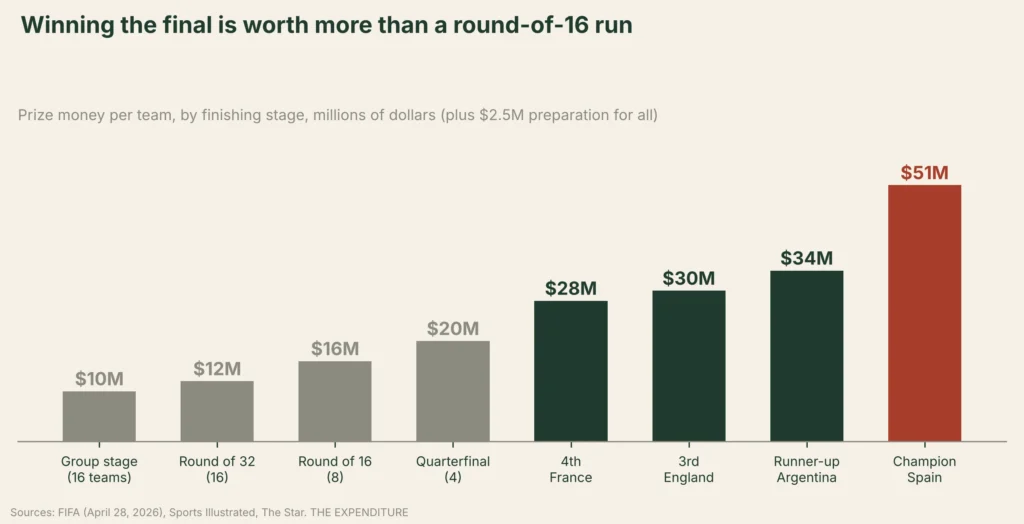
Most of it is paid by performance, in eight fixed tiers. The further a team advances, the more it earns, and every team within a tier earns exactly the same amount. The lowest tier, for teams eliminated in the group stage, rose from $9 million to $10 million with the April decision.
On top of that, each of the 48 federations received $2.5 million in preparation money before the tournament, up from $1.5 million, and FIFA set aside more than $16 million for delegation costs and tickets. Those payments do not depend on results, so they are left out of the ranking below.
The ranking, worst to first
33rd to 48th place, eliminated in the group stage: $10 million each. Czechia, South Korea, Qatar, Scotland, Haiti, Turkey, Curaçao, Tunisia, Iran, New Zealand, Uruguay, Saudi Arabia, Iraq, Jordan, Uzbekistan, Panama.
17th to 32nd place, eliminated in the round of 32: $12 million each. South Africa, Australia, Germany, Ivory Coast, Netherlands, Japan, Cape Verde, Austria, Croatia, DR Congo, Sweden, Ecuador, Ghana, Bosnia and Herzegovina, Algeria, Senegal.
9th to 16th place, eliminated in the round of 16: $16 million each. Canada, Paraguay, Brazil, Mexico, Portugal, United States, Egypt, Colombia.
5th to 8th place, eliminated in the quarterfinals: $20 million each. Morocco, Belgium, Norway, Switzerland.
4th place: $28 million. France, after losing the third-place match to England 6-4.
3rd place: $30 million. England, who beat France 6-4 in a ten-goal match for the bronze.
Runner-up: $34 million. Argentina, after losing the final 1-0 to Spain in extra time.
Champion: $51 million. Spain, world champions for the second time after 2010, beating Argentina on a Ferran Torres goal in the 106th minute.
What the ranking adds up to
Added together, the eight tiers come to $703 million paid by performance. With the $120 million in preparation money and the $16 million in other support, that accounts for $839 million of the $871 million total. FIFA has not published a breakdown of the remainder.
The arithmetic shows how the money is weighted. Every team was guaranteed at least $12.5 million, $10 million for taking part and $2.5 million for preparation. Sixteen teams, a third of the tournament, went home with exactly that, whether they lost all three group games or went out on the last day. The payout then grows slowly through the early knockout rounds and sharply at the end. Winning the final, rather than losing it, was worth $17 million to Spain, more than a team eliminated in the round of 16 earned for its entire tournament.
The record total also hides how much of it comes from the bigger format. Spread across 48 teams, the $871 million works out to about $18.1 million per federation. In Qatar, $440 million across 32 teams came to about $13.8 million. The pool almost doubled, but the average team received about 32% more, because the money is shared among half as many teams again.
What this ranking does not include
FIFA’s money for national teams is not the only money in play. FIFA separately pays $355 million to the clubs whose players were called up, through its Club Benefits Programme, up from $209 million after Qatar 2022. That money goes to clubs such as Real Madrid or Manchester City for releasing their players, not to the national teams.
Sponsorship, ticketing and broadcast revenue that FIFA collects from the tournament are also left out. FIFA projected $13 billion of revenue for its 2023 to 2026 cycle, after an upward revision of $2 billion in May 2025. The $871 million is what it chose to redistribute to the 48 participating federations. What the tournament cost FIFA to stage is covered in the $3.76 billion World Cup.
What to watch
FIFA’s annual report for 2026, normally published the following spring, will show the final amounts paid to each federation and to clubs, and the remaining $32 million of the distribution. For how much revenue another event earns for each dollar it pays the players, see Wimbledon vs Roland Garros.
Frequently asked questions
$51 million in prize money, plus $2.5 million in preparation money paid to every team.
Between $10 million for a group-stage exit and $51 million for the champion, plus $2.5 million in preparation money for every team.
$12.5 million per federation: $10 million for taking part and $2.5 million in preparation money, according to FIFA's April 2026 decision.
$871 million for the 48 national teams, raised from $727 million in April 2026, against $440 million at Qatar 2022.
$355 million through FIFA's Club Benefits Programme, up from $209 million after Qatar 2022.
Notes. All figures are in US dollars as announced by FIFA. Stage amounts after the April 2026 increase are as reported by Sports Illustrated and The Star; FIFA’s release gives the totals and the changes to preparation and participation money. The $703 million and $839 million totals are our sums.
Sources
- FIFA, “FIFA Council increases record financial distribution to all 48 Participating Member Associations at the FIFA World Cup 2026,” April 28, 2026: https://inside.fifa.com/media-releases/council-increases-record-financial-distribution-member-associations-world-cup-2026
- Sports Illustrated, “2026 World Cup prize money: how much each team will earn”: https://www.si.com/soccer/2026-world-cup-prize-money-how-much-each-team-will-earn
- The Star, “World Cup 2026 prize money,” July 21, 2026: https://www.the-star.co.ke/news/infographics/2026-07-21-world-cup-2026-prize-money
- Inside World Football, “FIFA boosts 2026 World Cup prize fund,” April 29, 2026: https://www.insideworldfootball.com/2026/04/29/fifa-boosts-2026-world-cup-prize-fund-126m/
- Flashscore, “FIFA to share record $355m with clubs for 2026 World Cup”: https://www.flashscore.com/news/soccer-world-cup-fifa-to-share-record-355m-with-clubs-for-2026-world-cup/hUiaA85S
- Inside World Football, FIFA’s revised budget for 2023 to 2026, May 16, 2025: https://www.insideworldfootball.com/2025/05/16/fifa-reports-2bn-upward-budget-revision-11bn-2023-26-cycle/
- Sky Sports, “Spain 1-0 Argentina (aet)”: https://www.skysports.com/football/news/12098/13564318/2026-world-cup-spain-1-0-argentina-aet-ferran-torres-extra-time-winner-secures-spains-second-title
- WION, “England beat France 6-4 in the third-place playoff”: https://www.wionews.com/sports/bukayo-saka-s-hat-trick-helps-england-beat-france-6-4-in-fifa-world-cup-2026-third-place-playoff-1784415865980