Record Data Sheet
On September 3, 2026, West Virginia’s governor announced more than $81 billion in new private-sector data center investment, split between two projects in Mason County, according to the official announcement from the Office of the Governor. The number that makes this genuinely unusual isn’t the total itself. It’s the comparison the governor’s own office volunteered alongside it: West Virginia’s entire annual GDP is about $109 billion. One week of announcements came in at roughly 74% of that.
What was actually announced
Nscale, a UK-headquartered AI infrastructure company, committed $69.2 billion to Phase One of its Monarch Compute Campus in Mason County, a project expected to require approximately 2 gigawatts of power and create 4,375 construction jobs and 645 permanent positions, according to the governor’s office. Separately, Starwood Digital Ventures committed $12 billion to a project known as Project Tamarack in the same county, requiring approximately 2.16 gigawatts of power and creating more than 1,000 construction jobs and 300 permanent positions.
Combined, the two projects require roughly 4.16 gigawatts of new electrical capacity, a scale of power demand that would, on its own, rank among the larger consumers on the entire regional grid.
Who actually pays for the power
Both projects were certified under West Virginia’s High Impact Data Center law, a state statute that requires developers of large data centers to cover the cost of the electrical infrastructure and grid upgrades their projects require, rather than passing those costs on to existing ratepayers. In practice, that means Nscale and Starwood Digital Ventures are contractually responsible for the transmission and generation buildout their own facilities create, not West Virginia households or other businesses on the grid.
This is the detail that determines whether a data center boom is a windfall or a liability for the state hosting it. Data center projects elsewhere in the country have drawn criticism precisely because their power demands raised electricity costs for everyone else on a shared grid. West Virginia’s law is a direct response to that risk, structured before these two projects were approved rather than negotiated after the fact.
The comparison that came from the state itself
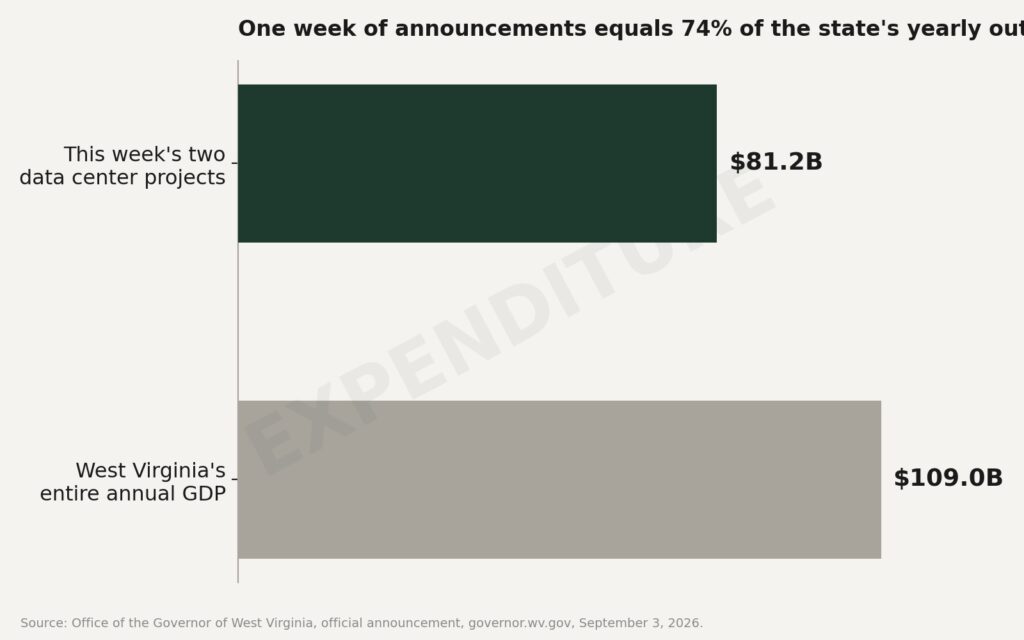
Most of the scale comparisons in this publication’s coverage are calculations we make ourselves, converting a headline figure into a GDP comparison or a cost per unit to give it context. This time, the state did it first. West Virginia’s governor’s office stated that the state’s GDP runs approximately $109 billion a year, offered specifically as context for these announcements. Measured against that figure, the $81.2 billion announced this week alone equals about 74% of everything the state’s economy produces in a full year.
Zoom out further and the number gets more extreme. The governor’s office says West Virginia has attracted approximately $96 billion in total private investment since October 2025, less than a year, a figure equal to roughly 88% of the state’s entire annual GDP, concentrated in a single sector, arriving in under twelve months.
Why this is concentrated in one county, and what that means
Both projects sit in Mason County, which raises a question distinct from the dollar totals: what happens to a rural county’s tax base, land use, and infrastructure planning when two projects each individually larger than most companies’ annual revenue land in the same jurisdiction within the same year. The governor’s office has not published a county-level breakdown of tax revenue or infrastructure obligations tied specifically to Mason County, so the fiscal impact at that more local level remains something to watch for in future disclosures rather than something confirmed today.
What we could not verify
Separate reporting has described Anthropic as an anchor tenant expected to lease roughly a third of the Nscale campus’s capacity, in an arrangement reportedly worth billions of dollars. This publication was not able to locate an official Nscale or Anthropic statement confirming the specific terms of that arrangement with the same level of detail as the governor’s own announcement, so it is noted here as reported rather than treated as a confirmed figure.
Why we consider this relevant
West Virginia’s own framing of this announcement, measuring it directly against state GDP rather than leaving readers to work out the scale themselves, is worth noting as a communications choice as much as an economic one. States competing for data center investment increasingly have an incentive to make these numbers sound as large as possible, and comparing an investment total to a state’s entire annual economic output is about as large as a comparison can get. That doesn’t make the comparison inaccurate, the arithmetic checks out against the state’s own cited GDP figure, but it’s a useful reminder that even official sources choose which comparisons to volunteer and which to leave out, including a county-level breakdown that hasn’t yet been published.
Frequently asked questions
How much data center investment did West Virginia announce this week?
More than $81 billion combined, $69.2 billion from Nscale and $12 billion from Starwood Digital
Ventures, according to the Office of the Governor of West Virginia’s official announcement on September 3, 2026.
How does this compare to West Virginia’s economy?
The governor’s office stated that West Virginia’s annual GDP is approximately $109 billion, meaning this single announcement equals roughly 74% of the state’s entire yearly economic output.
Who pays for the electricity infrastructure these projects need?
The developers themselves. Both projects were certified under West Virginia’s High Impact Data Center law, which requires large data center developers to cover their own power and grid infrastructure costs rather than passing them on to other ratepayers.
Is Anthropic involved in either project?
Separate reporting describes Anthropic as an expected anchor tenant for a portion of the Nscale campus, but this publication could not locate an official statement from Nscale or Anthropic confirming the specific terms, so it is not treated as a confirmed figure here.
Sources
Office of the Governor of West Virginia, official announcement on Nscale and Starwood Digital Ventures data center investments, governor.wv.gov, September 3, 2026
State of West Virginia, High Impact Data Center certification law and program requirements