Record Data Sheet
How much did Grand Theft Auto VI cost to make?
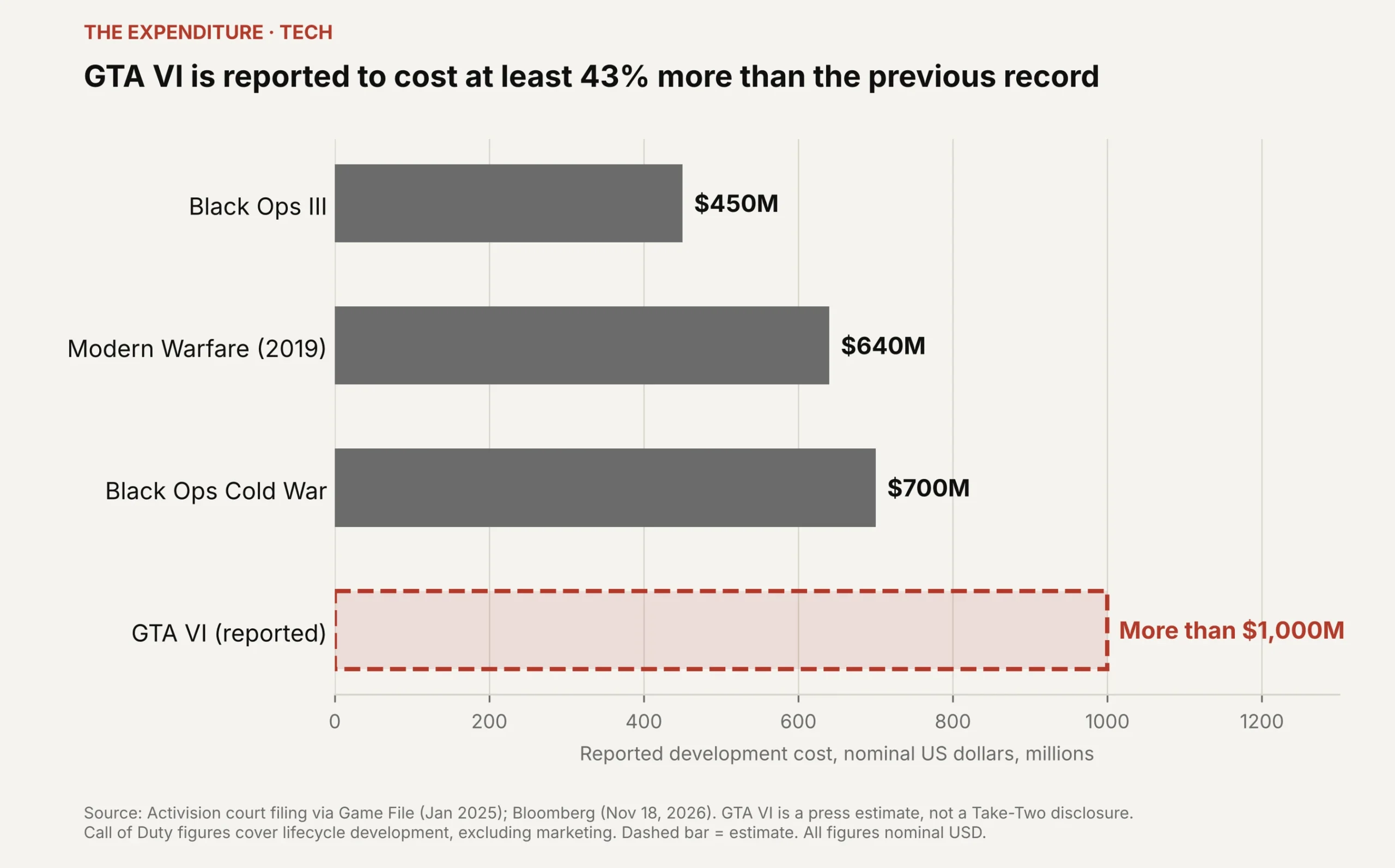
More than $1 billion, according to Bloomberg, which wrote on November 18, 2026 of “a budget that reportedly exceeded $1 billion” over 13 years of development. That would be the most expensive video game on record, about 43% above the previous record of $700 million for Call of Duty: Black Ops Cold War. No official figure exists. Take-Two Interactive, the publisher, has never published one.
Most readers ask this question expecting a number from a company report. That is the wrong expectation. A game of this kind is not a project with a budget line. It is a studio’s work over more than a decade, shared with an online service, an engine and a back catalog. What public accounts do show is the size of the pool the money came from, and that is what the rest of this article measures.
What has Take-Two actually said about the budget?
Almost nothing, and on November 9, 2026 it said so on the record. On the earnings call, a Citi analyst asked about a press claim that development costs were capped at $1.5 billion. Chief executive Strauss Zelnick answered: “We haven’t spoken about budgets at all.” He added that the company had invested heavily in the game and hoped it would prove a sound investment in time.
In May 2026 he told Bloomberg that development costs had kept rising and called the game “a high-stakes game for big boys only.” Business Insider reported the same month that anonymous industry analysts put the cost at $1 billion to $1.5 billion. A figure of $2 billion has circulated from an investor’s post in August 2025. It is unverified and we do not use it.
Rockstar has gone one step further than its parent, without giving a number either. In a feature published in October 2026, Bloomberg reported that Rockstar denied a budget of $1.5 billion, and that the studio’s headcount had reached 4,711 across 12 studios by August 2026, up from 2,441 when Red Dead Redemption 2 came out in 2018.
So the record rests on press reports and analyst estimates, with a denial that sets a ceiling. We report it as reported.
What do Take-Two’s accounts show?
They show the scale of what sits behind the game, not the game itself. At March 31, 2026, the end of Take-Two’s last fiscal year, the non-current software development costs tied to unreleased titles stood at $2,149.7 million, up $334.7 million from $1,815.0 million a year earlier. That is the capitalized spending on every game not yet on sale, not on GTA VI alone.
Two features of the accounting matter. Take-Two capitalizes a game’s costs only after technological feasibility is reached. Earlier spending is expensed as research and development, so it never appears in that balance. And the balance includes internal payroll and stock-based compensation, and is amortized over a short period once a game ships.
The cash flow statement gives a second view. Cash spent on software development costs and licenses was $688.9 million in fiscal 2026, against $691.6 million in 2025 and $603.4 million in 2024. Research and development expense was $1,074.6 million in fiscal 2026.
Why is $1 billion plausible?
Because the people cost alone points there. Rockstar North, the Edinburgh studio that leads the game, files accounts at Companies House as Rockstar Games UK Limited. A compilation of those filings by onmsft.com, which we have not been able to check line by line against the originals, puts the studio’s staff costs at £245.9 million in fiscal 2019-20, rising to £433.2 million in 2021-22 and £404.4 million in 2023-24. Over those five years the total is £1.78 billion. At a rate of 1.33 dollars per pound, derived from the ECB reference rates of November 11, 2026, that is about $2.4 billion.
We do not claim that figure as the cost of GTA VI. The studio also supports GTA Online and Red Dead Online, and the compilation excludes Rockstar’s other studios. What it shows is the ceiling of the question. For GTA VI to have cost under $700 million, most of five years of the lead studio’s payroll would have to belong to something else. That is possible. It is not the likeliest reading.
How does it compare with earlier records?
The comparison is narrower than it looks. The previous documented record is $700 million for Call of Duty: Black Ops Cold War, a figure from a court filing by an Activision executive, reported in January 2025, covering the game’s lifecycle and excluding marketing. Modern Warfare (2019) was reported at $640 million and Black Ops III at $450 million.
Grand Theft Auto V, released in 2013, is the closest ancestor. A Scottish press estimate in 2013 put its development and marketing at $265 million. That was not a Rockstar disclosure. Adjusted by the consumer price index from September 2013 (234.149) to October 2026 (337.511), a factor of 1.44, it equals about $382 million today. By Take-Two’s own account it sold more than $800 million in its first 24 hours and more than $1 billion in three days.
Star Citizen, a crowd-funded game, has raised large sums from backers, but that is revenue from players, not a studio’s cost, and we exclude it.
How much has GTA VI already earned in pre-orders?
About $1.65 billion, by one firm’s estimate, before a single copy went on sale. Sensor Tower, a market intelligence company that models digital storefront activity, put pre-order spending on PlayStation 5 and Xbox Series X|S at roughly $942 million on November 10, $1.18 billion on November 13, $1.45 billion on November 16 and $1.54 billion on November 17. Forbes reported about $1.65 billion on November 18. Sensor Tower says about 75% of orders are on PlayStation.
That is already more than the reported development cost. GTA V needed three days after its 2013 launch to pass $1 billion in sales. GTA VI passed it eight days before launch, on Sensor Tower’s numbers.
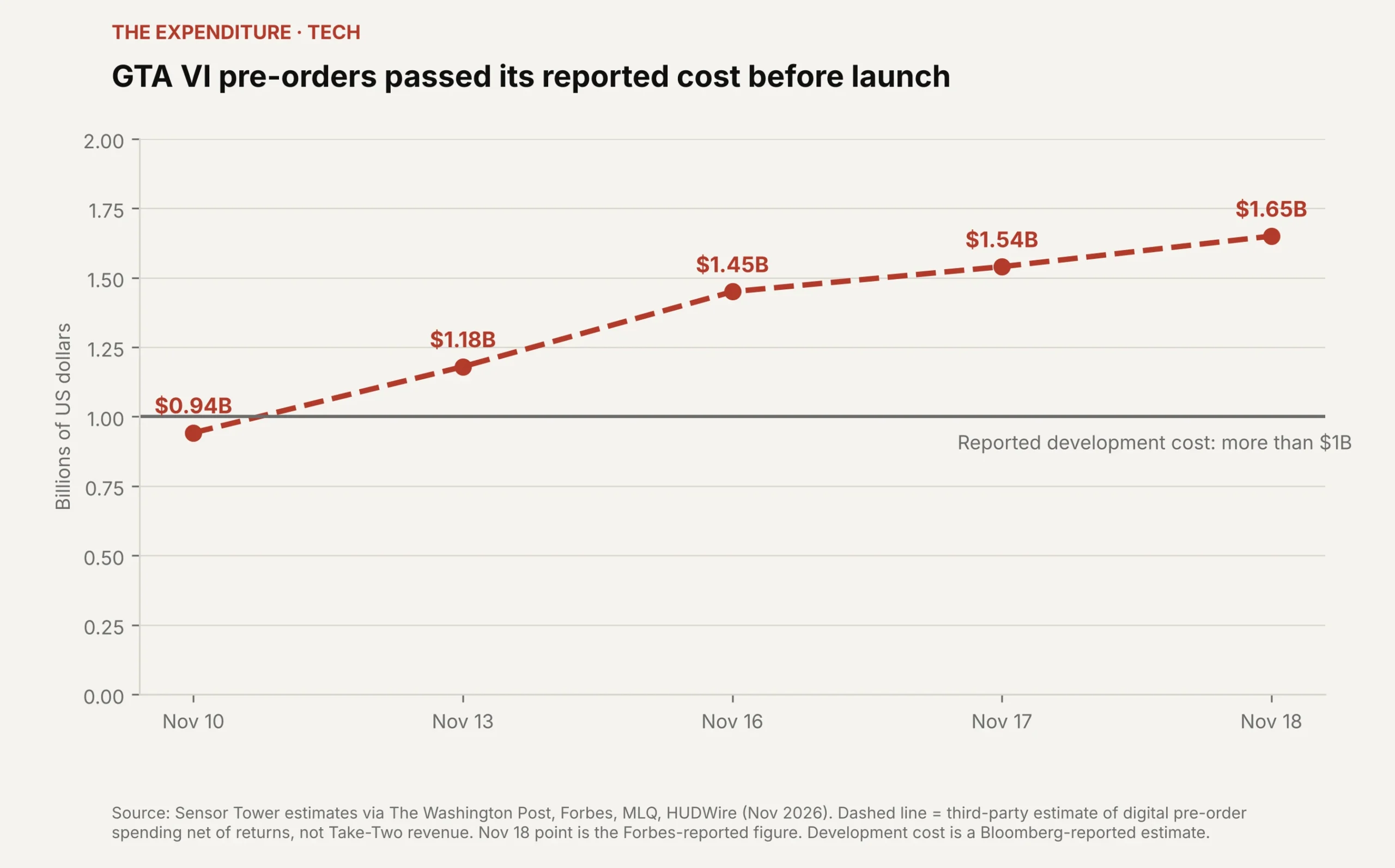
Read that comparison with care, because it mixes two different things. Pre-order spending is what consumers have committed to pay, estimated by a third party and net of returns. It is not Take-Two’s revenue. We have not seen how Take-Two will book it, and what the platforms and retailers keep is not netted out. It covers digital sales only. Take-Two itself has said only that pre-orders were running far ahead of its initial expectations. We use the pre-order figures as a measure of demand, not as proof that the game has paid back its cost.
What will launch day cost the US economy?
About 1% of that day’s US GDP, in our central estimate, with a range of 0.5% to 2%. In dollars that is between about $0.6 billion and $2.5 billion of output for the day itself, with $1.3 billion as the central case. The estimate is ours, and it is consistent with the one published by economist José García Montalvo of Pompeu Fabra University, whose $1 billion is 0.8% of a working day of US GDP and whose headcount of 1.5 million absent workers is the one our central case uses. These are our calculations from public data, not a forecast by any statistical agency, and the range depends on how many workers were absent, which nobody has measured yet.
How do you turn absences into lost output?
You multiply absent workers by what a worker produces in a day. Our inputs are three. US nonfarm payroll employment was 158.6 million in September 2026 (Bureau of Labor Statistics). GDP was $31.44 trillion at an annual rate in the fourth quarter of 2025 (Bureau of Economic Analysis, via the Joint Economic Committee), the latest level we verified, so the result is slightly low. Dividing gives about $198,000 of output per job a year, or about $793 per worker-day on a 250-day working year.
Montalvo’s figure is consistent with that. His estimate of 1.5 million absent workers is 0.95% of payroll jobs, and at $793 a day they cost about $1.19 billion. The $70,000 per worker quoted alongside his estimate is closer to average pay than to output per worker; output per job is the right basis for a GDP calculation.
The scenarios below count only full-day absences beyond a normal day, as a share of payroll jobs. They are assumptions, not data.
| Scenario | Extra absent share | Absent workers | Gross loss of output | If 25% is made up | If 50% is made up |
|---|---|---|---|---|---|
| Low | 0.5% | 0.79 million | $0.63 billion | $0.47 billion | $0.31 billion |
| Central | 1.0% | 1.59 million | $1.26 billion | $0.94 billion | $0.63 billion |
| High | 2.0% | 3.17 million | $2.52 billion | $1.89 billion | $1.26 billion |
| Ceiling | 5.0% | 7.93 million | $6.29 billion | $4.72 billion | $3.14 billion |
The central case matches Montalvo’s headcount. The ceiling is a bound, not a forecast: it would mean one worker in twenty is absent beyond the norm.
What do the studies and employers show?
The data on intent is stronger than anything on actual absence. BambooHR, a human resources software firm, reports two things. Its platform data on more than 3.4 million US employees shows pre-approved leave requests for November 19 running about 13% above comparable days in 2024 and 2025, and about 11% above for the Friday after. Its survey of more than 1,500 salaried workers found 18% planning to take the day off, 32% among Gen Z and 27% among millennials, with about half of those planning to call in sick instead of booking leave. Gusto, a payroll firm, found the share of workers with time off booked for the release day 9% higher than on the two Thursdays before it, and 17% higher among workers in their 20s. For scale, BambooHR found 6% planning to take the day off for Taylor Swift’s album release in October 2025.
Other surveys point the same way but measure different things. A PCMag survey estimates as many as 12.5 million US gamers plan to take paid leave or adjust their work or school schedules, which would be 7.9% of payroll jobs, though adjusting a schedule is not a full day lost. GameSquare, surveying 1,000 gamers, found 10% planning to skip work. None of these counts absences that have happened. In 2013 an IGN survey of 11,000 readers found 46% had taken the day off in advance, and about 6% of workers aged 18 to 35 in large cities took time off for GTA V.
Two reference points frame the baseline. The Bureau of Labor Statistics reports that 3.2% of full-time wage and salary workers had an absence in an average week of 2025, and that absences cost 1.7% of usual hours. Those figures exclude vacation, so they describe ordinary illness and family absences, not leave. Against that, an extra 1% of workers absent on one day is a visible rise in the sick-day rate and a small one in total leave.
Some employers have not waited: Burger Motorsports, a California parts retailer, warned customers of slower shipping and support around the launch. Take-Two’s chief executive said in 2026 that he expected many people to call in sick on November 19.
How much of the loss is permanent?
Less than the gross figure, for three reasons. Paid leave is a day of labor that was always going to be taken at some point, so it moves output between days. One analyst quoted by Newsweek argued that because employers are not adding leave days, every worker who takes a day or two now will take fewer over the next year. The Wall Street Journal reported that many full-time employees saved up vacation days for the release. Second, sick-day work is often made up in the following days, which is why the table shows 25% and 50% recovery as sensitivities. We have no measured recovery rate for a one-day event and do not claim one. Third, the spending on the game is itself part of GDP. Sensor Tower puts pre-order spending at about $1.65 billion, but that is a worldwide estimate that includes platform and retailer shares and imports, so we cannot say how much of it is domestic value added. The sign of the net effect on US GDP is not certain.
Will it show up in US GDP?
Not in the published figures. A day is about 1.6% of a quarter’s working days, so each extra percentage point of absent workers lowers fourth-quarter output by about 0.016%, which is roughly 0.064 percentage points on an annualized growth rate. That gives about 0.03 points in the low case, 0.06 in the central case and 0.13 in the high case. Only the 5% ceiling, at about 0.32 points, would rise above the one decimal place in which the Bureau of Economic Analysis reports growth, and its advance estimate for the third quarter of 2026 was 3.4%. The Friday after adds a smaller effect, given BambooHR’s 11% rise in leave requests. Newsweek also noted that official statistics are too infrequent or too imprecise to isolate a single day. Our expectation is that November 19 will leave no mark on the fourth-quarter release.
What else moves with the launch?
Sensor Tower expects play on other games to fall by more than 10% after the launch. Console buyers face prices that have risen: one report puts a PlayStation 5 at $649.99. We have not verified that price against Sony, so we do not build on it. The more reliable signal sits in Take-Two’s own guidance: net bookings of $3.35 billion to $3.5 billion for the quarter ending December 31, 2026, against $1.76 billion a year earlier.
What is the skeptic’s case?
The strongest argument against the headline is that nobody outside Take-Two knows the number. The $1 billion figure is attributed to a Bloomberg report and to unnamed analysts, and the chief executive has disputed press claims about the budget without giving his own. A reported figure that has been repeated enough times starts to read as a disclosed one. It is not. The same caution applies to the pre-order and absenteeism numbers: both are third-party estimates, and neither comes from a company disclosure.
The comparison with Black Ops Cold War is also uneven. That figure covers the lifecycle of an annual game. GTA VI is a single release built over 13 years, on technology the studio also uses elsewhere. The two numbers do not measure the same thing.
The case has weaknesses. Every sourced competitor figure is under $1 billion, so the record is not threatened by a modest overshoot. And the aggregates are too large for GTA VI to fall below the previous record without an allocation that implies most of the lead studio’s work went elsewhere.
What is included, and what is excluded?
We treat the $1 billion as a development figure and not a total cost of ownership. It is not a figure from Take-Two’s accounts. Marketing is excluded: Take-Two says its expense growth is driven mainly by marketing for the game, with most of it in the quarter ending December 2026. Publisher overheads, platform fees and the online service that follows launch are excluded. The pre-order figures are Sensor Tower estimates for digital sales, net of returns, and are not Take-Two revenue. The $1 billion absenteeism figure is one economist’s estimate. Dollar figures for earlier years are nominal unless stated. The pound figures are converted at 1.33, from ECB reference rates of November 11, 2026, the latest we verified, and not at a rate for November 18.
Key figures
- Reported cost: more than $1 billion (not confirmed)
- Previous record: $700 million, Black Ops Cold War
- Increase: at least 43%
- Estimated pre-order spending, November 18, 2026: about $1.65 billion (Sensor Tower, via Forbes)
- Share of the launch day’s US GDP lost, our central estimate: about 1% gross (range 0.5% to 2%), or $1.26 billion; the published estimate of $1 billion (Montalvo) is 0.8% of a working day
- Output per US worker-day, on payroll jobs and the Q4 2025 GDP level: about $793
- BambooHR leave requests for November 19: about 13% above comparable days in 2024 and 2025
- Unreleased-title software costs on Take-Two’s books, March 31, 2026: $2,149.7 million
- Take-Two cash spent on software development, fiscal 2026: $688.9 million
- Price at launch: $79.99 standard, $99.99 Ultimate
- GTA V first-day sales, 2013: more than $800 million
The open question
What did the game cost, and will we ever know? Take-Two’s fiscal year ends on March 31, 2027. The annual report that follows will show the capitalized balance again, now with GTA VI released and amortizing. If the balance falls sharply, it will say something about the game’s cost. It will not say it in one line.
Frequently asked questions
On November 19, 2026, on PlayStation 5 and Xbox Series X|S, at $79.99 for the standard edition and $99.99 for the Ultimate edition. The prices were announced on June 24, 2026, and pre-orders opened the next day.
Mostly the dearer one. Sensor Tower says 87% of pre-orders were for the Ultimate edition. Its November 16 figures of $1.45 billion over 14.94 million pre-orders work out to about $97 per order, close to the $99.99 Ultimate price.
At the end of the fiscal year to March 31, 2026, Take-Two had 12,909 full-time employees, of whom 9,998 worked in its development studios.
The franchise accounted for 12.4% of net revenue of $6,656.4 million in fiscal 2026, which we calculate at about $825 million.
Notes and sources
- Bloomberg (Jason Schreier), November 18, 2026: budget “reportedly exceeded $1 billion”; 13 years of development.
- Bloomberg (Jason Schreier), October 2026 feature on the making of GTA VI: Rockstar’s denial of a $1.5 billion budget; headcount of 4,711 across 12 studios by August 2026, against 2,441 in 2018 (as summarized by Gagadget and WN Hub).
- Take-Two Interactive Q2 fiscal 2027 earnings call, November 9, 2026 (transcript) and Form 8-K filed the same day.
- Take-Two Interactive Form 10-K, fiscal year ended March 31, 2026: software development costs, cash flow statement, R&D expense, net revenue, headcount.
- Strauss Zelnick interview with Bloomberg, May 4, 2026, as reported by PC Gamer; Business Insider interview, May 2026.
- Activision court filing (Patrick Kelly) on Black Ops Cold War costs, reported by Game File, January 2025.
- Rockstar Games UK Limited (formerly Rockstar North Limited), Companies House 03312220; staff costs from onmsft.com compilation (secondary).
- Take-Two Interactive press releases of September 18 and 20, 2013 (SEC Form 8-K): GTA V sales.
- The Scotsman, 2013, press estimate of GTA V cost.
- Bureau of Labor Statistics, CPI-U all items, not seasonally adjusted: September 2013 234.149; October 2026 337.511 (release of November 10, 2026).
- European Central Bank euro reference rates, November 11, 2026: USD 1.1127, GBP 0.83618.
- Gematsu, Game Informer: GTA VI pricing.
- Sensor Tower pre-order estimates: The Washington Post (November 11, 2026), Forbes (Conor Murray, November 18, 2026), MLQ and Wccftech (November 16 tracker), HUDWire (November 13).
- José García Montalvo (Pompeu Fabra University) lost-output estimate, via The Hill, Fox 32 Chicago (October 21, 2026) and IBTimes UK; our arithmetic is shown in the text.
- BambooHR data story on GTA VI and PTO; Gusto Insights (November 17, 2026); Fortune (November 10, 2026) on BambooHR; Forbes (Antonio Pequeño IV, November 18, 2026); PCMag survey via ClickOrlando.
- US GDP level: Bureau of Economic Analysis, fourth quarter 2025 second estimate ($31,442.5 billion, annual rate) via the Joint Economic Committee; third quarter 2026 advance estimate (real GDP 3.4%), BEA, October 29, 2026.
- BambooHR survey and platform data, via Gadget Review; GameSquare survey, via Tech Insider; 2013 IGN survey, via KCRA.
- Bureau of Labor Statistics: payroll employment, September 2026 (158,591.4 thousand, via Revelio Labs reproduction of the release); CPS absence tables 46 and 47, 2025 (absence rate 3.2%, lost worktime 1.7%).
- Newsweek, “GTA VI Could Cost US Businesses $1 Billion in Lost Productivity”, on the limits of official data.