Record Data Sheet
The argument people still have about Y2K is whether it was a real problem or a manufactured panic. It is the wrong argument, because it is unwinnable: the countries that spent heavily and the countries that spent little both woke up on January 1, 2000, to working banks. What can be settled is the money. Somebody wrote the checks, several institutions counted them, and the figures survive. This is the largest sum ever spent on fixing software, and it belongs in the record of what the world spends on technology whatever anyone concludes about whether it was needed.
How much did the United States spend on Y2K?
About $100 billion. The Senate Special Committee on the Year 2000 Technology Problem put it plainly in its final report of February 29, 2000: “The U.S. spent an estimated $100 billion ($8.5 billion within the federal government alone) on the Y2K problem, and the positive results domestically were not unexpected.”
The committee was quoting the Commerce Department, whose Economics and Statistics Administration had reported in November 1999 that “cumulative Y2K readiness spending appears to be in the neighborhood of $100 billion, or about $365 per U.S. resident.” The same report estimated that spending “have been running on the order of $30 billion a year since 1997”, and projected that “over the seven year period 1995-2001, U.S. private and public spending on Y2K-software issues will come to $114 billion.”
In August 2026 dollars, using the Bureau of Labor Statistics consumer price index, $100 billion of 1999 money is about $201 billion. The index stood at 166.6 for 1999 as a whole and at 334.980 in August 2026, a factor of 2.01.
Other counts ran higher. The Senate’s own footnote records that “the Gartner Group estimated that the U.S. spent $150-$225 billion”, and that “International Data Corporation’s Project Magellan estimated costs at $320 billion worldwide, $134 billion of which was spent by the U.S.”
What did the federal government spend, and who counted it?
$8.38 billion, and the Office of Management and Budget counted it agency by agency. Its eleventh quarterly report, dated December 14, 1999, states: “Federal agencies now estimate they will spend a total of $8.38 billion on the Y2K problem from FY 1996 when OMB began supervising agency on this issue through FY 2000.” The same report notes this was “an increase from $8.34 billion in September 1999.”
This is the only Y2K figure anywhere that rests on reported expenditure rather than survey or extrapolation, which is why the two numbers moved by only $40 million in three months. Everything larger in this article is an estimate.
Congress funded part of it directly. The Senate records that “Congress appropriated $3.35 billion in Y2K emergency supplemental funding: $1.1 billion for the DOD and $2.25 billion for non-defense departments and agencies.”
The $8.5 billion the Senate used in its headline sentence, and which the White House Y2K coordinator John Koskinen also gave to reporters, is the same program rounded up. We use OMB’s $8.38 billion where precision matters.
What did the world spend?
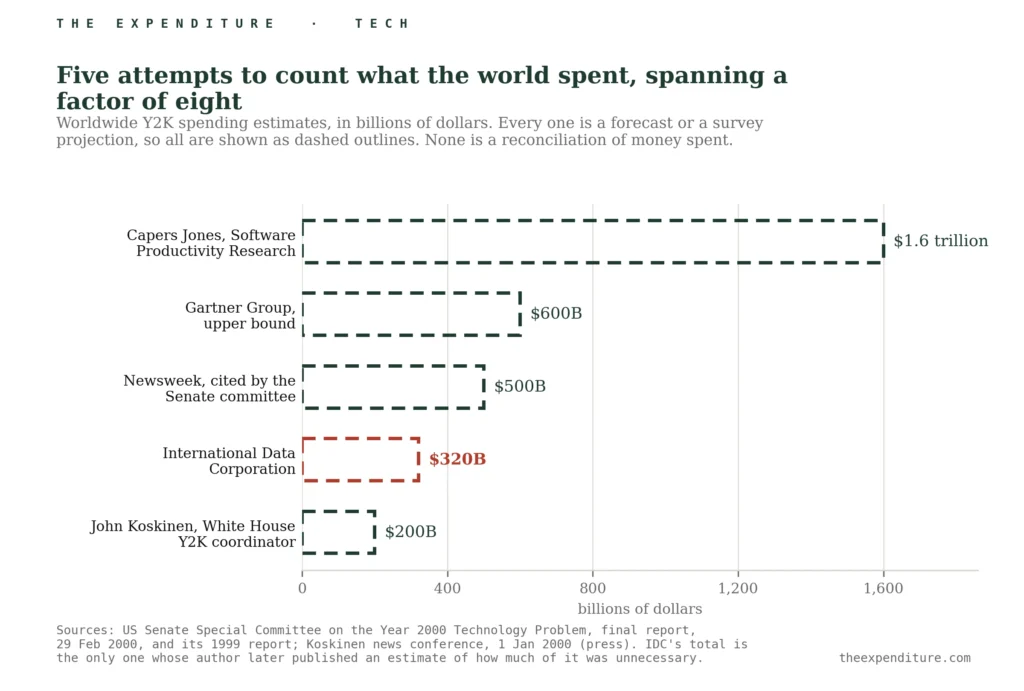
Nobody knows, and the spread between the serious attempts is a factor of eight. The Senate said so itself: “the worldwide cost of preparing for Y2K may never be known.”
The candidates, in order: Capers Jones of Software Productivity Research put the global figure at over $1.6 trillion, although the Senate noted that “Jones’ estimate includes over $300 billion for litigation and damages” which the others exclude. The Gartner Group’s range was $300 billion to $600 billion, and the Senate’s 1999 report called “$600 billion worldwide” a frequently cited number. A Newsweek journalist, cited by the Senate with no article or author named, put it at $500 billion. International Data Corporation’s Project Magellan arrived at $320 billion. Koskinen, speaking at a news conference on January 1, 2000, said governments and companies worldwide had spent $200 billion, of which the United States accounted for half.
Every one of those is a forecast or a survey projection. Not one is a reconciliation of money actually spent, and no institution has ever published one.
What actually failed on January 1, 2000?
Small things, in large numbers. The Senate’s final report lists them without drama: “Examples of domestic problems have included Medicare payment delays, double-billing by some credit card companies, degradation of a spy satellite system, 911 problems in several localities, and a nuclear weapons plant system anomaly.”
The Government Accountability Office put figures to several. At least $50 million in payments to Medicare Part A providers were delayed by one day. Credit card companies reported to financial regulators on January 6, 2000, that they had identified a failure resulting in over 470,000 duplicate transactions. On January 3 the Federal Reserve Bank of Chicago reported a failure involving the transmission of about $700,000 in tax payments. The Low Level Wind Shear Alert System displayed an error at eight airports.
Internationally, the picture was the same. The International Y2K Cooperation Center reported that “the Y2K bug produced no serious disruptions of critical services on a national, regional, or global level”, and that minor glitches “were managed by the organizations that operate the affected systems.”
Did the world overspend?
Yes, by between $66 billion and $76 billion, according to the firm that produced the most-quoted worldwide total. International Data Corporation, having estimated global spending at $320 billion, went back afterwards and concluded that a substantial share of it had been unnecessary. It called the excess a “hype tax”. The United States, by IDC’s reckoning, “led the way in overspending on preparations with a total of up to $41bn”, and across the world “the overspending bill was between $66bn and $76bn”.
John Gantz of IDC was unusually direct about why: “Y2K took on a life of its own through politicians, the media, and consultants.” He returned to it in November 2000: “There has been a lot of spin doctoring to try to find benefits, but the fact is we fixed more than we needed to.”
That is roughly a fifth to a quarter of IDC’s own worldwide total, judged as waste by the people who counted it. It is the closest thing to a post-event audit that Y2K ever received.
The academic case runs further. John Quiggin of the University of Queensland concluded in 2004 that most of the money “can be seen, in retrospect, to have been unproductive or, at least, misdirected”, and rested the argument on the observation that “Y2K-related problems had been insignificant even where little or no remediation effort had been undertaken.” He dismissed the usual rebuttal in advance: a low-spending country suffering nothing “might plausibly be made in relation to very poor countries with few computers, but it is absurd in relation to OECD countries like Italy, where computers are ubiquitous.”
Is Y2K the most expensive software effort in history?
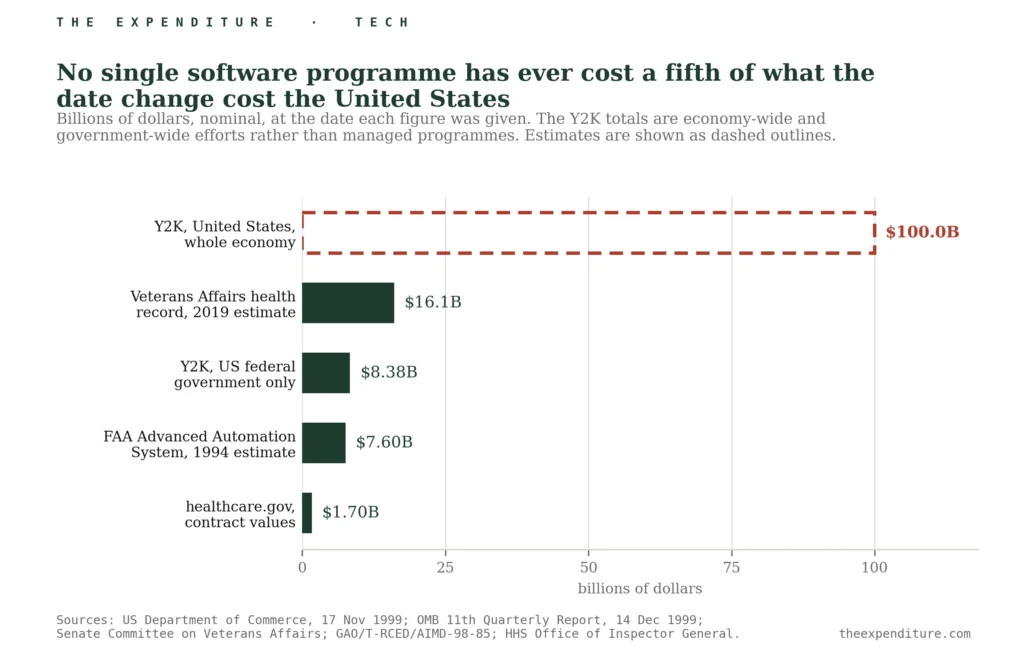
Yes, and nothing else is close, though the comparison needs care. Y2K spending was an aggregate across an entire economy, thousands of organizations and six or seven years, not a single managed program. No individual software program has ever approached $100 billion.
The largest single programs on record are an order of magnitude smaller. The United States Department of Veterans Affairs health record modernization was initially estimated in 2019 at $16.1 billion over a decade, with an independent 2021 estimate running to $50 billion. Britain’s National Programme for IT in the NHS was, in the National Audit Office’s words, “an £11.4 billion programme of investment”. The Federal Aviation Administration’s Advanced Automation System was budgeted at $2.5 billion in 1983 and estimated at as much as $7.6 billion by 1994. The contracts behind healthcare.gov had original estimated values totaling $1.7 billion.
Added together in nominal dollars, the three American programs come to $25.4 billion. The United States spent roughly four times that on the date change alone, and no individual program in the set reaches even a fifth of it.
The case that the money was well spent
The strongest argument against treating this as waste comes from the people closest to the systems. Anthony Finkelstein, writing in the Computing & Control Engineering Journal in August 2000, took both sides and landed firmly: “I believe that most organisations that spent heavily on Y2K were justified in doing so”, not because the bug itself was dangerous but because an organization that does not know which of its systems are business critical has a problem that Y2K forced it to solve. Firms emerged from 1999 with asset registers, dependency maps and tested recovery procedures they had never had before, and much of the spending bought durable capability rather than date arithmetic.
The comparison with low-spending countries is also weaker than it looks. Britain’s trade secretary Margaret Beckett rejected it at the time, and Computer Weekly reported that the £1.6 million Italy was said to have spent covered only the running costs of its year 2000 coordination office, not the remediation work done by Italian banks, utilities and manufacturers. Comparing a coordination budget with a national remediation bill is not a comparison. The Senate committee, having reviewed the evidence, concluded that “the level of effort was justified, and the expenditures of the public and private sectors were indeed necessary.”
Both points are fair. Neither disposes of IDC’s finding, because IDC was not arguing that nothing needed doing. It was arguing that too much was done, by firms buying insurance against a risk whose size nobody could state. That claim survives everything said above.
What was counted and what was not
The headline figure is the Commerce Department’s estimate as adopted by the Senate, and it is an estimate, not a reconciliation. The Commerce report itself says “in the neighborhood of $100 billion”. Only the federal figure of $8.38 billion rests on reported agency spending.
The inflation adjustment uses the BLS consumer price index for all urban consumers, 1999 annual average of 166.6 against August 2026 at 334.980, a factor of 2.01. Y2K money was spent from roughly 1995 to 2001 rather than all in 1999, so the adjustment is approximate and is given as context rather than as a headline.
Worldwide figures are not added to American ones anywhere in this article, because they rest on different methods and overlapping periods. IDC’s overspend finding is measured against IDC’s own $320 billion worldwide total and not against the $100 billion United States figure.
Excluded: litigation and damages, which Capers Jones included and the others did not, and which account for more than $300 billion of the difference between his figure and Gartner’s. Excluded too is any attempt to value the disruption avoided, because no such valuation exists and constructing one would require assuming the answer to the question the article is about.
Key figures
- $100 billion: United States spending on Y2K readiness, per the Commerce Department
- $201 billion: the same sum in August 2026 dollars
- $8.38 billion: federal government spending, reported agency by agency to OMB
- $3.35 billion: the Y2K emergency supplemental appropriation
- $320 billion: IDC’s worldwide estimate
- $66 billion to $76 billion: IDC’s own estimate of worldwide overspending
- $1.6 trillion: Capers Jones’s worldwide figure, including over $300 billion of litigation and damages
- 470,000: duplicate credit card transactions traced to a Year 2000 failure in the first week of January
The open question
Y2K is the only megaproject in history whose success criterion was that nobody would notice it, and it met that criterion. Twenty-six years later there is still no agreed figure for what the world spent, no study comparing national spending to national outcomes, and no way to price what was avoided. The most expensive software effort ever undertaken remains, by design, unauditable.
Frequently asked questions
Software that stored years as two digits, so that 00 could be read as 1900 rather than 2000. It was a deliberate choice made when storage was expensive, not an error, and it propagated through decades of code that outlived its expected life.
Central government departments and agencies in Great Britain estimated £420 million, according to the National Audit Office in May 1999, with the NHS in England at approximately £321 million on top. No final post-event United Kingdom total was ever published.
No critical service failed anywhere. The International Y2K Cooperation Center reported no serious disruption at national, regional or global level. The documented failures were a one-day delay to Medicare payments, duplicate credit card transactions, an airport wind shear display error and similar.
John Koskinen, as chair of the President’s Council on Year 2000 Conversion. He gave the $200 billion worldwide figure at a news conference on January 1, 2000, and later served as Commissioner of the Internal Revenue Service.
The United States Department of Veterans Affairs health record modernization, initially estimated at $16.1 billion over a decade in 2019, with an independent assessment in 2021 putting the full cost at up to $50 billion.
About $365 per resident, the Commerce Department’s own calculation in November 1999. That is roughly $734 in August 2026 money at the same inflation factor used elsewhere in this article.
Notes. Currency note: all figures are in dollars of the year stated, with no conversion between currencies. British figures are left in pounds for that reason. The inflation adjustment to August 2026 uses the BLS consumer price index for all urban consumers, 1999 annual average 166.6 against August 2026 at 334.980, read on October 6, 2026. Estimates from different sources rest on different methods and are never added together.
Sources
- US Senate Special Committee on the Year 2000 Technology Problem, “Y2K Aftermath: Crisis Averted: Final Committee Report”, February 29, 2000
- US Senate Special Committee on the Year 2000 Technology Problem, “Investigating the Impact of the Year 2000 Problem”, February 24, 1999
- Office of Management and Budget, 11th Quarterly Report on Federal Government Year 2000 Progress, December 14, 1999
- US Department of Commerce, Economics and Statistics Administration, “The Economics of Y2K and the Impact on the United States”, November 17, 1999
- US General Accounting Office, GAO/T-AIMD-00-70, January 27, 2000, and GAO/AIMD-99-154, April 28, 1999
- International Y2K Cooperation Center reporting, via the US Department of State Washington File, 3 and February 17, 2000
- International Data Corporation, worldwide estimates and the “hype tax” finding, via Accountancy Age and Computerworld (press)
- John Koskinen, news conference of January 1, 2000, as reported by Federal Computer Week and CNN/IDG (press)
- UK National Audit Office, “The Millennium Threat: 221 Days and Counting”, HC 436, May 26, 1999
- John Quiggin, “The Y2K scare: causes, costs and cures”, University of Queensland, Australian Public Policy Program Working Paper WPP04_1, 2004
- Anthony Finkelstein, “Y2K: a retrospective view”, Computing & Control Engineering Journal 11(4), August 2000
- Computer Weekly, “Was Y2K a costly non-event”, January 13, 2000 (press)
- UK National Audit Office, HC 888, “The National Programme for IT in the NHS”, May 18, 2011
- US Senate Committee on Veterans’ Affairs, statements on the electronic health record modernization program
- US Bureau of Labor Statistics, consumer price index for all urban consumers