Record Data Sheet
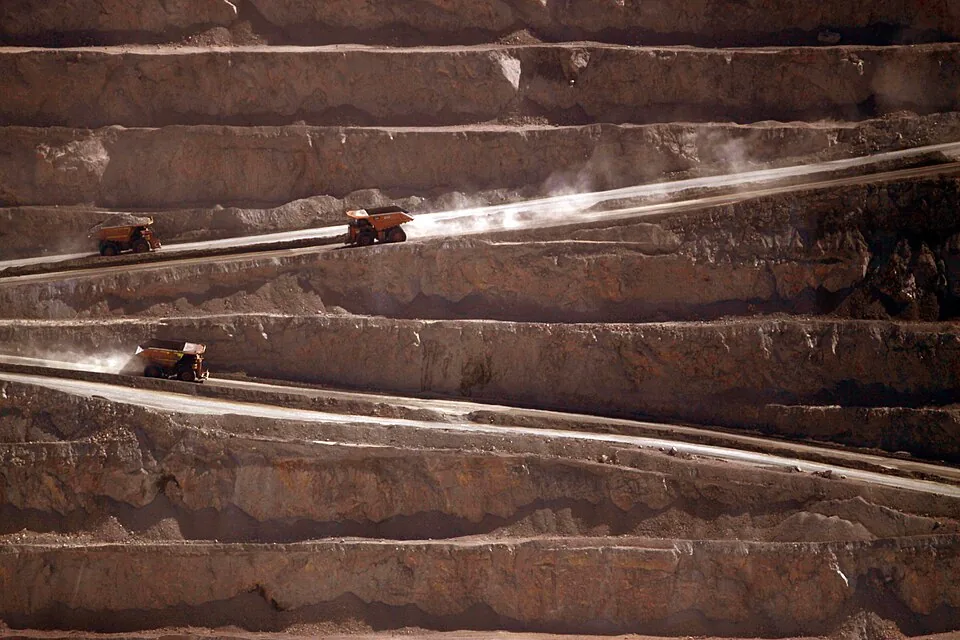
Desert at 3,100 meters. A pipeline to the Pacific. One pit, then a second beside it. The largest copper mine in the world.
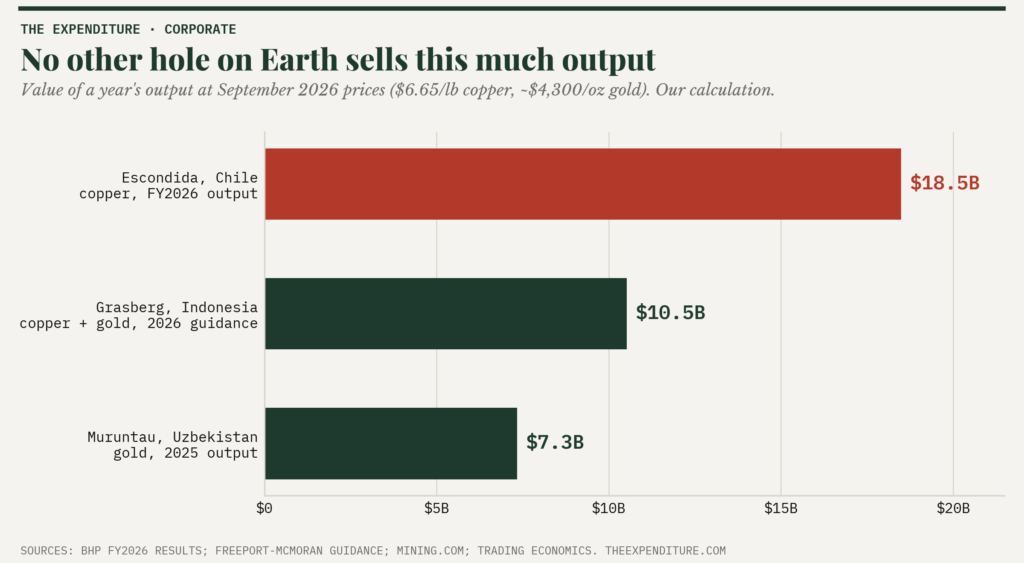
Escondida, 170 kilometers southeast of Antofagasta, produced 1,261,000 tonnes of copper in BHP’s financial year to June 2026. Copper traded at $6.65 a pound on September 21, 2026, about $14,660 a tonne and 45 percent higher than a year earlier. At that price, one year of Escondida’s output is worth about $18.5 billion. No other mine on Earth sells a year of output worth as much.
The claim needs a definition, because “biggest mine” means different things to different people. Here it means the single operation whose annual output is worth the most at market prices: the measure this site uses, because it counts what comes out of the ground rather than how big the hole is. The $18.5 billion is our calculation, output times today’s price, and it is not reported revenue. What BHP does report is almost as striking: Escondida earned $12.4 billion of underlying EBITDA in FY2026, up 45 percent in a year. (More Corporate records here.)
Is it the biggest mine of any kind?
In dollars, yes, and the two plausible rivals show it. Grasberg in Indonesia, the great copper and gold mine, would normally run closest. But a mudslide on September 8, 2025, killed seven workers and halted its main underground mine. Freeport guided 2026 output to about 1.0 billion pounds of copper and 900,000 ounces of gold. At today’s prices that is about $10.5 billion, and it is an upper bound: in April Freeport cut its expected operating rate for the second half of 2026 from 85 percent of capacity to 65 percent.
Muruntau in Uzbekistan, the largest open-pit gold mine, produced 1,708,000 ounces in 2025, according to MINING.COM’s ranking. At about $4,300 an ounce, that is $7.3 billion.
Escondida’s $18.5 billion is 76 percent more than Grasberg’s 2026 and two and a half times Muruntau’s. Iron ore and coal do not compete at the level of a single operation: the giant iron districts are complexes of many mines, and they are excluded here by definition.
How much does Escondida actually make?
This is the question the headline figure invites, and BHP’s accounts answer most of it. Escondida’s unit cost in FY2026 was $1.07 a pound. Copper is selling at more than six times that. The result is the $12.4 billion of EBITDA, on a 100 percent basis, against $8.6 billion the year before, with BHP attributing the jump to higher realized copper, gold and silver prices.
The owners split it. BHP operates Escondida and holds 57.5 percent, Rio Tinto holds 30 percent, and a Japanese consortium led by Mitsubishi holds 12.5 percent. Chile takes its share first: the mine paid more than $4 billion in taxes and royalties in the year to June 2025, according to Panorama Minero. Other giant mines carry bills that never show up in the output figures: in Sweden, the iron ore miner LKAB is spending about $4.4 billion on moving a town out of its way.
But “how much does it make” is the wrong question for this mine. The right one is how long it can keep being this big.
Why is Escondida’s output falling?
Because the ore is running out of copper. When the mine opened in the early 1990s, its ore ran at roughly 2.5 to 3 percent copper. Rio Tinto’s filings show a head grade of 1.51 percent in 2004. By 2022 it was 0.78 percent. Investment pushed feed grade back above 1 percent in 2024, but the direction since then is plain in BHP’s own reports: 0.93 percent in the second half of 2025, about 0.90 percent for FY2026, and about 0.70 percent guided for FY2027.
The mine is working harder than ever. BHP reported record material mined and record concentrator throughput in FY2026. Output still fell 3 percent, from 1,305,000 tonnes (worth $19.1 billion at today’s price) to 1,261,000. For FY2027, BHP guides 1,000,000 to 1,100,000 tonnes. For FY2028 to FY2031, it guides 900,000 to 1,000,000 tonnes a year.
At today’s price, that guidance takes the value of a year’s output from $18.5 billion to about $15.4 billion in FY2027, a loss of roughly $3.1 billion without anything going wrong, and to about $13.9 billion a year after that.
BHP’s answer is a new concentrator, now budgeted at $5.4 billion to $6.3 billion and designed to add 230,000 to 270,000 tonnes a year. The environmental permit application went in in March 2026. First production depends on a final investment decision BHP has placed in 2027 or 2028.
Will Escondida still be the biggest mine in 2028?
On the owners’ own guidance, possibly not. Freeport expects Grasberg to average about 1.6 billion pounds of copper and 1.3 million ounces of gold a year from 2027 to 2029. At today’s prices that is about $16.2 billion a year: more than Escondida’s FY2027 midpoint of $15.4 billion, and more than its $13.9 billion a year from FY2028.
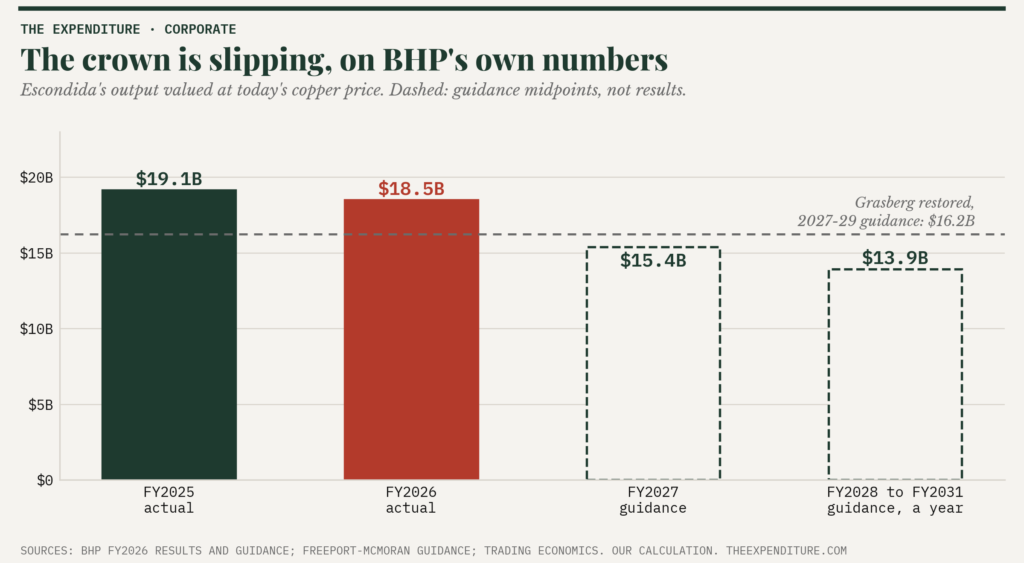
The skeptic has three good answers, and they should be stated. Grasberg has to get there first: its full recovery has already slipped once, and Freeport now expects to approach full capacity only by the end of 2027. The comparison also depends on the ratio between gold and copper prices, because about a third of Grasberg’s value is gold. And Escondida’s new concentrator, if approved on BHP’s timetable, would lift it back above Grasberg’s guided level later in the decade. What the guidance says is that the gap, which is $8 billion today, closes. Whether the title changes hands depends on prices and on two restarts, one in Indonesia and one on a BHP board agenda.
What did we count, and what did we leave out?
The $18.5 billion is our calculation, BHP’s reported FY2026 production multiplied by the copper price on September 21, 2026 ($6.65 a pound, about $14,660 a tonne, as reported by Trading Economics; the US benchmark has recently traded above the London price). It is not reported revenue. EBITDA and unit cost are BHP-reported on a 100 percent basis. Rival values use the same copper price and a gold price of about $4,300 an ounce (mid-September 2026). Escondida figures are on BHP’s July to June financial year; Grasberg and Muruntau on calendar years. The unit is the single operation: Escondida mines two adjacent pits, Escondida and Escondida Norte, under one name and one ownership. Districts that group separately run mines, such as Carajás or Nevada Gold Mines, are excluded. Future values hold today’s prices constant; they show the effect of volume guidance, not a price forecast.
Key figures
- $18.5B: market value of Escondida’s FY2026 output (1,261,000 tonnes) at $14,660 a tonne. Our calculation.
- $12.4B: Escondida’s underlying EBITDA in FY2026, up 45 percent (BHP, 100 percent basis)
- $1.07/lb: unit cost in FY2026, against a copper price of $6.65/lb
- $10.5B / $7.3B: Grasberg (2026 guidance) and Muruntau (2025 output) at the same prices
- 0.90% to 0.70%: feed grade, FY2026 to FY2027 guidance; 1.51% in 2004; 2.5 to 3% at startup
- 1,000 to 1,100 kt: FY2027 output guidance, about 17% below FY2026
- $3.1B: value lost between FY2026 and the FY2027 guidance midpoint, at today’s prices
- $16.2B: Grasberg’s guided average for 2027 to 2029 at today’s prices
- BHP 57.5% · Rio Tinto 30% · JECO 12.5%: ownership
The open question
BHP’s answer to a thinning orebody is a concentrator it has not yet approved, with the decision placed in 2027 or 2028. Freeport’s answer at Grasberg is a recovery that has already slipped once. Both are schedules rather than results, and the title now turns on which of the two slips further. Only the next two years of quarterly reports can settle it.
Frequently asked questions
What is the biggest mine in the world?
Escondida, in Chile’s Atacama Desert, measured by the value of a year’s output. Its FY2026 production of 1,261,000 tonnes of copper is worth about $18.5 billion at September 2026 prices, against about $10.5 billion for Grasberg in Indonesia on 2026 guidance and about $7.3 billion for Muruntau in Uzbekistan.
How much money does Escondida make?
BHP reported underlying EBITDA of $12.4 billion for Escondida in the year to June 2026, up 45 percent, on a unit cost of $1.07 a pound. The mine also paid more than $4 billion in taxes and royalties to Chile in the year to June 2025.
Who owns the Escondida mine?
BHP operates it and owns 57.5 percent. Rio Tinto owns 30 percent and the Japanese JECO consortium, led by Mitsubishi, owns 12.5 percent.
Where does a mine in the Atacama get its water?
From the sea. Escondida runs on desalinated seawater pumped about 180 kilometers inland from Puerto Coloso and lifted some 3,200 meters. The larger of its two plants was commissioned in 2017 and inaugurated in April 2018 at a cost of $3.43 billion, starting at 2,500 liters a second and expanded to 3,800 by FY2020. BHP says the mine stopped drawing from the Salar de Punta Negra aquifer in 2017 and from the Salar de Atacama in FY2020, a decade ahead of the commitment it made in 2019.
When was Escondida discovered?
In March 1981, by nine scout drill holes on a joint venture between Utah International and Getty, on ground the geologist David Lowell had argued was worth testing. The orebody does not reach the surface: it sat under 140 to 365 meters of leached capping, which is where the name comes from, escondida being Spanish for hidden. The Los Colorados concentrator started up in November 1990 and BHP marks March 14, 1991, as the operational start.
How is Escondida powered?
By contracted renewable electricity. BHP moved its Chilean copper operations, Escondida and Spence, onto 100 percent renewable contracted supply in its 2022 financial year, through long term power purchase agreements and several years ahead of the target it set in 2019. That covers the power it buys rather than power it generates: on site solar and battery storage at Escondida were only contracted in 2026.
Notes. Currency note: all figures are in US dollars. No conversion was needed.
Sources
BHP (primary)
- BHP FY2026 results, Form 6-K (Escondida 1,261 kt, FY25 1,305 kt, EBITDA $12.4B vs $8.6B, unit cost $1.07/lb, FY27 guidance 1,000 to 1,100 kt, medium term 900 to 1,000 ktpa, new concentrator $5.4 to 6.3B and 230 to 270 ktpa, permit filed March 2026)
- BHP Form 20-F FY2026 (FY27 feed grade ~0.70%)
- BHP half-year results to December 31, 2025, Form 6-K (feed grade 0.93% vs 1.03%)
- BHP operational review, nine months to March 31, 2026 (record material mined and throughput, feed grade 0.91%)
- BHP half-year results release, February 2026 (new concentrator potential FID CY27 to 28)
Rivals
- Freeport-McMoRan: update on restart plans for Grasberg (2026 ~1.0 bn lb copper and 0.9 Moz gold; 2027 to 2029 average 1.6 bn lb and 1.3 Moz)
- MINING.COM: Freeport plans to restore large-scale production at Grasberg (September 8, 2025, mudslide, seven workers killed)
- MINING.COM: Freeport stock on Grasberg ramp-up delay (H2 2026 operating rate cut from 85% to 65%; full capacity by end-2027)
- MINING.COM: World’s top 20 largest gold mines (Muruntau 1,708 koz in 2025)
Water, energy and history
- BHP: BHP targets 100 percent renewable energy at Escondida and Spence and elimination of water usage from aquifers in Chile (October 20, 2019; the 2030 aquifer commitment)
- BHP: Breaking the water-energy nexus (September 2020; Salar de Punta Negra stopped 2017, Salar de Atacama stopped FY2020; renewable contracts from FY2022)
- International Mining: BHP opens Escondida Water Supply, the largest desalination plant in Latin America (April 7, 2018; 2,500 l/s, Puerto Coloso, 180 km, 3,200 m lift)
- MINING.COM: BHP to supply water for Escondida mine from desalination plant only (February 4, 2020; $3.43 billion)
- International Mining: BHP advances renewable power supply and storage at Escondida and Spence (June 1, 2026; 110 MW solar and 110 MW battery at Escondida, from FY2029)
- Ortiz, Lowell, Bratt, Rojas and Burns: Escondida porphyry copper deposit, II Región, Chile, history of the discovery (1986; drilling 3 to March 21, 1981, nine holes, 140 to 365 m of leached capping)
Prices
- Trading Economics: Copper ($6.65/lb on September 21, 2026, up 44.8% year on year)
- PriceGold: gold price, September 14, 2026 ($4,304/oz)
Ownership, taxes, grade history
- Panorama Minero: Minera Escondida, a look inside the world’s largest copper producer (more than $4B in taxes and royalties to June 2025; ownership)
- Rio Tinto 20-F, FY2005 (head grade 1.51% in 2004)
- Earth Resource Investments: Grade decline at the world’s largest copper mine (2.5 to 3% at startup)
- Goehring & Rozencwajg: Copper market analysis (0.78% in 2022)