Record Data Sheet
ICBC has the biggest balance sheet on the planet. Its market value is a third of JPMorgan’s, why?
The number that misleads
ICBC closed 2025 with ¥53.48 trillion in assets, up 9.5% from the year before, making it the first bank in history to cross the ¥50 trillion mark. JPMorgan closed the year at $4.4 trillion. Converted at a rough exchange rate — ICBC doesn’t publish an official dollar figure — the Chinese bank is somewhere between 60% and 70% bigger.
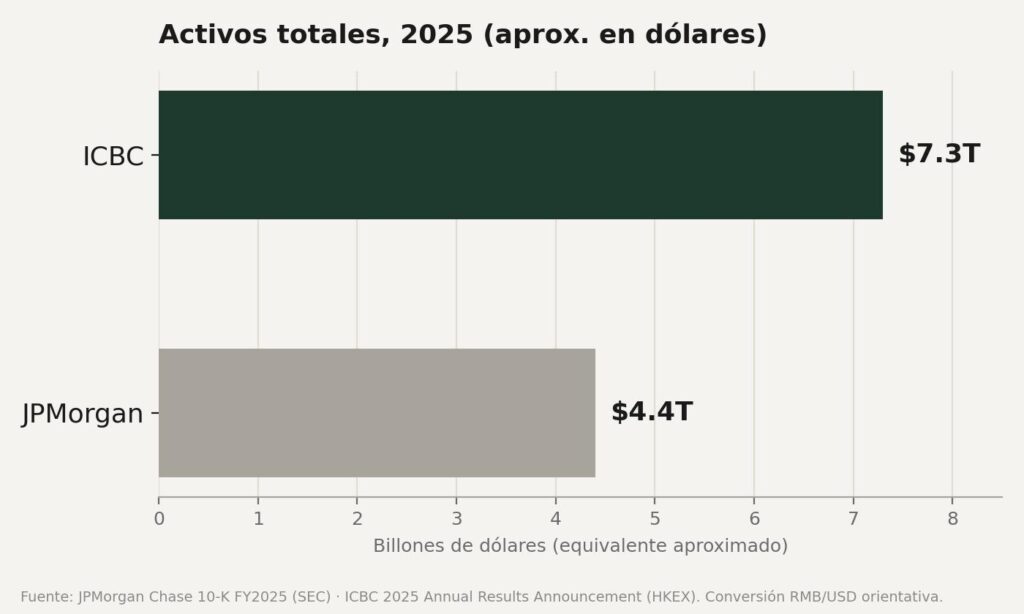
That’s not because it runs a better business. It’s because in China, nearly all of the country’s credit flows through the balance sheets of a handful of state-owned banks, and ICBC is the largest of the four. In the U.S., a lot of that financing happens outside the banking system entirely, through bond markets and asset managers like BlackRock. ICBC’s size doesn’t measure a stronger bank. It measures an entire financial system compressed into a single set of books.
Profitability tells a different story
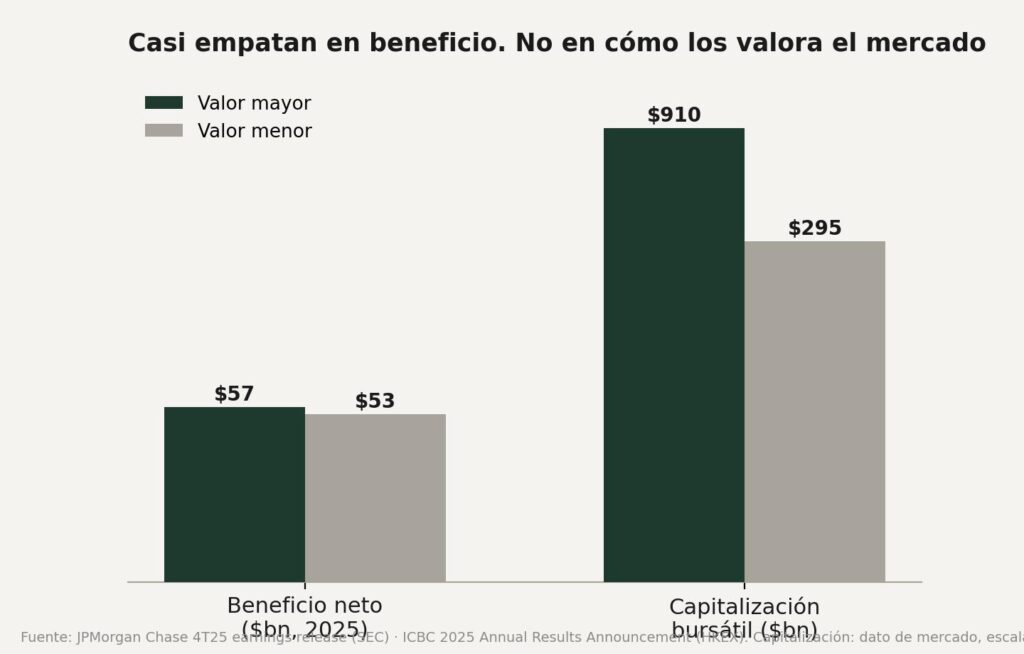
Net income, $57 billion (JPMorgan) vs ¥370.766 billion, roughly $53 billion (ICBC) Return on assets — 1.3% vs 0.72% ICBC’s net interest margin – 1.28%, down for a fifth straight year Return on equity — 20% ROTCE (JPMorgan) vs 9.45% ROE (ICBC)
Beijing wants its state banks to keep credit cheap to prop up manufacturing and domestic spending, and ICBC gives up margin to make that happen. JPMorgan answers to nobody but its shareholders. Its wealth and asset management arm, the most profitable part of the bank, closed the year with a 40% return on equity and $4.8 trillion under management.
What the market is actually paying for
With a balance sheet 40% smaller, JPMorgan trades at a market value of around $910 billion. ICBC, despite being the largest bank in the world, trades between $290 and $300 billion. The market isn’t paying for size. It’s paying for the certainty that capital can leave a country and come back in without a government deciding otherwise.
One more data point puts both banks in perspective: HSBC, the bank historically built as a bridge between East and West, made $29.9 billion in 2025 — more than half of JPMorgan’s profit — and still, neither bank plays in the same league as any other international lender, HSBC included.
What about American Express?
American Express moves a fraction of what JPMorgan moves in a single day, and yet most people on the street would recognize its brand faster. Amex built its value around exclusivity; JPMorgan built its around necessity. Fame and power aren’t the same currency. Something similar separates Visa and Mastercard from both of them: neither is technically a bank — they don’t lend money or take on credit risk — they just collect a toll on every transaction that crosses their network, which makes them more profitable per dollar of capital than either giant in this story. BlackRock makes the same point from another angle: it manages trillions that never show up on its own balance sheet, because it’s paid a fee to manage that money, not to risk it. And Goldman Sachs, the closest thing to a mirror image of JPMorgan, is really a specialist sniper in investment banking, next to a bank that plays every position on the field at once.
What ICBC has that none of them can match is sheer population scale: 782 million retail customers and 14.7 million corporate clients, more people than live in the U.S., the EU, and Japan combined. JPMorgan, with 318,512 employees across 66 countries, has the international footprint ICBC still lacks, partly because the yuan still isn’t a freely convertible currency.
The same race, run toward different finish lines
Both banks are chasing the same obsession without saying so out loud. JPMorgan presents its AI spending to Wall Street analysts every quarter as a competitive edge. ICBC has built its own financial-sector large language model, “ICBC Zhiyong,” with hundreds of billions of parameters, already deployed across more than a hundred use cases in its custody business. One sells AI as productivity. The other sells it as infrastructure for a system that serves 782 million people.
Verdict
Assets → ICBC Net income → JPMorgan Market capitalization → JPMorgan, nearly triple Retail customers → ICBC, 782 million International footprint → JPMorgan, 66 countries Capital mobility → JPMorgan, unrestricted JPMorgan wins on everything the market can price today: profitability, valuation, capital mobility. ICBC wins on the one thing the market can’t replicate overnight: being the credit infrastructure for 782 million people.
The question the numbers don’t answer yet
JPMorgan needs the world to keep needing dollars. ICBC needs the world to eventually start needing yuan. Every new yuan clearing bank it opens — the latest one, in Turkey — is a bet that day is coming. It hasn’t arrived yet, which is why the biggest bank on the planet still trades like it’s the smaller of the two.