Record Data Sheet
Some projects get measured in miles. Others get measured in years of delay. The Gulf Railway — the GCC Railway — gets measured in both, plus tens of billions of dollars that six different governments have committed trying to finally deliver on something they’ve been promising for fifteen years.
The number that explains everything
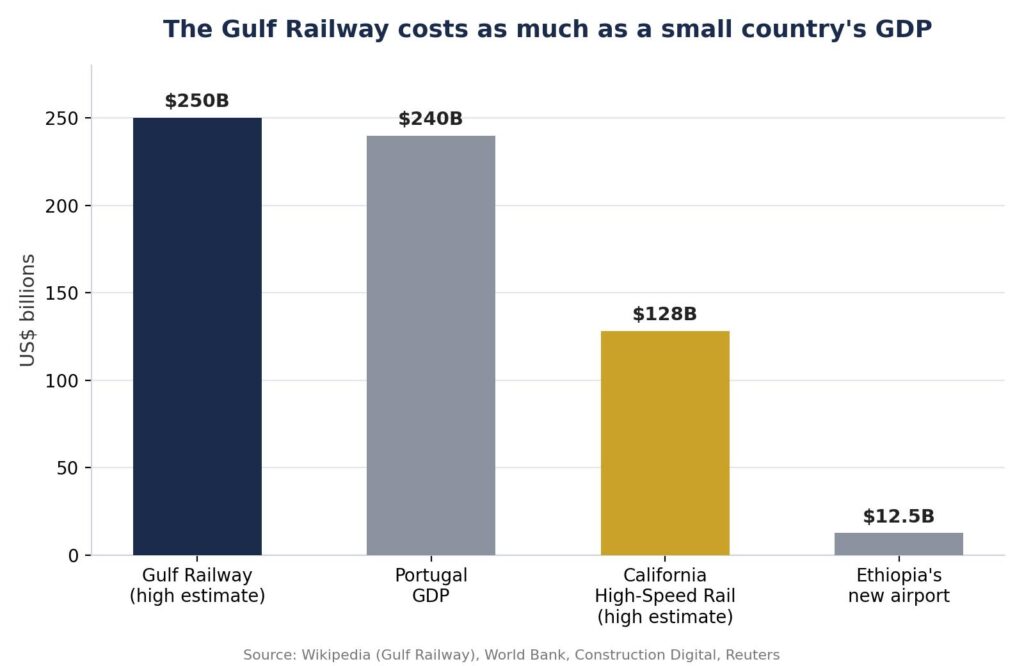
The project will link all six Gulf Cooperation Council states — Saudi Arabia, the United Arab Emirates, Qatar, Kuwait, Bahrain and Oman — through a 2,177-kilometer rail network, according to Wikipedia, which cites official project estimates putting the total cost at $250 billion. That’s $250 billion, per those same estimates, to lay track between Kuwait and Muscat.
Other infrastructure-focused sources in the region are a bit more conservative, but not by much: according to ALG Global, a transport-focused consultancy, the project’s cost tops $240 billion. That’s $240 billion as the floor analysts are working with to call the network complete.
To put that in perspective: $240 billion, per World Bank figures, is roughly the size of the entire annual GDP of a country like Portugal or Greece. One single rail project, split across six governments, costs what an entire nation produces in a year.
Fifteen years of delays, and a bill that keeps climbing
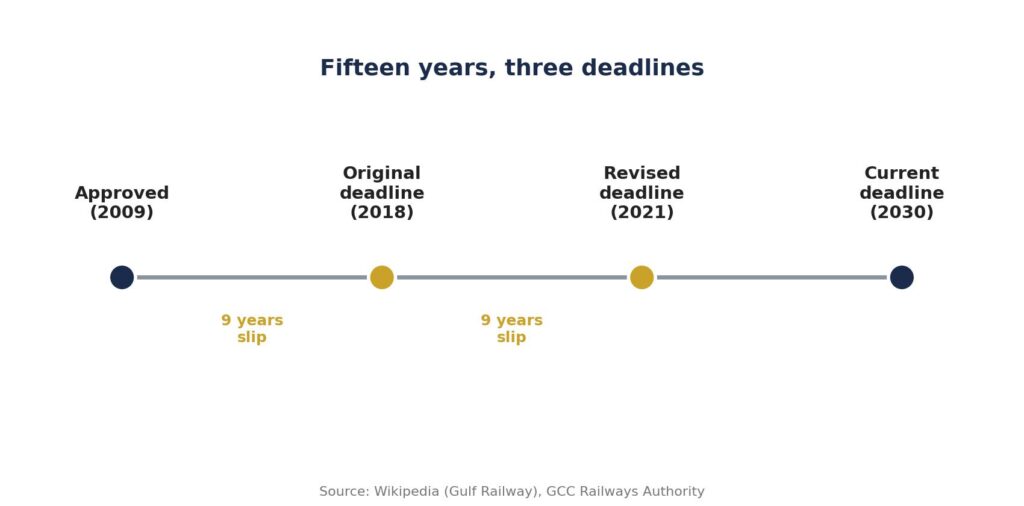
This isn’t a new idea. It was approved at the 30th GCC summit in Kuwait back in December 2009, per Wikipedia. The original delivery date was 2018. That slipped to 2021. The official target now is December 2030, according to the GCC Railways Authority.
Every delay has come with an upward revision to the budget — standard practice for infrastructure megaprojects in the region. The think tank Observer Research Foundation (ORF) Middle East notes that the initial estimate hovered around $250 billion, but a unified GCC fund to guarantee that financing never materialized, leaving each country to cover its own stretch.
That fragmentation hits each government’s wallet differently. The spending isn’t split evenly: per Wikipedia, costs are distributed across the six countries in proportion to the length of track each one builds, meaning Saudi Arabia and the UAE with the longest stretches are on the hook for the biggest checks, followed by Oman, Qatar, Kuwait and Bahrain.
One train, six separate ledgers
What makes this project especially interesting from a public-spending standpoint is that there isn’t one bill there are six.
Kuwait has brought on Turkish consultancy Proyapo Engineering and Consulting to design its 111-kilometer stretch between Al-Nuwaiseeb and Al Shadadiya, according to Time Out Doha.
Saudi Arabia already has its Landbridge underway, a 950-kilometer line between Riyadh and Jeddah that forms the backbone of the broader project.
The UAE, through Etihad Rail, already runs a freight network across all seven emirates and is preparing to launch passenger service — roughly 900 kilometers connecting 11 cities, per Time Out Dubai.
Qatar formally signed on in July 2025, per Time Out Doha, with a stretch that will include a maritime bridge to Dammam, Saudi Arabia.
Every one of these national outlays feeds into the shared $240-250 billion total, but none of the six governments publishes a consolidated breakdown of total project spending — which makes it hard to track exactly what’s been spent, and when.
So where does the project actually stand?
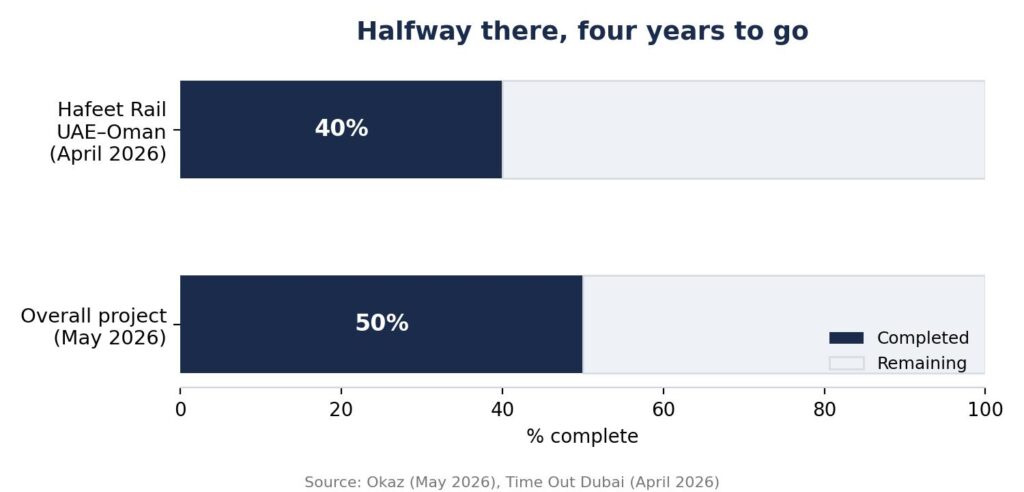
According to Mohammad Al-Shabrami, director general of the GCC Railways Authority, quoted by the Saudi newspaper Okaz on May 11, 2026, the project is 50% complete. Half of it, per the authority running the project, is built; the other half — with that 2030 deadline looming — isn’t.
The Hafeet Rail segment, linking the UAE and Oman, was 40% complete as of April 2026, according to Time Out Dubai. That’s a notable data point because that corridor is one of the few with an active international partner already in place: Oman Rail and Etihad Rail launched a joint venture back in 2022 specifically to build it.
What the analysts say about the delay
The Gulf Railway’s problem, according to Observer Research Foundation, was never purely technical. The think tank points to the absence of a joint financing mechanism, the 2017 diplomatic rift between Qatar and its neighbors — which froze Qatar’s segment for years — and competition for capital from other national megaprojects like NEOM in Saudi Arabia and the 2022 Qatar World Cup buildout, both of which soaked up budget that might otherwise have gone to the railway.
There’s also a deeper mismatch between national wealth and a shared timeline: while the UAE and Saudi Arabia have pushed ahead on their own with their segments, Kuwait, Bahrain and Oman have faced more delays tied to fiscal constraints — especially after the 2014 oil price crash and during the pandemic, per the same ORF analysis.
The comparison that never misses in stories like this
If the project ends up costing the $250 billion the higher estimates suggest, that would top the combined cost of two other infrastructure giants we’ve covered at The Expenditure: California’s high-speed rail line, whose price tag has climbed from $33 billion to somewhere between $89 billion and $128 billion, according to Construction Digital, and Ethiopia’s $12.5 billion airport, which Reuters described in February 2026 as the largest in Africa.
Put another way: for what it’s going to cost to link six Gulf countries by rail, you could pay for the California train and the Ethiopian airport several times over — and still have money left.
Sources: Wikipedia (Gulf Railway), ALG Global, Observer Research Foundation (ORF) Middle East, Time Out Doha, Time Out Dubai, Okaz, Construction Digital, Reuters. All figures reflect public estimates and statements available as of July 2026.
The Expenditure ® 2026