Record Data Sheet
Hinkley Point C is the most expensive thing ever built on a single site. Eight years under construction, zero electricity produced. And the reason is not the reactor.
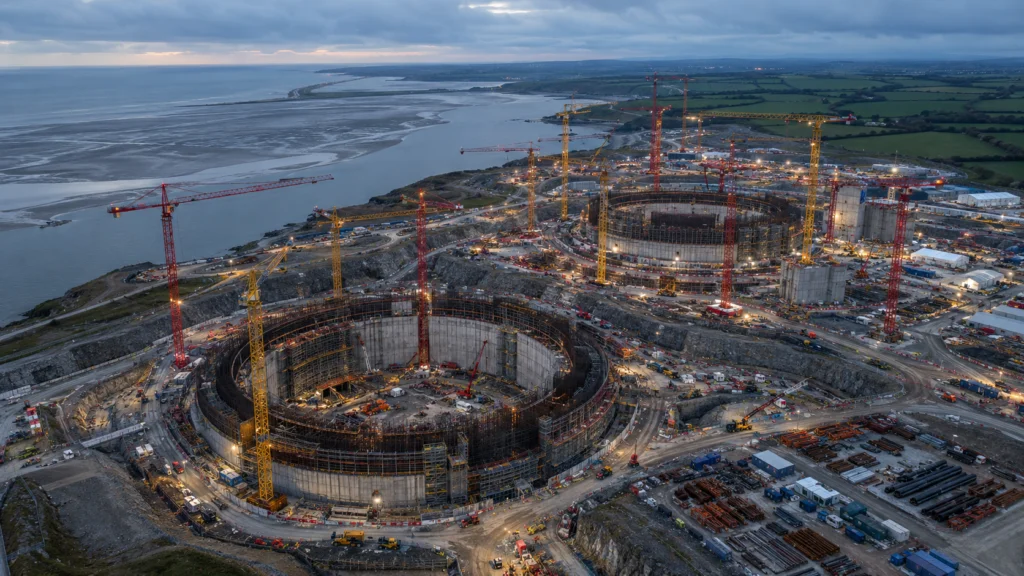
On a stretch of the Somerset coast, more than 7,000 people are assembling the most expensive construction humanity has ever put on one site. It is not a skyscraper, not an airport, not a stadium. It is a power station.
Hinkley Point C is priced at £35 billion in 2015 money, which inflation turns into roughly £48.7 billion today, about $65 billion. When the project was approved in 2016, the budget was £18 billion. In real terms the bill has roughly doubled. In cash terms it has nearly tripled. The plant has never produced a watt.
The obvious explanation is the reactor. The obvious explanation is wrong.
The design that has never been delivered on time
Hinkley uses two EPR reactors, a French design from Framatome, drawn up in the 1990s after Chernobyl and revised after Fukushima. Before Hinkley, exactly three EPR projects existed anywhere, four reactors between them. What each was promised, and what happened:
Olkiluoto 3, Finland.
Construction began 2005, promised for 2009 at around €3 billion. Entered commercial operation in 2023, fourteen years late, at more than €11 billion.
Flamanville 3, France.
Construction began December 2007, promised for 2012 at €3.3 billion. Connected to the grid in 2024. The last public figure, from 2022, was €12.7 billion.
Taishan 1 and 2, China.
Construction began 2009, promised for 2013 at $7.5 billion. Entered commercial operation in December 2018 and September 2019.
Hinkley Point C.
Construction began December 2018, promised for 2025 at £18 billion. Now scheduled for 2030 at £35 billion in 2015 prices.
Sizewell C.
Reached financial close in November 2025. Two more EPRs, £38 billion.
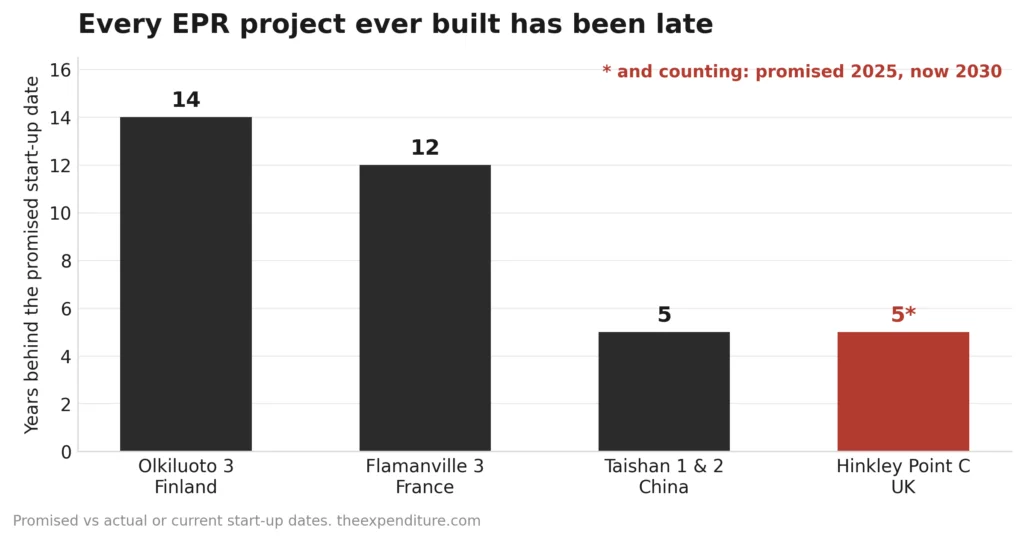
Eight reactors, five sites, not one delivered on its original date. The EPR is expensive everywhere. But look again at Taishan.
Why it costs this much here
Taishan runs the same two reactors as Hinkley. Same design, same era, same supplier. Analysis by Britain Remade puts its cost at just over a fifth of Hinkley’s per megawatt. If an EPR were inherently a £48 billion machine, Guangdong would have paid £48 billion for one.
So the useful question is not why EPRs are expensive. It is why an EPR is this expensive in Britain. Two things account for the gap, and neither is bolted to the reactor.
Britain last began building a nuclear power station in 1987.
That was Sizewell B, thirty nine years ago. In the decades since, the country lost its nuclear supply chains, its certified welders, its nuclear-grade concrete expertise, and the institutional memory of how to sequence a build like this. All of it had to be reconstructed from nothing, and Hinkley paid the tuition. China never stopped building and never had to.
Then time compounded the bill.
Every additional year adds financing costs, inflation and idle capital. Construction that was meant to take seven years will take at least twelve. Hinkley was once expected to be powering British kettles in 2025. The current date for the first reactor is 2030.
What is actually being built
Two EPR units side by side, 1,630 megawatts each, 3,260 combined. EDF says that covers around six million homes and roughly 7 percent of British electricity, for sixty years.
The site was not chosen for its scenery. Hinkley Point A generated from 1965 until 2000. Hinkley Point B generated from 1976 until August 2022, forty six years. As each closed, it released exactly what a new station needs and cannot easily obtain anywhere else: a grid connection already sized for nuclear output, a licensed nuclear footprint, road and marine access, and cooling water from the Severn Estuary. C was built on that headland because A and B had finished with it.
In raw capacity Hinkley is large but not the largest. Japan’s Kashiwazaki-Kariwa, with seven reactors, is more than twice its size. What makes Hinkley exceptional is not the wattage. It is the invoice.
The number, taken apart
Time is the largest line item. The project’s history is the history of its price. Approved at £18 billion in 2016. Raised to between £25 and £26 billion in 2022. Raised again to between £31 and £34 billion in January 2024. Confirmed at £35 billion in 2015 prices in February 2026, roughly £48.7 billion in today’s money. The plant did not double in size. It doubled in duration.
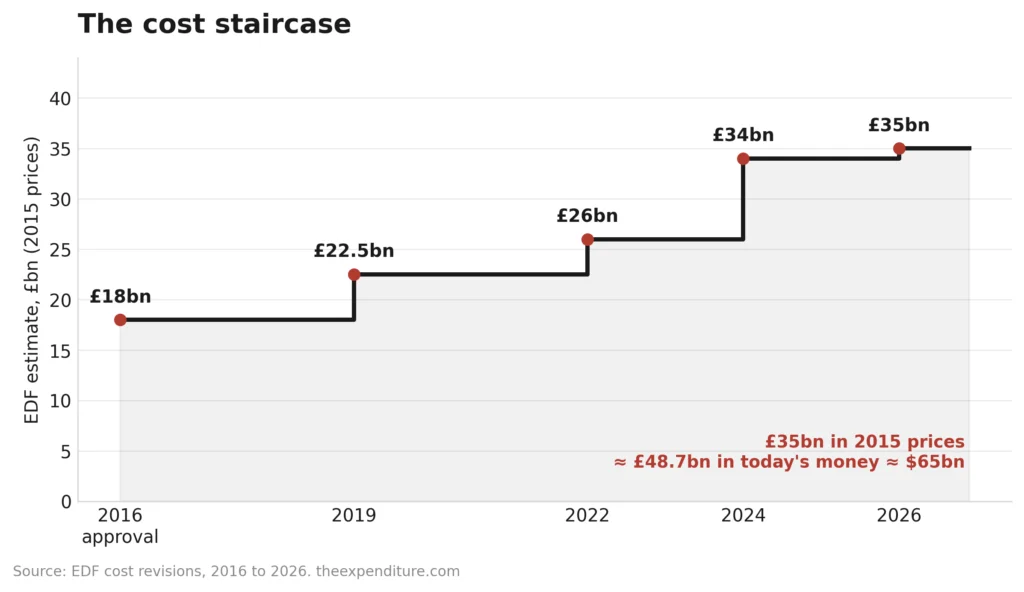
And that figure is EDF’s base case, not a ceiling. The company’s own review prices a further twelve-month slip, to 2031, at around £1 billion more in 2015 values. Nothing in the project’s record suggests February 2026 was the final revision.
Cost per kilowatt.
At £35 billion in 2015 prices, Hinkley works out at roughly £10,700 per kilowatt of capacity. When the British government modeled new nuclear in its 2008 white paper, the central assumption was £1,250 per kilowatt, about £1,475 in 2015 money. The real figure is close to seven times the projection. Twenty two years separate that white paper from first power, and most of the overrun lives in those years.
Concrete and steel.
Three million metric tons of concrete, more than 1.4 million cubic meters. At standard density, enough to build roughly four Burj Khalifas. Add 230,000 metric tons of reinforcing steel, more than thirty Eiffel Towers of metal, and 5.6 million cubic meters of rock excavated before anything could be poured.
The base of each reactor is a single slab weighing 49,000 metric tons. Completing the second one required a continuous pour of 8,991 cubic meters, which EDF describes as a UK record, beating the mark set by The Shard.
The concrete is made on site and its ingredients arrive by ship.
Four batching plants operate inside the perimeter, each capable of 2,200 cubic meters a day, running around the clock. Almost 7 million metric tons of aggregate have been delivered, 1.8 million of them by sea to a 500-meter wharf built for the purpose. The cement comes from France.
Run those four plants flat out and the site could batch its entire concrete requirement in about 160 days. It has taken years. The constraint was never the plant. It was curing, sequencing and inspection, which is another way of saying it was time.
The cooling system.
Two tunnels, each around three kilometers long, bored under the Bristol Channel, with a third to carry the water back out. When the plant runs, 120,000 liters of seawater will pass through them every second. That is close to what the Nile delivers to the Mediterranean, around 150 cubic meters per second by the time dams and irrigation have taken their share, and roughly twice the flow of the Thames through London. A hidden piece of civil engineering the size of a metro line, built for the sole purpose of moving heat.
The financing.
The British state is not paying for construction. EDF is, originally alongside China’s CGN with 33.5 percent, under a contract that guarantees a fixed price for the plant’s electricity for 35 years: £92.50 per megawatt hour in 2012 money, indexed to inflation. When costs overran, CGN stopped contributing beyond its contractual share and EDF absorbed the rest. The most expensive construction on Earth is a very long bet by a French utility on British electricity bills.
The guaranteed price is also a ceiling
The £92.50 figure is a decade out of date. The CfD register put the indexed value at around £127 per megawatt hour in January 2026. Set it against the alternatives.
British wholesale electricity averaged above £80 per megawatt hour in 2025. Offshore wind cleared the January 2026 auction at £91.20 in England and Wales. A new gas plant is estimated by the government at around £147.
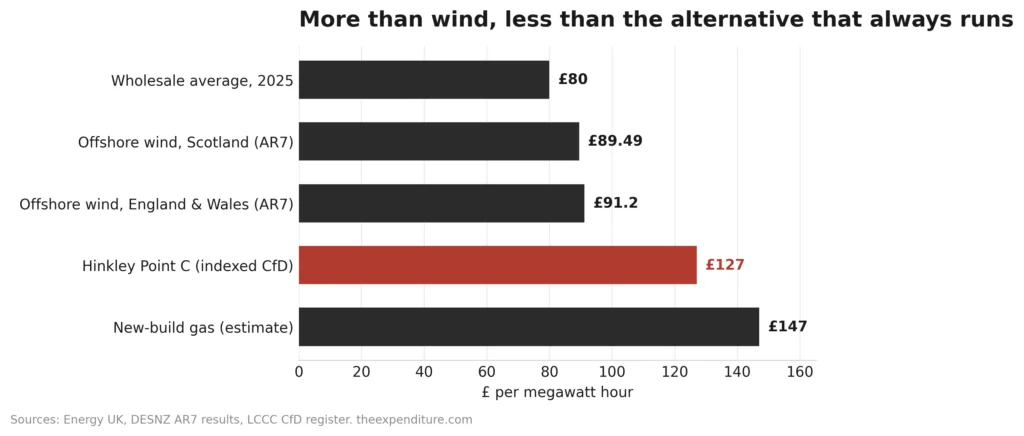
So Hinkley is more expensive than the market and more expensive than offshore wind. It is cheaper than the only other option on that list that runs regardless of the weather. Wind does not blow to order, and the gas that covers the gap when it does not costs more per megawatt hour than the nuclear does.
Then there is the part that almost never gets reported. The contract runs both ways. If wholesale prices rise above the strike price, EDF pays the difference back. The £127 is not only a floor under EDF’s revenue. It is a cap on what billpayers can be charged for that electricity, for 35 years, whatever happens to the price of gas.
And it has already fallen. The strike price drops from £92.50 to £89.50 in 2012 prices once Sizewell C is committed, because the first-of-a-kind costs of the EPR are shared across both British projects. Sizewell C, a near-replica two-reactor station in Suffolk, reached financial close in November 2025 at around £38 billion. In its 2025 accounts EDF recognized around £3 billion of impairment on Hinkley, including £1.55 billion reflecting that £3 cut, offset by a £1.6 billion payment from Sizewell C for Hinkley’s expertise. The guaranteed price everyone attacks has gone down, and the party absorbing the adjustment is the French utility.
What $65 billion buys, per unit
Divide the bill by the output and the record becomes strangely precise. Around $20 million per megawatt of capacity. Roughly $10,900 for every home the plant is expected to supply.
Whether that is a scandal or a bargain depends entirely on the counterfactual, and the counterfactual runs for sixty years. Nobody knows what electricity will cost in 2060. Hinkley’s $65 billion is the price of an insurance policy that took twenty two years to write and pays out for six decades. The awkward part is that the premium is knowable to the pound, and the payout is not knowable at all.
Frequently asked questions
Hinkley Point C, a two-reactor nuclear power station in Somerset, England. It is priced at £35 billion in 2015 money, roughly $65 billion today, more than any other single construction on one site with a verifiable contemporary price.
Two reasons, on top of a reactor design that has been expensive everywhere. Britain had not begun building a nuclear power station since 1987 and had to rebuild the entire industrial capability from zero. And delay compounded the bill: construction meant to take seven years will take at least twelve, with financing costs and inflation accruing every extra year. The design alone does not explain it. China built the same EPR reactors at Taishan for around a fifth of the cost per megawatt.
Not the British taxpayer, and also the British taxpayer. EDF, the French state utility, finances the construction. In exchange the plant receives a guaranteed, inflation-indexed price for its electricity for 35 years, paid through British electricity bills. The households and businesses paying those bills are the same taxpayers.
The current estimate is 2030 for the first reactor, with the second about a year
later. The original target was 2025. EDF has priced a further one-year slip at
around £1 billion.
Per megawatt, yes. Vogtle 3 and 4 in Georgia, the only new American reactors in three decades, cost around $35 billion for 2,234 megawatts against an original estimate of $14 billion, and arrived seven years late. That is one of the most expensive infrastructure projects in American history, and it is still cheaper per megawatt than Hinkley.
Sixty years on EDF’s projection, which would take the station into the 2090s.
Sources
Cost and schedule
- New Civil Engineer: Hinkley Point C’s cost climbs to £35bn, Unit 1 in 2030 (February 2026, from EDF’s 2025 accounts, including the impairment detail)
- World Nuclear News: EDF announces Hinkley Point C delay and rise in project cost (January 2024 revision and the three schedule scenarios)
- National Audit Office: Hinkley Point C (2017 report: £18 billion approval, strike price terms, the £89.50 Sizewell clause, CGN’s 33.5 percent) International comparison
- Britain Remade: Britain is one of the most expensive places in the world to build new nuclear (cost per MW, Taishan comparison)
- E&E News: After Vogtle, what’s next for nuclear? (Vogtle 3 and 4: $35 billion, seven years late) Electricity prices
- Low Carbon Contracts Company: Hinkley Point C CfD (the contract and indexed strike price)
- DESNZ: Contracts for Difference Allocation Round 7 results (offshore wind at £91.20/MWh, January 2026)
- Energy UK: Allocation Round 7 explained (2025 wholesale average, new-build gas estimate)
Sizewell C
- World Nuclear News: Sizewell C gets final go-ahead decision (July 2025, £38 billion)
- NucNet: All financing confirmed for Sizewell C (financial close, November 2025)
Construction
- EDF: Record-breaking achievement (the 8,991 cubic meter pour)
- PBC Today: Europe’s largest construction project (1.4 million cubic meters of concrete, BYLOR)
Cooling comparison
- GRID-Arendal: River discharge of freshwater into the Mediterranean (the Nile’s 150 cubic meters per second, from Ludwig et al. 2009)