Record Data Sheet
On July 29, 2026, EY announced that it was adding an on-site quantum computer, run by EY Canada from Toronto, as part of what it describes as a global investment of more than $3 billion in artificial intelligence and “next frontier technologies.” Rather than renting quantum capacity through the cloud, as most companies do, EY chose to own the hardware.
The quantum computer is the headline. The $3 billion is the bigger story, and it is easiest to judge next to what EY’s three rivals have pledged.
What EY announced
EY did not name the supplier of the machine, its model or its capacity. Post-Quantum, a specialist publication, identified two photonic suppliers with a presence in Toronto as the likely candidates, Xanadu and ORCA Computing, but EY declined to confirm either.
What EY did explain is the purpose. With the hardware on site, the firm can run sensitive work, such as fraud detection, risk management and data protection, without sending client data to an outside provider, and keep it within Canada’s borders. EY calls its approach “Client Zero”: it tests quantum tools on its own operations before offering them to clients. EY Canada received a quantum patent in February 2026, according to the firm, so the machine builds on existing work.
There is a gap between the use cases EY lists and what today’s machines can do. Post-Quantum noted that no current photonic quantum computer delivers production-scale performance in optimization or fraud detection, and that EY Canada’s chief technology officer, Biren Agnihotri, described the purchase as building “capability and readiness.” Agnihotri also said the move “shifts the conversation on quantum computing from concept to practical use for clients.”
What the $3 billion is, and is not
EY has not said how much of the $3 billion goes to quantum computing. The figure covers its broader spending on AI and frontier technology over several years, and it is not new money announced in July. EY’s earlier milestone was the $1.4 billion it said it had invested when it launched its EY.ai platform in September 2023.
Two months before the quantum announcement, on May 21, 2026, EY and Microsoft said they would invest more than $1 billion over five years to help clients scale AI. That money is shared between the two companies, and EY has not said whether its part falls within the $3 billion. Adding the two together would overstate what EY has committed.
How it compares with the rest of the Big Four
Each of the four largest professional services firms has announced an AI commitment. The figures are not directly comparable, because they cover different periods and scopes, but together they show who has put the most on the table.
| Firm | Announced commitment | When | Revenue, fiscal 2025 | Commitment as share of revenue |
|---|---|---|---|---|
| EY | More than $3B, AI and frontier technology | July 2026 | $53.2B | 5.6% |
| Deloitte | $3B, generative AI, through fiscal 2030 | March 2025 | $70.5B | 4.3% |
| KPMG | $2B, AI and cloud, with Microsoft | July 2023 | $39.8B | 5.0% |
| PwC | $1B over three years, US and Mexico | November 2023 | $56.9B | 1.8% |
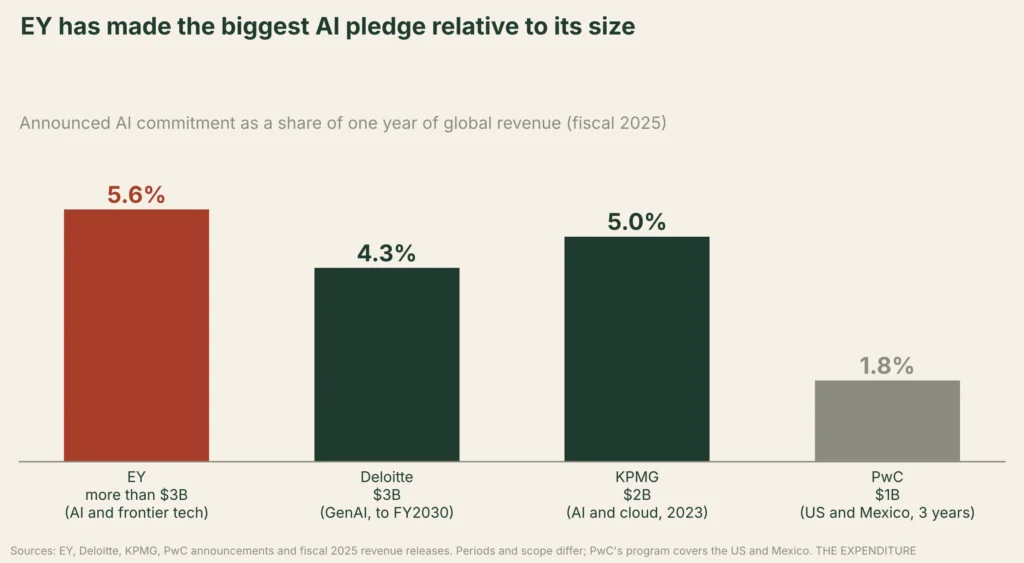
In absolute terms, EY and Deloitte are level at about $3 billion. Relative to one year of revenue, EY’s pledge is the largest, at 5.6%, ahead of KPMG’s 5.0% and Deloitte’s 4.3%. PwC’s figure looks smallest, but it covers only its US and Mexico operations, so measuring it against global revenue understates it.
Why it matters
For firms that sell hours of expert work, AI is both a tool and a threat: it can make their people more productive, and it can automate work clients now pay for. The size of these pledges, billions against revenues of $40 billion to $70 billion, shows how seriously the firms take both sides. Spending at that scale also puts them among the larger corporate buyers of AI outside the technology sector, a race led by the hyperscalers, as in Microsoft’s $80 billion AI year.
What we could not confirm
We could not confirm the supplier or capacity of EY’s quantum computer, the share of the $3 billion spent on quantum, or the period the $3 billion covers.
Frequently asked questions
More than $3 billion globally, over several years, according to EY. It has not said how much goes to quantum computing.
At EY's offices in Toronto, run by EY Canada.
EY has not said. Industry reporting points to a photonic system from Xanadu or ORCA Computing, which EY has not confirmed.
To keep sensitive client data on its own hardware and within Canada, according to the firm.
Deloitte has committed $3 billion to generative AI through fiscal 2030, KPMG $2 billion, and PwC $1 billion in the US and Mexico. Relative to revenue, EY's pledge is the largest.
Notes. All figures are in US dollars as announced by each firm. Shares of revenue are our calculations: each commitment divided by the firm’s global revenue for its fiscal 2025 (EY, year to June 2025; Deloitte, year to May 2025; PwC, year to June 2025; KPMG, year to September 2025). The commitments cover different periods, so the shares are a guide to scale, not to annual spending.
Sources
- EY, “EY announces on-site quantum computing to help shape the next frontier of enterprise technology transformation,” July 29, 2026: https://www.ey.com/en_gl/newsroom/2026/07/ey-announces-on-site-quantum-computing-to-help-shape-the-next-frontier-of-enterprise-technology-transformation
- EY Canada, “EY Canada makes leading investment in quantum computing,” July 29, 2026: https://www.newswire.ca/news-releases/ey-canada-makes-leading-investment-in-quantum-computing-828953801.html
- Post-Quantum, “EY quantum computer in Toronto”: https://postquantum.com/industry-news/ey-quantum-computer-toronto/
- Microsoft, “EY and Microsoft announce global initiative to help clients scale AI,” May 21, 2026: https://news.microsoft.com/source/2026/05/21/ey-and-microsoft-announce-global-initiative-to-help-clients-scale-ai-enterprisewide-value-creation-and-move-beyond-experimentation/
- CFO Dive, “EY launches AI-focused platform”: https://www.cfodive.com/news/ey-launches-ai-focused-platform-generativeai-digitaltransformation/693726/
- CPA Practice Advisor, “Deloitte tops $70 billion in global revenue,” October 1, 2025: https://www.cpapracticeadvisor.com/2025/10/01/deloitte-tops-70-billion-in-global-revenue/170024/
- Crowdfund Insider, Deloitte’s $3 billion generative AI investment, March 31, 2025: https://www.crowdfundinsider.com/?p=237944
- Technology Magazine, “KPMG to invest $2bn in AI in expanded Microsoft partnership,” July 2023: https://technologymagazine.com/articles/kpmg-to-invest-2bn-in-ai-in-expanded-microsoft-partnership
- IO+, “PwC’s colossal AI investment,” November 2023: https://ioplus.nl/archive/en/pwcs-colossal-ai-investment-a-billion-dollar-game-changer/
- CPA Practice Advisor, “EY posts 4% jump in global revenue in 2025,” October 17, 2025: https://www.cpapracticeadvisor.com/2025/10/17/ey-posts-4-jump-in-global-revenue-in-2025/171117/
- CPA Practice Advisor, “PwC reports global revenue of $56.9 billion in 2025,” October 28, 2025: https://www.cpapracticeadvisor.com/2025/10/28/pwc-reports-global-revenue-of-56-9-billion-in-2025/171838/
- CPA Practice Advisor, “KPMG sees global revenue rise to $39.8 billion in 2025,” December 17, 2025: https://www.cpapracticeadvisor.com/2025/12/17/kpmg-sees-global-revenue-rise-to-39-8-billion-in-2025/175177/