Record Data Sheet
For years, Apple’s annual report contained one line that answered this question directly. In fiscal 2015, it said the company had spent $1.8 billion on advertising, 50% more than the $1.2 billion of the year before. The following year, the line disappeared. Apple has not published an advertising figure since.
What the company discloses instead is a broader line, “selling, general and administrative expenses,” which bundles marketing with the cost of running its stores, its corporate staff and everything else that is neither research nor the cost of making products.
What Apple used to disclose
Between fiscal 2010 and fiscal 2015, Apple reported its advertising expense every year. It rose from $691 million to $933 million, $1.0 billion, $1.1 billion, $1.2 billion and finally $1.8 billion, according to its annual reports as reported by Campaign.
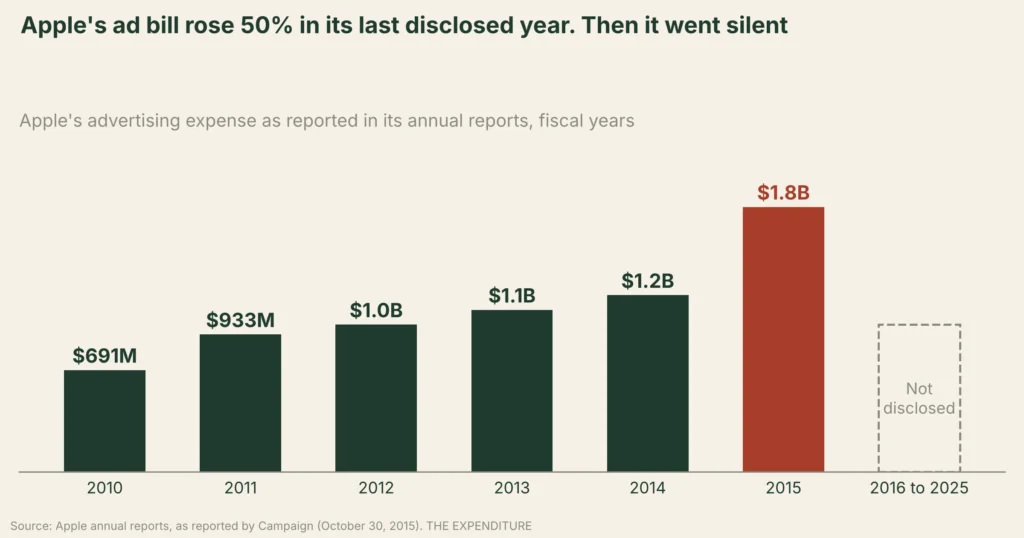
Even at its peak, the figure was small for a company of Apple’s size: $1.8 billion was less than 1% of the $233.7 billion of revenue Apple reported in fiscal 2015. When the disclosure stopped, analysts at Wells Fargo noted that it came just as overhead was rising as a share of sales, and suggested Apple might prefer not to show growing promotional costs. Apple did not explain the change.
What Apple discloses now
In fiscal 2025, which ended on September 27, 2025, Apple reported revenue of $416.16 billion and selling, general and administrative expenses of $27.60 billion, according to its Form 10-K. That line covers retail, corporate overhead and marketing together. Nowhere in its financial statements does Apple break out advertising.
That is why a headline figure for “Apple’s ad spend” does not hold up. Nobody outside the company has an authoritative number. Anyone who gives one is estimating, not reporting.
The trend that matters: overhead growing slower than sales
What the filings do allow is a comparison over time. Between fiscal 2020 and fiscal 2025, Apple’s revenue grew 52%, from $274.52 billion to $416.16 billion. Selling, general and administrative expenses grew 39%, from $19.92 billion to $27.60 billion. As a share of revenue, the line fell from 7.3% to 6.6%.
That is operating leverage: Apple has grown its business without growing its overhead at the same pace, helped by brand loyalty and an ecosystem that does not require winning back the same customer every year.
How that compares with a company that does disclose
A fair comparison is hard, because Apple’s 6.6% is a much broader category than marketing. Nike offers a useful contrast. It breaks out “demand creation,” its term for brand marketing and sports sponsorships, as its own line. In fiscal 2025, Nike spent $4.7 billion on demand creation, on revenue of $46.3 billion, about 10.2%.
So the fairest statement is this: Apple’s entire overhead line, which covers far more than marketing, is a smaller share of revenue than Nike’s marketing alone. And when Apple last disclosed its advertising, it was under 1% of sales.
Where marketing sits in Apple’s spending
Whatever Apple spends on marketing is small next to its other uses of money. In fiscal 2025, it spent $34.55 billion on research and development, which it reports as its own line and which is its largest operating expense, up 10% from $31.37 billion. It spent $90.71 billion repurchasing its own shares and paid $15.42 billion in dividends and dividend equivalents, according to its cash flow statement.
Put simply, Apple spent more than three times its entire overhead line on buying back its own stock. Its last disclosed advertising budget would cover about a week of buybacks.
Frequently asked questions
Apple has not disclosed a figure since fiscal 2015, when it reported $1.8 billion. Since then, marketing has been included in selling, general and administrative expenses, which were $27.60 billion in fiscal 2025.
It has not said. US rules do not require companies to break out advertising, and Apple removed the line from its annual report for fiscal 2016.
$416.16 billion, up 6% from the year before, according to its Form 10-K.
Apple's selling, general and administrative expenses were 6.6% of revenue in fiscal 2025. Nike's demand creation alone was about 10.2% of revenue in its fiscal 2025.
Share buybacks: $90.71 billion, against $34.55 billion on research and development and $15.42 billion in dividends.
About 166,000 full-time equivalent employees as of September 27, 2025.
Notes. All figures are in US dollars as reported by Apple and Nike. Shares of revenue are our calculations. Buyback and dividend figures are the cash amounts in Apple’s statement of cash flows for fiscal 2025. The comparison of $1.8 billion with buybacks divides $90.71 billion by 52 weeks.
Sources
- Apple, Form 10-K for fiscal 2025: https://www.sec.gov/Archives/edgar/data/320193/000032019325000079/aapl-20250927.htm
- Apple, fourth quarter fiscal 2025 results, with condensed financial statements, October 30, 2025: https://static.poder360.com.br/2025/10/Apple-3T25.pdf
- Campaign, “Apple ad spend rises 50% to record $1.8 billion,” October 30, 2015: https://campaignlive.com/article/apple-ad-spend-rises-50-record-18-billion/1370742
- 9to5Mac, “Apple stops disclosing ad spend,” November 24, 2016: https://9to5mac.com/2016/11/24/apple-aapl-ad-spend-2016/
- Nike, fiscal 2025 fourth quarter and full year results: https://sec.gov/Archives/edgar/data/320187/000032018725000034/q4fy25exhibit991er.htm