Record Data Sheet
Europe has been actively rearming for three consecutive summers, but this year stands apart. For the first time, the European Defence Agency has confirmed that the combined military spending of all 27 member states has surpassed a quarter of a trillion euros, while the European Commission has begun disbursing the initial tranche of joint loan programs dedicated to weapon procurement.
The Macro Picture According to the European Defence Agency
On July 16, 2026, the European Defence Agency (EDA) released its official report, Defence Data 2025–2026. The figures reveal that total defense spending across the 27 EU nations reached €418 billion in 2025, a 20% increase over 2024, with projections climbing to €454 billion for 2026. This translates to roughly 2.2% of the EU’s aggregate GDP in 2025, expected to rise to 2.4% by the end of 2026.
According to the EDA, capital investment (earmarked for new equipment and infrastructure rather than routine operating costs) will account for 36% of total expenditures in 2026. Meanwhile, research and development budgets are set to jump from €17 billion to €20 billion. EDA Chief Executive André Denk noted that if current trajectories hold, overall spending could hit €547 billion by 2029.
Who is Spending What: Country-by-Country Breakdown
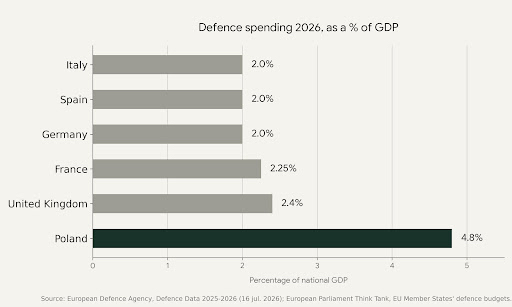
The answer largely depends on the metric used. In absolute terms, Germany remains Europe’s top spender, allocating approximately €97 billion to defense in 2025, a 24% jump from the previous year. In relative terms, however, Poland stands out dramatically. The Polish government’s approved 2026 budget allocates 200 billion zlotys (roughly €47 billion) to defense, representing 4.8% of its GDP, the highest proportional commitment across the entire NATO alliance.
France raised its 2026 defense budget to €68.5 billion, or 2.25% of its GDP, according to European Parliamentary Research Service (EPRS) analyses of national budgets. The United Kingdom currently devotes roughly 2.4% of its GDP to defense, maintaining one of the highest ratios among major NATO members behind Poland and the Baltic states. Meanwhile, both Italy and Spain have converged at the 2.0% benchmark. Spain achieved this milestone following an approximate 50% surge in its military budget, hitting NATO’s historic target for the first time since the 1990s.
The €150 Billion EU Loan Rollout
Beyond national budgets, the European Commission has activated its dedicated joint framework: SAFE (Security Action for Europe). This lending mechanism provides up to €150 billion to help member states cooperatively acquire defense equipment. On January 15, 2026, the Commission authorized the first funding wave for eight countries (Belgium, Bulgaria, Denmark, Spain, Croatia, Cyprus, Portugal, and Romania) totaling roughly €38 billion.
Romania is by far the largest beneficiary in this initial group, provisionally allocated €16.68 billion, whereas Cyprus accounts for the smallest share at €1.18 billion. SAFE operates as a core component of the Commission’s broader Readiness 2030 strategy, which aims to catalyze up to €800 billion in total defense investments across the Union.
Defense Industrial Developments
Governments are not the only entities scaling up operations. Rheinmetall, Germany’s largest arms manufacturer, announced a £400 million investment to establish a heavy-caliber barrel manufacturing facility in Telford, United Kingdom. Set to commence production by 2027, the plant will create up to 400 jobs and restore industrial capabilities the UK has lacked since 2016, according to Rheinmetall CEO Armin Papperger.
Additionally, during the NATO summit in Ankara on July 7, 2026, Rheinmetall and Lockheed Martin signed a memorandum of understanding to bring ATACMS missile production to Europe for the first time via a joint venture, with Rheinmetall taking a 60% stake. In recent weeks, Rheinmetall has also established a joint venture with MBDA focused on naval laser weapons and another with Destinus for cruise missiles, both anchored at its Unterlüß facility in Germany.
Concurrently, BAE Systems secured a £453.5 million contract from the UK Ministry of Defence to initiate full- scale production of the ECRS Mk2 radar system for Royal Air Force Typhoon fighters.
Frequently Asked Questions
How much is the European Union spending on defense in 2026? An estimated €454 billion, according to the EDA’s official Defence Data 2025–2026 report published on July 16, 2026.
Which country spends the most in absolute terms? Germany, having invested around €97 billion in 2025 (a 24% increase over 2024), making it Europe’s largest absolute spender.
Which country dedicates the largest share of its economy to defense? Poland, with its 2026 budget allocating 4.8% of GDP to defense the highest proportion across all of NATO, per its Ministry of Finance.
What is the European Union’s SAFE program? A joint loan mechanism offering up to €150 billion to help EU countries collectively acquire defense equipment under the broader Readiness 2030 plan.
Which nations have received initial SAFE funding? An initial group of eight countries (Belgium, Bulgaria, Denmark, Spain, Croatia, Cyprus, Portugal, and Romania) was approved on January 15, 2026, to receive roughly €38 billion.