Record Data Sheet
In 2008, California voters approved a $9.95 billion bond to link San Francisco and Los Angeles in under three hours, according to the Authority. The project’s total cost was estimated at $33 billion at the time. Eighteen years later, completing that same route costs $126.1 billion — confirmed by the Revised Draft 2026 Business Plan, approved on June 1, 2026 — and not a single high-speed train is running yet.
Microsoft spent that same figure — $126.1 billion — on AI infrastructure in eighteen months.
$126.1 billion is more than three times NASA’s full annual budget. And that’s the cheap version: the agency calculates that building the full system with no cuts would cost $231.3 billion. The $126.1 billion figure already factors in roughly $105 billion in cuts from that original full-system cost.
THE ONLY SEGMENT THAT EXISTS
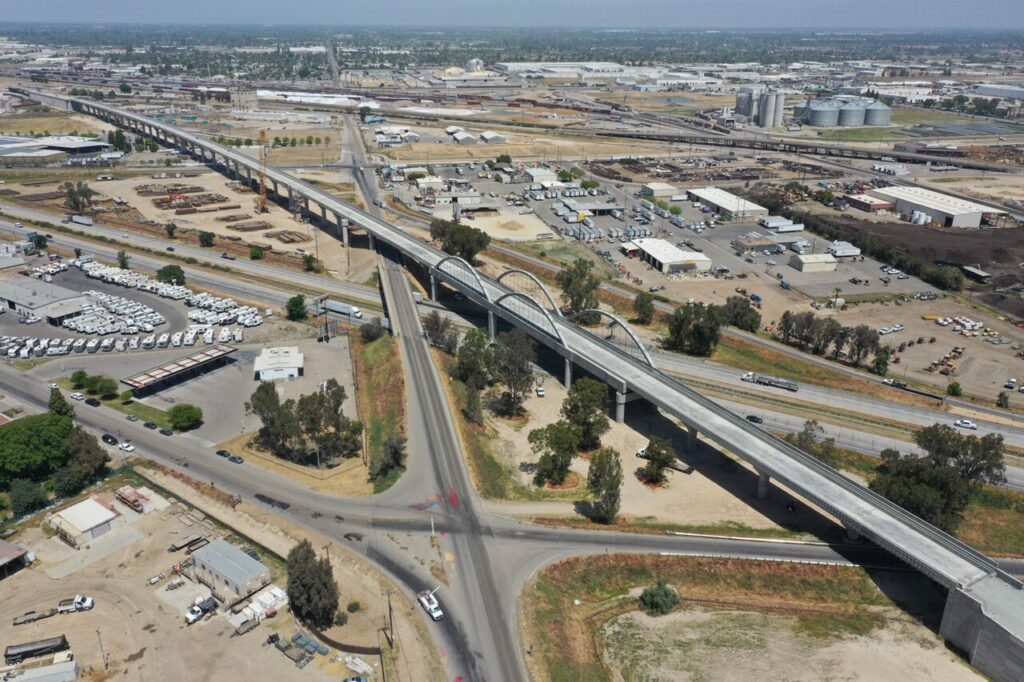
California is spending it on 171 miles of track between Merced and Bakersfield — the only segment under actual construction. That segment alone will cost $35.7 billion, per the official document, with the service date pushed from 2031 to 2032 for construction completion, and 2033 for commercial passenger service. As of June 2026, $15.7 billion of the $39.3 billion secured through 2045 has already been spent.
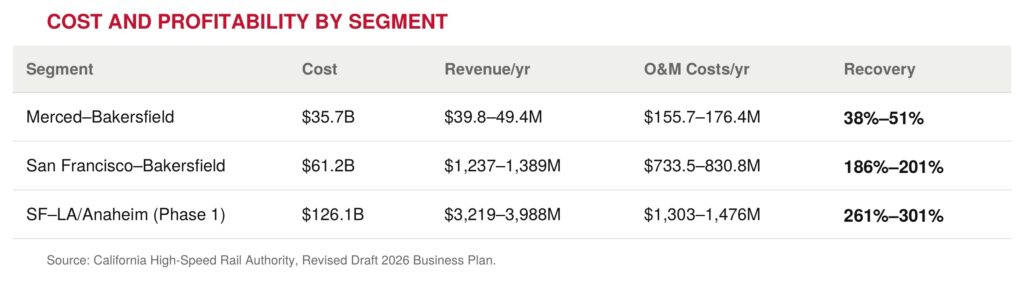
When that segment opens, it will lose money. The Authority admits as much: it will generate between $39.8 and $49.4 million a year in fare revenue, against operating costs of between $155.7 and $176.4 million. In other words, it will cover between 38% and 51% of what it costs to run — the rest will be a public subsidy,
on a project that California law (Prop. 1A) expressly prohibits from being subsidized.
COST AND PROFITABILITY BY SEGMENT
Source: California High-Speed Rail Authority, Revised Draft 2026 Business Plan.
THE NUMBER THAT ACTUALLY WORKS
Not all of the project is a money-loser. If the line reaches San Francisco and the Bay Area, the picture changes: that extended segment would generate between $1,237 and $1,389 million a year in fare revenue, against $733.5 to $830.8 million in costs — a recovery ratio of between 186% and 201%. The catch is that the one segment that would actually turn a profit still has no secured funding.
WHERE THE MONEY IS
$39.3 billion secured through 2045, of which $15.7 billion has already been spent. To complete the full $126.1 billion Phase 1, roughly $86.8 billion is still missing — dependent on private investment, new bonds, and legislative changes that don’t yet exist. Less than 10% of the total budget comes from federal funds, after the federal administration pulled nearly $4 billion in previously committed aid.
WHAT THEY’RE PROMISING IN RETURN
Once Phase 1 is complete, the project’s own forecasts point to between 23.8 and 30.3 million annual riders (first full year of service, in 2040) and up to 18 million metric tons of CO2 avoided. The 2026 business plan also estimates it will generate $173 billion in total economic output and nearly 797,500 job-years — figures that only materialize if the rest of the funding, currently nonexistent, shows up. Nearly two decades after voters approved it, the largest rail project in U.S. history is still, mostly, a construction site.
THE EXPENDITURE · Every record has a price tag