Record Data Sheet
Five years. Two crises. One smart decision and one that wasn’t.
In 2020, Coca-Cola lost 16% of its revenue in a single quarter. Its most valuable customers — bars, stadiums, restaurants, airports — shut down overnight. PepsiCo barely noticed: when the world locked down at home, snacks sold themselves.
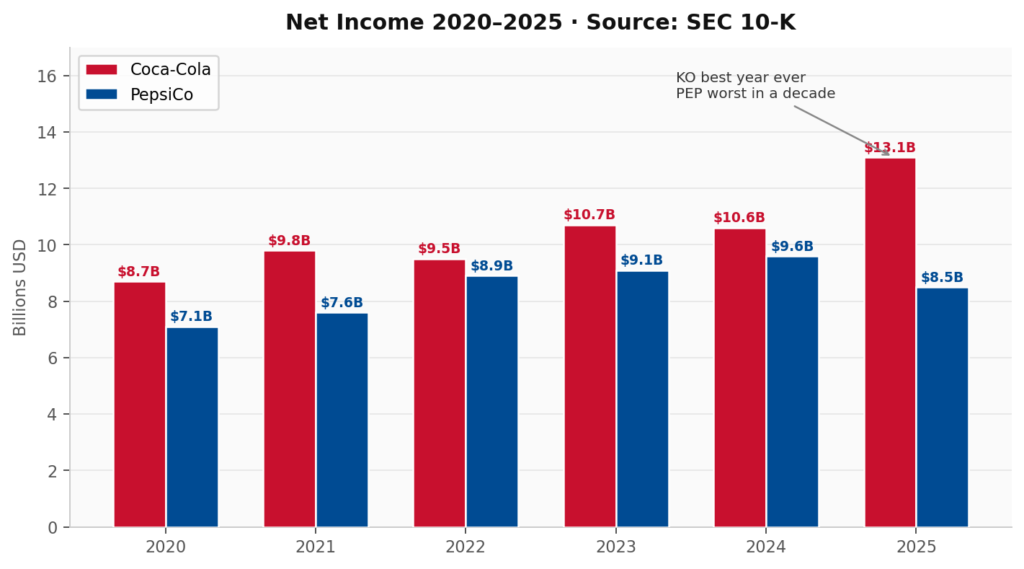
Five years later, the story flipped. 2025 was Coca-Cola’s best year on record. PepsiCo closed factories, cut prices 15% under pressure from an activist investor, and saw its operating income drop 11%. The same architecture that protected it in 2020 was dragging it down in 2025.
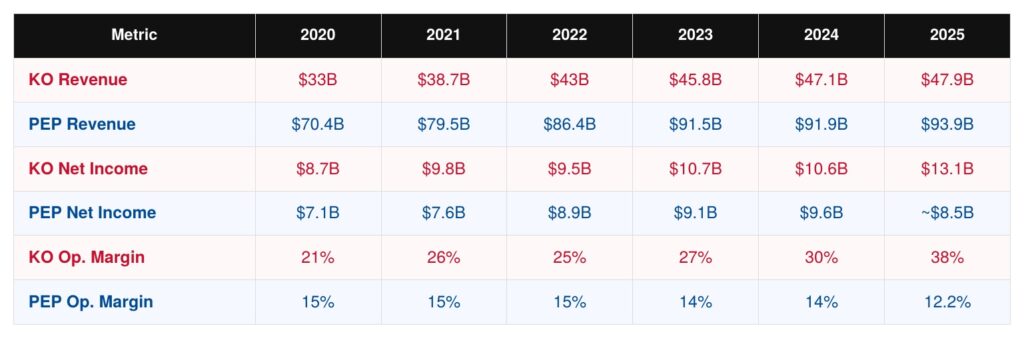
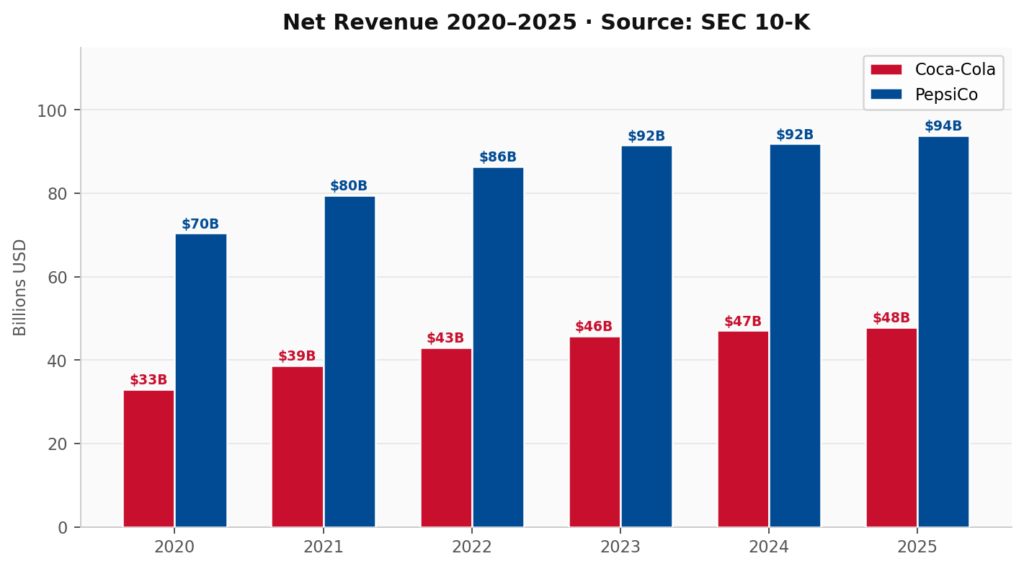
The numbers: six years head to head
2020 — The pandemic
Coca-Cola took the bigger hit, but it knew exactly why. 55% of its sales ran through channels that closed overnight: restaurants, bars, stadiums, cinemas, airports. Volumes fell 25% in Q2 2020.
PepsiCo didn’t have that problem. Its snacks sell in supermarkets — the one channel that grew during lockdown. Frito-Lay saw e-commerce sales jump 46% in the first months. PepsiCo launched Snacks.com and PantryShop.com in May 2020 — built entirely in-house in a matter of weeks.
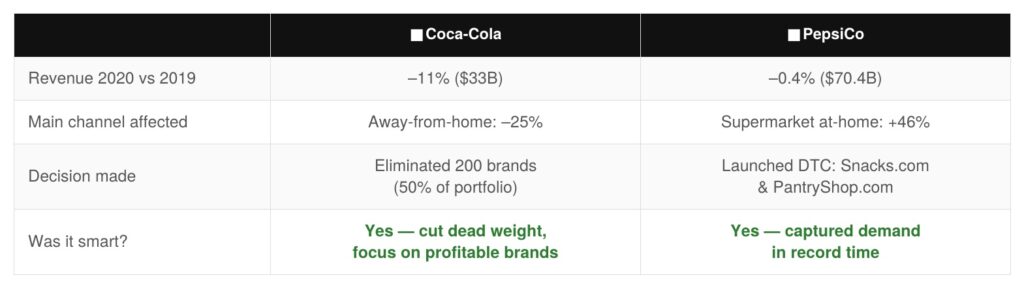
The smart move for Coca-Cola in 2020 wasn’t surviving. It was using the crisis to do what no company does in good times: kill products. In October 2020, James Quincey announced the elimination of more than 200 brands — half the portfolio — including TaB, Odwalla, and Zico. “They take time, process and shelf space disproportionate to the revenue they generate,” he said on the earnings call. With the away-from-home channel closed, there was little to lose. With a simpler portfolio, there was a lot to gain when it reopened.
2021–2022 — Inflation. Who raised prices better?
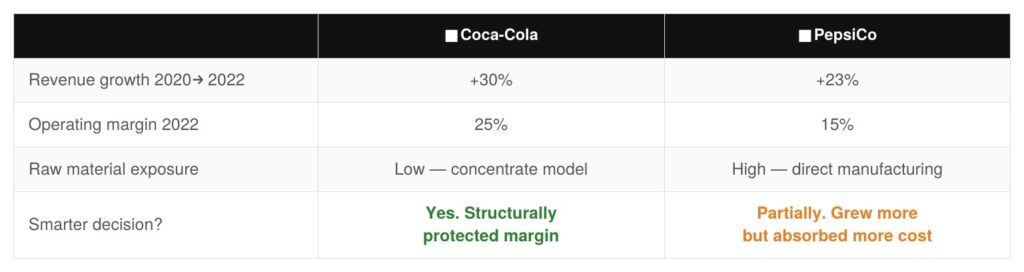
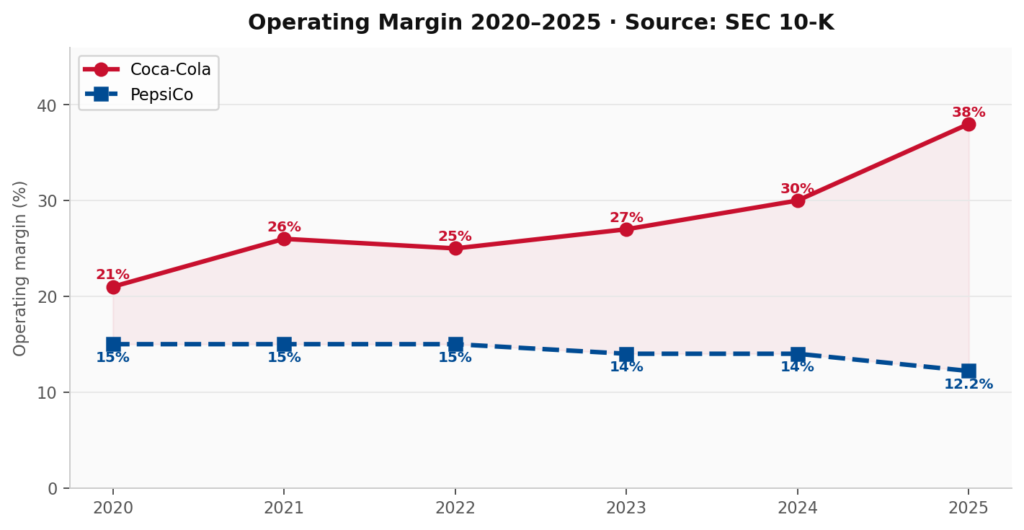
When inflation hit, both companies raised prices. Coca-Cola negotiates the price of concentrate with its bottlers — it doesn’t directly absorb the cost of raw materials. PepsiCo manufactures, packages, and distributes: every increase in the cost of corn, oil, or packaging hits its income statement directly.
Between 2020 and 2022, Coca-Cola grew revenue 30% with operating margin steady at 25–26%. PepsiCo grew revenue 23% but margin stayed flat at 15%.
2023–2024 — Two companies, two different problems
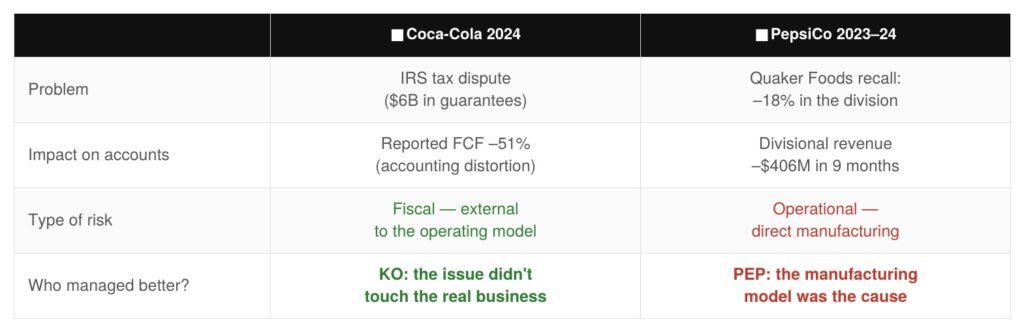
In 2023, PepsiCo’s Quaker Foods division issued a mass recall of granola bars and cereals in North America due to salmonella contamination. The division went from $2.208 billion to $1.802 billion in nine months — an 18% collapse in a segment PepsiCo had acquired for $13.8 billion back in 2001. This wasn’t a strategy problem. It was an operational execution failure in its own manufacturing.
Coca-Cola had its own problem in 2024, but of a different kind. Free cash flow dropped 51% — from $9.7 billion to $4.7 billion — because it deposited $6 billion with the IRS as a guarantee in a tax dispute that has been running through the courts for years. Adjusted for that deposit, free cash flow actually grew 11%, to $10.8 billion. A tax
problem, not an operational one. The difference matters.
2025 — The year that explains everything
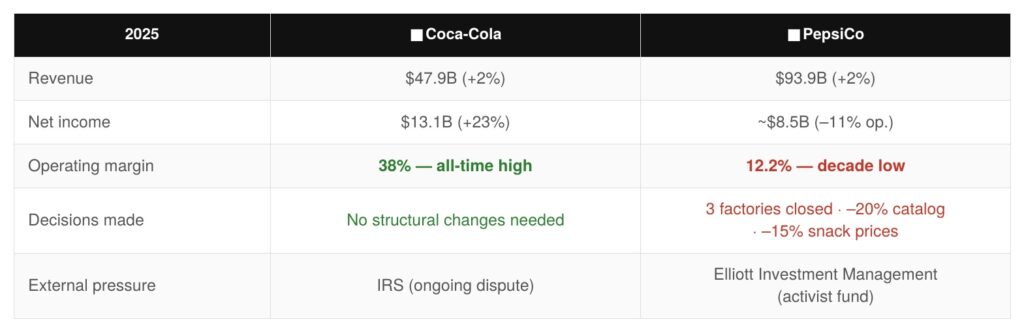
In 2025: Coca-Cola posted its best year on record — net income of $13.1 billion, operating margin of 38%. PepsiCo reported an 11% drop in operating income, closed at least three factories, agreed with activist fund Elliott Investment Management to cut 20% of its product catalog, and slashed prices on Lay’s, Doritos, and Cheetos by up to 15%.
On February 3, 2026, CEO Ramon Laguarta told analysts: “Consumers have told us they’re feeling the pressure.” Rachel Ferdinando, CEO of PepsiCo Foods US, added: “Lowering prices is an important step in our commitment to consumers.”
PepsiCo raised prices during inflation and was too slow to bring them back down. By 2025, consumers had found cheaper alternatives.
Coca-Cola raised prices too. But its bottlers absorb the execution. When consumers push back, Coca-Cola negotiates with 700 independent bottlers. PepsiCo has to close its own factories.
Verdict: who made the smarter decisions?
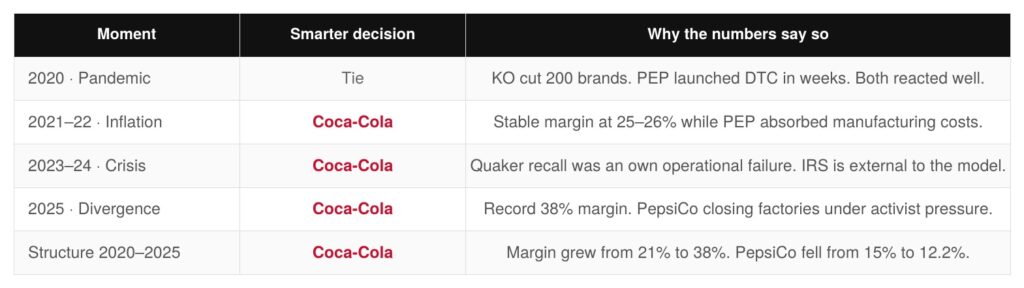
The question the data doesn’t answer yet
Coca-Cola won these five years through architecture, not execution. The concentrate model protected it from inflation, the recall, the activism. But that same model has a ceiling: it depends on the world continuing to drink sodas at the same rate.
PepsiCo has something Coca-Cola can’t easily buy: snacks are growing faster than beverages globally, and it has 23 brands that each exceed $1 billion annually. The question isn’t who won 2020–2025. It’s whether the strategy that won those five years works for the next five.
The 2025 numbers suggest PepsiCo is already correcting course. The price cuts, factory closures, and catalog reduction are exactly what Coca-Cola did in 2020 with its 200 brands. If PepsiCo executes that correction well, the game from 2026 to 2030 could look very different.
Sources
— The Coca-Cola Company — Annual Report on Form 10-K, FY2020–FY2025 (SEC EDGAR, February 2021–2026)
— The Coca-Cola Company — 8-K Q3 2020: “Strategic Actions to Emerge Stronger from the Pandemic” (October 22, 2020) — The Coca-Cola Company — Q4 & Full-Year 2025 Earnings Release (February 10, 2026)
— PepsiCo, Inc. — Annual Report on Form 10-K, FY2020–FY2025 (SEC EDGAR, February 2021–2026)
— PepsiCo, Inc. — Press Release: “PepsiCo Launches Direct-to-Consumer Offerings” (May 11, 2020)
— PepsiCo, Inc. — Q4 & Full-Year 2025 Earnings Release (February 3, 2026)
— Food Dive — “PepsiCo cutting prices on Doritos and other snacks by up to 15%” (February 3, 2026)
— All financial data is GAAP unless otherwise indicated.